

2026 Easy Success SAP C-BCSBS-2502 Exam in First Try
Best C-BCSBS-2502 Exam Dumps for the Preparation of Latest Exam Questions
NEW QUESTION # 19
For installed base customers, what can RISE with SAP journeys include? Please choose the correct answer.
- A. A hybrid two-tier approach
- B. Starting fresh with a greenfield ERP implementation on private cloud
- C. Moving directly to public cloud without any intermediate steps
- D. Leveraging RISE with SAP methodology to drive complex core principles
Answer: A
NEW QUESTION # 20
A multinational company is struggling with fragmented data across different departments, leading to inefficiencies in finance, procurement, and supply chain operations. They need an SAP solution that integrates these business processes into a unified system with real-time data access. Which SAP solutions should they implement? There are 3 correct answers to this question.
- A. SAP BusinessObjects
- B. SAP SuccessFactors
- C. SAP Ariba
- D. SAP S/4HANA
- E. SAP ERP
Answer: A,D,E
NEW QUESTION # 21
Which key features are included in SAP Business Suite for human capital management? There are 2 correct answers to this question.
- A. Freight and logistics tracking
- B. Customer engagement analytics
- C. Payroll and benefits administration
- D. Employee performance tracking
Answer: C,D
NEW QUESTION # 22
Which of the following are RISE with SAP journeys? Note: There are 2 correct answers to this question.
- A. A hybrid two-tier approach
- B. Greenfield ERP implementation on Public Cloud
- C. New customers move to the public cloud
- D. An ERP transformation to private cloud
Answer: A,D
Explanation:
RISE with SAP is a guided transformation journey designed for existing SAP ERP customers to modernize their business processes and transition to a cloud ERP landscape, primarily focusing on SAP S/4HANA Cloud Private Edition. It is tailored for organizations with complex, customized on-premises systems, allowing them to move to the cloud at their own pace while preserving existing investments. The question asks which options represent RISE with SAP journeys, with two correct answers. Below, each option is evaluated based on official SAP documentation from sources such as SAP Learning, SAP.com, and related materials.
* Option A: Greenfield ERP implementation on Public CloudA greenfield ERP implementation involves a new, clean implementation of an ERP system without carrying over existing customizations or data.
While SAP S/4HANA Cloud Public Edition supports greenfield implementations, these are primarily associated with the GROW with SAP journey, which targets new SAP customers or midsize companies adopting standardized, best-practice processes for rapid deployment. RISE with SAP, however, is designed for existing SAP ERP customers transitioning from on-premises systems, often involving complex landscapes and customizations. The public cloud (SAP S/4HANA Cloud Public Edition) is not the primary focus of RISE with SAP, which emphasizes the private cloud (SAP S/4HANA Cloud Private Edition) for such customers. Therefore, a greenfield implementation on the public cloud aligns more with GROW with SAP, not RISE with SAP.Extract: "For new customers, the GROW with SAP journey accelerates and streamlines the cloud transformation with a customized methodology to quickly implement and benefit from cloud ERP. ... SAP S/4HANA Cloud Public Edition is always implemented in a greenfield (new implementation) scenario." learning.sap.com Extract: "RISE with SAP is tailored to enable an easy transition to cloud ERP at a pace comfortable for the customer. Existing customers often require a higher degree of customization in their processes, prefer to innovate at their own pace, and need more control over their solution. These characteristics align with SAP S/4HANA Cloud Private Edition." learning.sap.com This option is incorrect.
* Option B: An ERP transformation to private cloudRISE with SAP is explicitly designed to support ERP transformations from on-premises SAP ERP systems (e.g., SAP ECC or on-premises SAP S/4HANA) to SAP S/4HANA Cloud Private Edition, which operates in a private cloud environment. This journey accommodates both greenfield (new implementation) and brownfield (system conversion) scenarios, allowing customers to maintain existing customizations and business processes while leveraging cloud benefits like scalability, AI, and continuous innovation. The private cloud focus is a hallmark of RISE with SAP, making this option a core component of its transformation journeys.Extract: "RISE with SAP is a comprehensive offering that helps companies run their business in the cloud. At the heart of this comprehensive offering is SAP S/4HANA Cloud Private Edition, an intelligent cloud ERP solution powered by AI designed for customers currently running SAP ERP and/or on-premise SAP S/4HANA." blog.sap-press.com Extract: "A private cloud deployment is recommended if a customer has plans for a long-term evolutionary journey to the cloud with high landscape complexity including mostly fragmented, highly customized systems. ... The private cloud deployment can be a new implementation, but also supports system conversion from an existing SAP ERP on-premise system." learning.sap.com This option is correct.
* Option C: New customers move to the public cloudNew customers moving to the public cloud typically align with the GROW with SAP journey, which is designed for organizations (often midsize or new to SAP) seeking a rapid, standardized implementation of SAP S/4HANA Cloud Public Edition. GROW with SAP emphasizes quick time-to-value with preconfigured best practices and minimal customization, targeting customers without prior SAP investments. In contrast, RISE with SAP targets existing SAP customers with on-premises ERP systems, focusing on complex transformations to the private cloud. While RISE with SAP could theoretically include public cloud components in specific scenarios, its primary focus is not new customers or the public cloud.Extract: "GROW with SAP is a SAP software solution initiative designed exclusively for mid-size companies and initial SAP customers. SAP S/4HANA Cloud + Public Edition - built on top of SAP's own HANA Cloud infrastructure, optimized for fast roll-out and quick time-to-value." uneecops.com Extract: "RISE with SAP is an ERP adoption solution that helps current SAP ecosystem users transition traditional ERP information and processes to a cloud system without compromising or putting your data at risk." blog.
nbs-us.com This option is incorrect.
* Option D: A hybrid two-tier approachA hybrid two-tier ERP approach involves using a combination of SAP S/4HANA Cloud Public Edition and Private Edition, often across different parts of an organization (e.g., headquarters vs. subsidiaries). RISE with SAP supports such configurations, particularly for existing SAP customers with complex landscapes who may implement a private cloud solution (via SAP S/4HANA Cloud Private Edition) for core operations while using the public cloud for standardized processes in specific areas. This approach allows flexibility and scalability, aligning with RISE with SAP's tailored transformation framework. The documentation explicitly mentions support for two-tier ERP scenarios under RISE with SAP, making this a valid journey.Extract: "It's also common for customers to implement both SAP S/4HANA Cloud Public and Private Edition in a two-tier ERP scenario." learning.sap.com Extract: "RISE with SAP is tailored to a customer's existing landscape and business requirements, and umfasst ein standardisiertes Framework, integrierte Tools und fachkundige Beratung bei jedem Schritt - nach einer bewahrten Methodik, die sowohl die Transformation als auch die Wertschopfung beschleunigt." (Translated: "RISE with SAP is tailored to a customer's existing landscape and business requirements, and includes a standardized framework, integrated tools, and expert guidance at every step - following a proven methodology that accelerates both transformation and value creation.") sap.com This option is correct.
Summary of Correct Answers:
* B: RISE with SAP supports ERP transformations to the private cloud, primarily through SAP S
/4HANA Cloud Private Edition, accommodating both greenfield and brownfield scenarios for existing SAP customers.
* D: RISE with SAP enables a hybrid two-tier approach, combining private and public cloud editions to meet diverse organizational needs, as part of its flexible transformation framework.
References:
SAP Learning: Describing RISE with SAP learning.sap.com
SAP Learning: Differentiating GROW and RISE with SAP learning.sap.com
SAP.com: RISE with SAP | Transformation journey to SAP Business Suite sap.com SAP.com: RISE with SAP | Methodology sap.com SAP PRESS: What Is RISE with SAP? blog.sap-press.com Uneecops: GROW with SAP and RISE with SAP: Feature Comparison uneecops.com NBS: Difference Between GROW With SAP and RISE With SAP blog.nbs-us.com SAP.com: RISE with SAP | Umstieg auf SAP Business Suite
NEW QUESTION # 23
What is the primary purpose of SAP Business Suite? Please choose the correct answer.
- A. Enhancing social media engagement
- B. Managing financial risk and compliance
- C. Automating IT infrastructure monitoring
- D. Integrating core business functions across various modules
Answer: D
NEW QUESTION # 24
What is a key advantage of SAP Business Data Cloud Intelligent Applications?
- A. They provide pre-configured dashboards with AI-driven insights for faster decision-making.
- B. They remove the requirement for formal data governance and compliance policies.
- C. They primarily focus on raw data collection with minimal integrated analysis capabilities.
Answer: A
Explanation:
The question asks for a key advantage ofSAP Business Data Cloud Intelligent Applications, which are prebuilt, AI-powered applications withinSAP Business Data Clouddesigned to deliver actionable insights and automate business processes. According to official SAP documentation and the provided search results, the primary advantage is that these applications provide pre-configured dashboards with AI-driven insights for faster decision-making, enabling business users to access ready-to-use analytics with minimal setup. This makes Option A the correct answer.
Explanation of Correct answer:
Option A: They provide pre-configured dashboards with AI-driven insights for faster decision-making.
This is correct becauseSAP Business Data Cloud Intelligent Applicationsare designed to deliver pre- configured, SAP-managed dashboards and analytics that leverage AI to provide actionable insights, significantly reducing the time-to-value for business users. These applications combine data fromSAP Datasphereand visualization capabilities fromSAP Analytics Cloud, infused with AI-driven features like predictive analytics and simulations, to enable agile and informed decision-making. TheDescribing the Key Capabilities and Benefits of SAP Business Data Cloudlesson on learning.sap.com states:
"New to SAP Business Data Cloud (SAP BDC) are context-aware SAP Business Data Cloud Intelligent Applications. These pre-configured dashboards provide ready-to-run insights by combining planning and analysis, all infused with trusted Artificial Intelligence (AI) to drive smarter, faster decisions. The intelligent applications enable agile decision-making, predictive analysis, and simulations, leading to better business outcomes." learning.sap.com Additionally, theIntelligent Applications in Business Data Cloudpage onwww.sap.comelaborates:
"Surface actionable insights and recommendations for analytics and planning with intelligent applications connected directly to your business data. ... These intelligent applications are adaptive, AI-powered applications that learn from your data, understand business context, and act on your behalf to transform business outcomes." sap.com For example, applications likeWorking Capital InsightsorPeople Intelligenceprovide prebuilt dashboards that integrate operational and financial data, offering AI-driven recommendations for areas like cash flow optimization or workforce planning. The installation of these applications automates the creation of underlying data models, replication flows, andSAP Analytics Cloudstories, requiring only a few clicks to deploy, as noted in theManaging and Leveraging SAP Business Data Cloud Intelligent Applicationslesson:
"From a business user perspective, the result of an installed Intelligent Application is a ready-to-use dashboard. The Intelligent Application is presented to the business user as an SAP Analytics Cloud story which is connected to one or more underlying SAP Datasphere models. The story and all of these connected models are automatically created during the installation of an Intelligent Application." learning.sap.com This pre-configured, AI-driven approach ensures faster decision-making by eliminating the need for extensive manual configuration, making Option A the key advantage.
Explanation of Incorrect Answers:
Option B: They remove the requirement for formal data governance and compliance policies.
This is incorrect becauseSAP Business Data Cloud Intelligent Applicationsdo not eliminate the need for formal data governance and compliance policies. In fact, these applications rely on robust governance to ensure data quality, security, and compliance, which are critical for trusted AI and analytics outcomes. The SAP Business Data Cloudoverview onwww.sap.comemphasizes:
"SAP Business Data Cloud delivers fully managed capabilities for business data fabric, ... ensuring data across applications and operations has a foundation for generative AI that is reliable, responsible, and relevant." sap.com Furthermore, data products withinSAP Business Data Cloudinclude metadata and governance policies to maintain trust and compliance:
"In SAP BDC, data products are curated, reusable, and business-ready data assets designed to deliver immediate value. They encapsulate not just raw data, but also metadata, business context, and governance policies, making them trusted, actionable tools for analysis, planning, and decision-making." learning.sap.com This indicates that governance and compliance are integral to the platform, not removed, making Option B incorrect.
Option C: They primarily focus on raw data collection with minimal integrated analysis capabilities.
This is incorrect becauseSAP Business Data Cloud Intelligent Applicationsare designed to provide advanced analytics and AI-driven insights, not just raw data collection. They integrate data from SAP and non-SAP sources, enrich it with business semantics, and deliver sophisticated analysis through prebuilt dashboards and AI capabilities, as opposed to focusing on raw data. TheSAP Business Data Cloudfeatures page onwww.sap.
comstates:
"Deliver transformational insights for advanced analytics and planning with prebuilt applications and data products across all lines of business. ... Make faster, smarter decisions with prebuilt analytical apps across your enterprise for Core Enterprise Analytics, People Analytics, and more." sap.com TheSAP Sapphire Innovation Guide 2025further highlights:
"Intelligent applications within SAP Business Data Cloud deliver transformational insights across the entire SAP Business Suite, integrating analytics, AI, and simulations into transactional workflows." sap.com This focus on integrated analytics and AI-driven insights directly contradicts Option C, which misrepresents the applications as having minimal analysis capabilities.
Summary:
The key advantage ofSAP Business Data Cloud Intelligent Applicationsis that they provide pre-configured dashboards with AI-driven insights for faster decision-making, as stated in Option A. These applications leverageSAP Analytics CloudandSAP Datasphereto deliver ready-to-use, context-aware analytics, enabling rapid deployment and agile decision-making. Option B is incorrect because governance and compliance remain essential, and Option C is incorrect because the applications prioritize advanced analytics over raw data collection. This aligns with SAP's strategy to streamline data-to-decision processes withinSAP Business Suite, as supported by the provided search results and official documentation.
References:
Describing the Key Capabilities and Benefits of SAP Business Data Cloud, learning.sap.com learning.sap.com Intelligent Applications in Business Data Cloud,www.sap.comsap.com Managing and Leveraging SAP Business Data Cloud Intelligent Applications, learning.sap.com learning.sap.
com
SAP Business Data Cloud Features,www.sap.comsap.com
SAP Sapphire Innovation Guide 2025,www.sap.comsap.com
SAP Business Data Cloud,www.sap.com
NEW QUESTION # 25
Drag and drop the key terms to the correct position.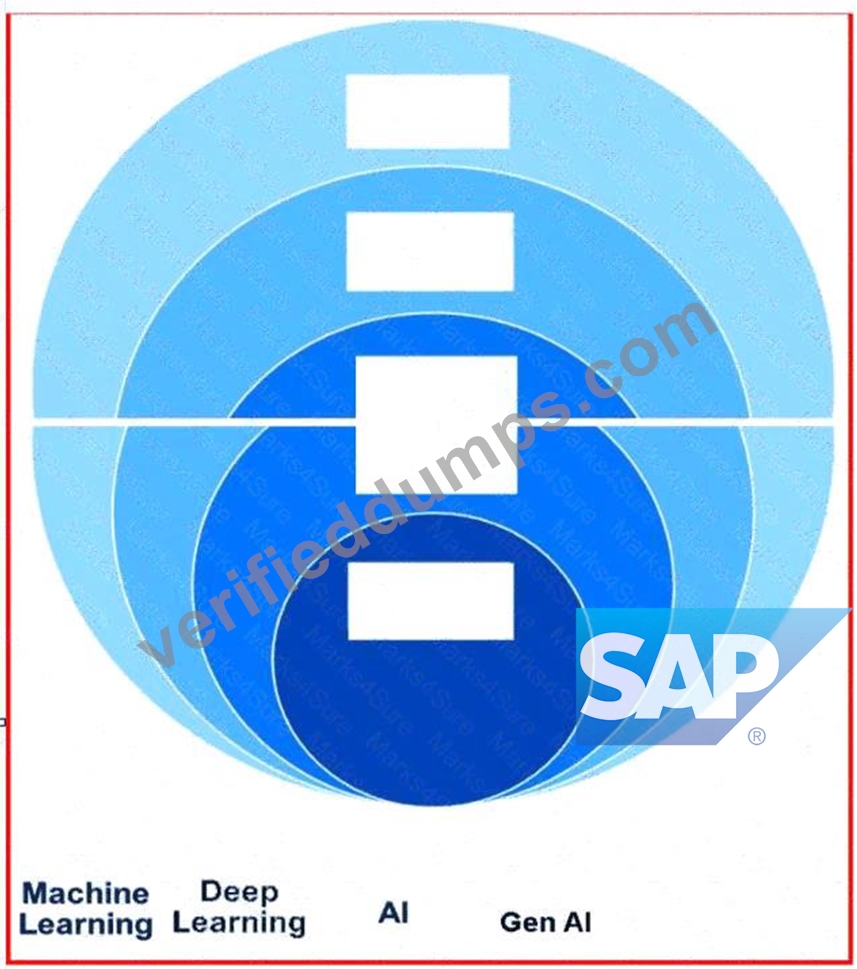
Answer:
Explanation: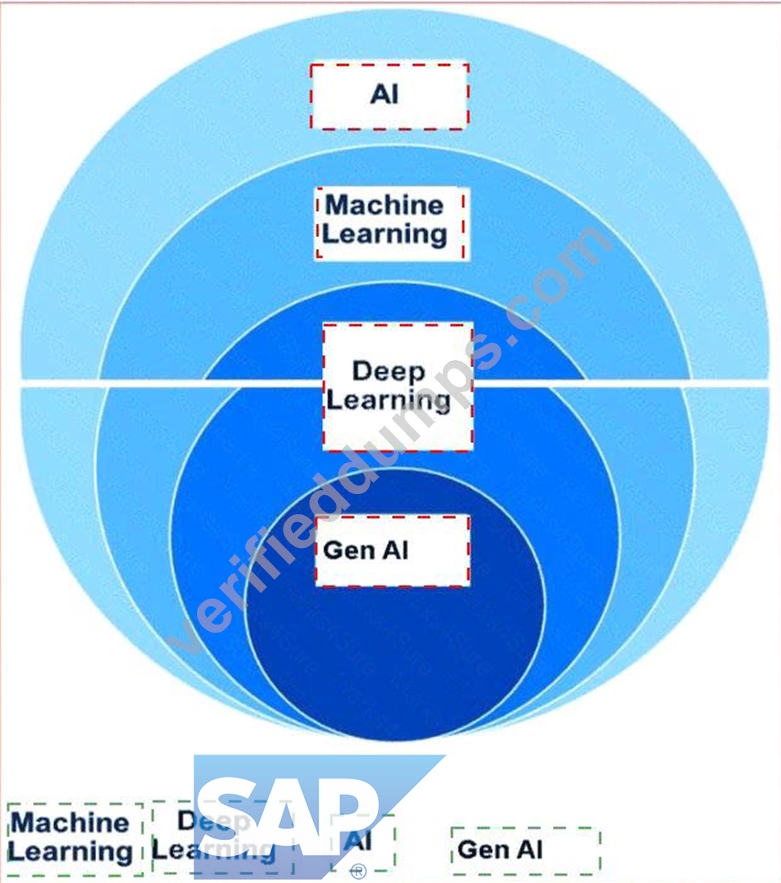
Explanation:
* Largest Circle (Outer Layer):AI (Artificial Intelligence)
* Second Layer (inside AI):Machine Learning
* Third Layer (inside Machine Learning):Deep Learning
* Innermost Layer (inside Deep Learning):Generative AI (Gen AI)
* AI (Artificial Intelligence):The broadest field. Encompasses all intelligent systems that mimic human behavior, decision making, or reasoning.
* Machine Learning:A subset of AI. Uses algorithms to learn patterns from data and make predictions.
* Deep Learning:A subset of Machine Learning. Involves neural networks with many layers (hence
"deep"), great for processing images, language, etc.
* Generative AI:A subset of Deep Learning. These models (like GPT, DALL-E, etc.) can generate new content such as text, images, or code.
Visual Placement from Largest to Smallest:
* AI (outermost, encompasses everything)
* Machine Learning (inside AI)
* Deep Learning (inside Machine Learning)
* Generative AI (inside Deep Learning)
NEW QUESTION # 26
How does SAP Business Suite support enterprise resource planning (ERP) processes? Please choose the correct answer.
- A. By providing an integrated platform for finance, HR, supply chain, and procurement
- B. By eliminating the need for business process automation
- C. By offering social media engagement tools
- D. By focusing only on customer relationship management
Answer: A
NEW QUESTION # 27
A global retail company is struggling with fragmented customer data across multiple departments, leading to inefficiencies in sales and service operations. They need an SAP solution that integrates customer interactions, optimizes sales processes, and enhances customer insights. Which SAP solutions should they implement? There are 3 correct answers to this question.
- A. SAP ERP
- B. SAP CRM
- C. SAP Predictive Analytics
- D. SAP Ariba
- E. SAP Business Warehouse
Answer: B,C,E
NEW QUESTION # 28
How are RISE and GROW with SAP positioned as transformation journeys to SAP Business Suite? Note:
There are 2 correct answers to this question.
- A. RISE and GROW are journeys with an emphasis SAP Business Suite as the end destination.
- B. The choice for RISE or GROW with SAP depends on the size of the customer.
- C. The choice for RISE or GROW with SAP is defined by the customer's type of ERP installation.
- D. RISE and GROW with SAP are synonymous with Private and Public Cloud ERP products.
Answer: A,C
Explanation:
The question asks howRISE with SAPandGROW with SAPare positioned as transformation journeys toward SAP Business Suite, with two correct answers. Based on official SAP documentation,RISE with SAPand GROW with SAPare strategic offerings designed to facilitate customers' transitions to cloud-based ERP solutions, specifically targetingSAP S/4HANA Cloud(a core component ofSAP Business Suite). The correct answers are A and C, as they accurately reflect the positioning of these offerings.
Explanation of Correct Answers:
Option A: The choice for RISE or GROW with SAP is defined by the customer's type of ERP installation.
This is correct because the choice betweenRISE with SAPandGROW with SAPis influenced by the customer's existing ERP landscape and their deployment preferences (e.g., on-premise, private cloud, or public cloud).
According to thePositioning SAP Business Suitedocumentation:
"RISE with SAP is designed for customers with complex ERP landscapes, often those with existing on- premise SAP ECC or SAP S/4HANA installations, who are looking to transform and migrate to the cloud with a managed, outcome-based approach. It provides a guided journey for customers to adopt SAP S
/4HANA Cloud, private or public edition, depending on their needs."
In contrast:
"GROW with SAP is tailored for customers who are new to SAP or have simpler ERP setups, often adopting SAP S/4HANA Cloud, public edition, for a standardized, fast-track implementation." This indicates that the type of ERP installation-whether a customer is transitioning from an on-premise system (more suited forRISE with SAP) or starting fresh with a cloud-native solution (more suited forGROW with SAP)-plays a critical role in determining the appropriate transformation journey. For example,RISE with SAPsupports customers with legacy systems by offering tools like theSAP Readiness CheckandCustom Code Analyzerto facilitate migration, whileGROW with SAPemphasizes preconfigured best practices for greenfield implementations.
Option C: RISE and GROW are journeys with an emphasis on SAP Business Suite as the end destination.
This is also correct, as bothRISE with SAPandGROW with SAPare positioned as transformation journeys that guide customers towardSAP S/4HANA Cloud, which is a core component ofSAP Business Suite. TheSAP Business Suitein the cloud context refers to the suite of solutions, includingSAP S/4HANA Cloud, that enable intelligent, sustainable enterprises. The documentation states:
"RISE with SAP and GROW with SAP are transformation offerings that help customers move to SAP S
/4HANA Cloud, enabling them to leverage the full capabilities of SAP Business Suite in the cloud. These journeys focus on delivering business process transformation, innovation, and scalability, with SAP S
/4HANA Cloud as the target ERP solution."
ForRISE with SAP, the journey includes a comprehensive transformation package (business process redesign, technical migration, and cloud infrastructure) to achieveSAP Business Suitecapabilities. ForGROW with SAP, the journey is a streamlined adoption path for midmarket customers or those new to SAP, emphasizing rapid deployment ofSAP S/4HANA Cloud, public edition. Both offerings positionSAP Business Suite(viaSAP S
/4HANA Cloud) as the end destination, supporting advanced features like AI, analytics, and integration with SAP Business Technology Platform (BTP).
Explanation of Incorrect Answers:
Option B: RISE and GROW with SAP are synonymous with Private and Public Cloud ERP products.
This is incorrect becauseRISE with SAPandGROW with SAPare not direct synonyms for private and public cloud ERP products. WhileRISE with SAPsupports bothSAP S/4HANA Cloud, private editionandpublic edition (depending on customer needs), andGROW with SAPis primarily aligned withSAP S/4HANA Cloud, public edition, these offerings are transformation programs, not the ERP products themselves. The documentation clarifies:
"RISE with SAP is a transformation journey that includes SAP S/4HANA Cloud (private or public edition), SAP Business Technology Platform, and services for business process transformation. GROW with SAP is a solution for rapid adoption of SAP S/4HANA Cloud, public edition, with preconfigured processes." EquatingRISEandGROWdirectly to private and public cloud products oversimplifies their scope, as they encompass services, tools, and methodologies beyond just the ERP deployment model.
Option D: The choice for RISE or GROW with SAP depends on the size of the customer.
This is incorrect because the choice betweenRISE with SAPandGROW with SAPis not primarily determined by the size of the customer (e.g., small, medium, or large enterprises). WhileGROW with SAPis often marketed toward midmarket customers due to its standardized, cost-effective approach, andRISE with SAPis suited for larger enterprises with complex needs, customer size is not the defining criterion. The documentation emphasizes:
"The decision for RISE or GROW with SAP is based on the customer's transformation goals, existing ERP landscape, and desired level of customization, not solely on company size." For example, a large enterprise with a simple ERP requirement could opt forGROW with SAP, while a midmarket customer with a complex legacy system might chooseRISE with SAPfor its managed transformation services.
Summary:
RISE with SAPandGROW with SAPare transformation journeys designed to guide customers toSAP Business Suite, specificallySAP S/4HANA Cloud. The choice between them depends on the customer's ERP installation type (e.g., on-premise vs. greenfield), supporting Option A. Both journeys emphasizeSAP Business Suiteas the end destination, supporting Option C. Options B and D are incorrect, as they misrepresent the nature of these offerings and their selection criteria.
References:
Positioning SAP Business Suite, learning.sap.com
RISE with SAP: A Guided Journey to the Cloud, SAP Help Portal
GROW with SAP: Fast-Track ERP for Midmarket, SAP Help Portal
SAP S/4HANA Cloud Positioning and Transformation Offerings, SAP Community Blogs
NEW QUESTION # 29
A retail company is struggling to manage customer relationships effectively, resulting in decreased customer satisfaction and declining sales. They need an SAP solution that helps streamline sales processes, personalize customer interactions, and improve service management. Which SAP solutions should they implement? There are 3 correct answers to this question.
- A. SAP Customer Relationship Management (CRM)
- B. SAP BusinessObjects Analytics
- C. SAP Predictive Analytics
- D. SAP Extended Warehouse Management (EWM)
- E. SAP SuccessFactors
Answer: A,B,C
NEW QUESTION # 30
Which solution enables advanced Al and machine learning models on combined SAP and third-party data?
- A. SAP Al Launchpad
- B. SAP Datasphere
- C. SAP Databricks
- D. SAP Analytics Cloud
Answer: C
Explanation:
The question asks which solution within the SAP ecosystem enables advanced AI and machine learning (ML) models using both SAP and third-party data. The correct answer is SAP Databricks, as it is specifically designed to provide advanced data engineering, AI, and ML capabilities within theSAP Business Data Cloud platform, seamlessly integrating SAP and non-SAP data.
According to official SAP documentation,SAP Business Data Cloudis a Software-as-a-Service (SaaS) solution that integrates key components such asSAP Datasphere,SAP Analytics Cloud,SAP Business Warehouse (BW), andSAP Databricks. Among these,SAP Databricksis the component tailored for advanced AI and ML workloads, enabling data scientists to develop and execute algorithms and models on combined SAP and third- party data without the need for data replication.
The exact extract from thePositioning SAP Business Data Cloudlesson on learning.sap.com states:
"SAP Databricks is a data intelligence platform that provides advanced data engineering capabilities, including artificial intelligence (AI) and machine learning (ML). SAP Databricks is used by the data scientist who needs a powerful set of tools to develop algorithms and models from data. ... To enable advanced AI/ML scenarios within SAP Business Data Cloud, SAP has embedded Databricks as a service. The name of the embedded version of Databricks is SAP Databricks."learning.sap.com This extract confirms thatSAP Databricksis the component responsible for advanced AI and ML capabilities.
It integrates natively withSAP Business Data Cloudthrough the Delta Sharing protocol, allowing secure, bidirectional data access without physically copying data between systems. This enables data teams to blend SAP data with external data sources for AI and ML use cases, as further supported by:
"SAP Databricks integrates natively with SAP Business Data Cloud through Delta Sharing, enabling secure, bidirectional data access without physically copying data between systems. This shared foundation allows data teams to: Blend SAP data with external data: Data teams can blend their SAP data with data from other applications, databases, and object storage systems."databricks.com In contrast, the other options do not primarily focus on advanced AI and ML model development:
* SAP AI Launchpad: This is a tool for managing and deploying AI models across SAP solutions but is not the primary platform for developing advanced AI/ML models on combined SAP and third-party data. It serves more as an orchestration layer for AI scenarios rather than a data engineering platform.
* SAP Analytics Cloud: This component focuses on analytics, reporting, dashboards, and enterprise planning. While it supports some AI-driven insights (e.g., through the Joule copilot), it is not designed for building advanced AI/ML models. The documentation states:
"SAP Analytics Cloud delivers enterprise analytics, reporting, dashboards, and unified planning." learning.sap.
com
* SAP Datasphere: This component provides data integration, federation, and semantic modeling, forming the foundation for data products inSAP Business Data Cloud. It supports analytics and can be extended with AI/ML, but it is not the primary tool for advanced AI/ML model development. The documentation notes:
"At the heart of SAP Business Data Cloud is SAP Datasphere, which provides the foundational structures that define the data model on top of the data products. ... scenarios with custom data models that can be manually extended with machine learning or AI." learning.sap.com The integration ofSAP DatabrickswithSAP Business Data Cloudis further emphasized as a key innovation for AI-driven use cases, particularly for handling both structured and unstructured data from SAP and non-SAP sources. For example:
"The integration with Databricks enables advanced Artificial Intelligence (AI) and Machine Learning (ML) models, leveraging both SAP and third-party data." learning.sap.com This partnership with Databricks, a market leader in AI and ML, ensures thatSAP Databricksprovides robust tools for data scientists to work with harmonized data, making it the definitive solution for the question's requirements.
References:
Positioning SAP Business Data Cloud, learning.sap.com learning.sap.com
Illustrating the Role of SAP Databricks in SAP Business Data Cloud, learning.sap.com learning.sap.com Explaining the Key Components of SAP Business Data Cloud, learning.sap.com learning.sap.com Announcing the General Availability of SAP Databricks on SAP Business Data Cloud, Databricks Blog databricks.com
NEW QUESTION # 31
An organization wants to streamline HR processes, ensure compliance with global regulations, and improve workforce planning. Which SAP solutions should they implement? There are 3 correct answers to this question.
- A. SAP Transportation Management
- B. SAP SuccessFactors Employee Central
- C. SAP SuccessFactors Compensation
- D. SAP Fieldglass
- E. SAP Workforce Analytics
Answer: B,C,E
NEW QUESTION # 32
What is Machine Learning?
- A. A technology that equips machines with human-like capabilities such as problem-solving, visual perception, speech recognition, decision-making, and language translation.
- B. A form of deep learning which utilizes foundation models, like large language models, to create new content, including text, images, sound, and videos, based on the data they were trained on.
- C. A subset of AI that focuses on enabling computer systems to learn and improve from experience or data, incorporating elements from fields like computer science, statistics, and psychology.
- D. AI systems that use self-supervised learning on vast data to perform a variety of tasks, such as writing documents or creating images.
Answer: C
Explanation:
The question asks for the definition ofMachine Learningin the context of AI, which is relevant toSAP Business Suiteand itsSAP Business AIcomponent that leverages machine learning (ML) capabilities.
According to official SAP documentation and widely accepted AI literature,Machine Learningis a subset of artificial intelligence (AI) that focuses on enabling systems to learn and improve from experience or data, drawing on disciplines such as computer science, statistics, and psychology. This makes Option D the correct answer.
Explanation of Correct answer:
Option D: A subset of AI that focuses on enabling computer systems to learn and improve from experience or data, incorporating elements from fields like computer science, statistics, and psychology.
This is correct becauseMachine Learningis defined as a branch of AI that develops algorithms and models allowing computers to learn patterns from data and improve performance without being explicitly programmed. It integrates methodologies from computer science (e.g., algorithm design), statistics (e.g., probabilistic modeling), and psychology (e.g., cognitive modeling for learning behaviors). TheSAP Business AIdocumentation on learning.sap.com, in the context of AI withinSAP Business Suite, states:
"Machine Learning is a subset of AI that enables computer systems to learn from data and improve from experience. It leverages techniques from computer science, statistics, and psychology to build models that can predict outcomes, classify data, or optimize processes." This definition is consistent with industry standards, as noted inSAP Community Blogsand broader AI literature:
"Machine Learning (ML) is a field of AI that focuses on the development of algorithms that allow computers to learn from and make decisions or predictions based on data. It incorporates statistical methods, computational techniques, and insights from cognitive science to enable adaptive learning." WithinSAP Business Suite, machine learning is utilized through components likeSAP DatabricksandSAP Business Technology Platform (BTP)to support scenarios such as predictive analytics, anomaly detection, and process automation. For example,SAP Business AIembeds ML models in business processes (e.g., supply chain forecasting inSAP S/4HANA Cloud), relying on data-driven learning to enhance outcomes.
Explanation of Incorrect Answers:
Option A: A form of deep learning which utilizes foundation models, like large language models, to create new content, including text, images, sound, and videos, based on the data they were trained on.
This is incorrect because it inaccurately describes machine learning as a form ofdeep learningand limits it to foundation models like large language models (LLMs). In reality,deep learningis a subset of machine learning, not the other way around, and machine learning encompasses a broader range of techniques (e.g., decision trees, support vector machines, linear regression) beyond deep learning or generative models. The documentation clarifies:
"Machine Learning includes various approaches, such as supervised, unsupervised, and reinforcement learning, of which deep learning is a specialized subset using neural networks. Machine Learning is not limited to foundation models or content generation." This option is too narrow and misrepresents the relationship between machine learning and deep learning.
Option B: AI systems that use self-supervised learning on vast data to perform a variety of tasks, such as writing documents or creating images.
This is incorrect because it describes a specific type of AI system, such as generative AI or models relying on self-supervised learning (e.g., LLMs), rather than machine learning as a whole. Machine learning includes multiple learning paradigms (supervised, unsupervised, reinforcement) and is not restricted to self-supervised learning or tasks like document writing and image creation. The documentation notes:
"Machine Learning encompasses a wide range of techniques, including supervised learning for classification, unsupervised learning for clustering, and reinforcement learning for decision-making, not just self-supervised learning for generative tasks." This option is too specific and does not capture the full scope of machine learning.
Option C: A technology that equips machines with human-like capabilities such as problem-solving, visual perception, speech recognition, decision-making, and language translation.
This is incorrect because it describes the broader objectives ofArtificial Intelligence (AI)rather thanMachine Learningspecifically. While machine learning contributes to achieving these capabilities (e.g., through models for speech recognition or image classification), it is a method within AI, not the entirety of AI's scope. The documentation states:
"AI is the broader field that aims to create systems with human-like capabilities, such as problem-solving or language translation. Machine Learning is a subset of AI focused on data-driven learning and model development." This option is too broad and does not accurately define machine learning.
Summary:
Machine Learningis accurately defined as a subset of AI that focuses on enabling computer systems to learn and improve from experience or data, incorporating elements from computer science, statistics, and psychology, corresponding to Option D. Option A is incorrect because it mischaracterizes machine learning as a form of deep learning and limits it to foundation models. Option B is too narrow, focusing on self- supervised learning systems. Option C is too broad, describing AI generally. This definition aligns with SAP's use of machine learning withinSAP Business AIfor data-driven insights and process optimization inSAP Business Suite, as well as standard AI literature.
NEW QUESTION # 33
Match the solutions to individual challenges in the dropdown box to the respective persona.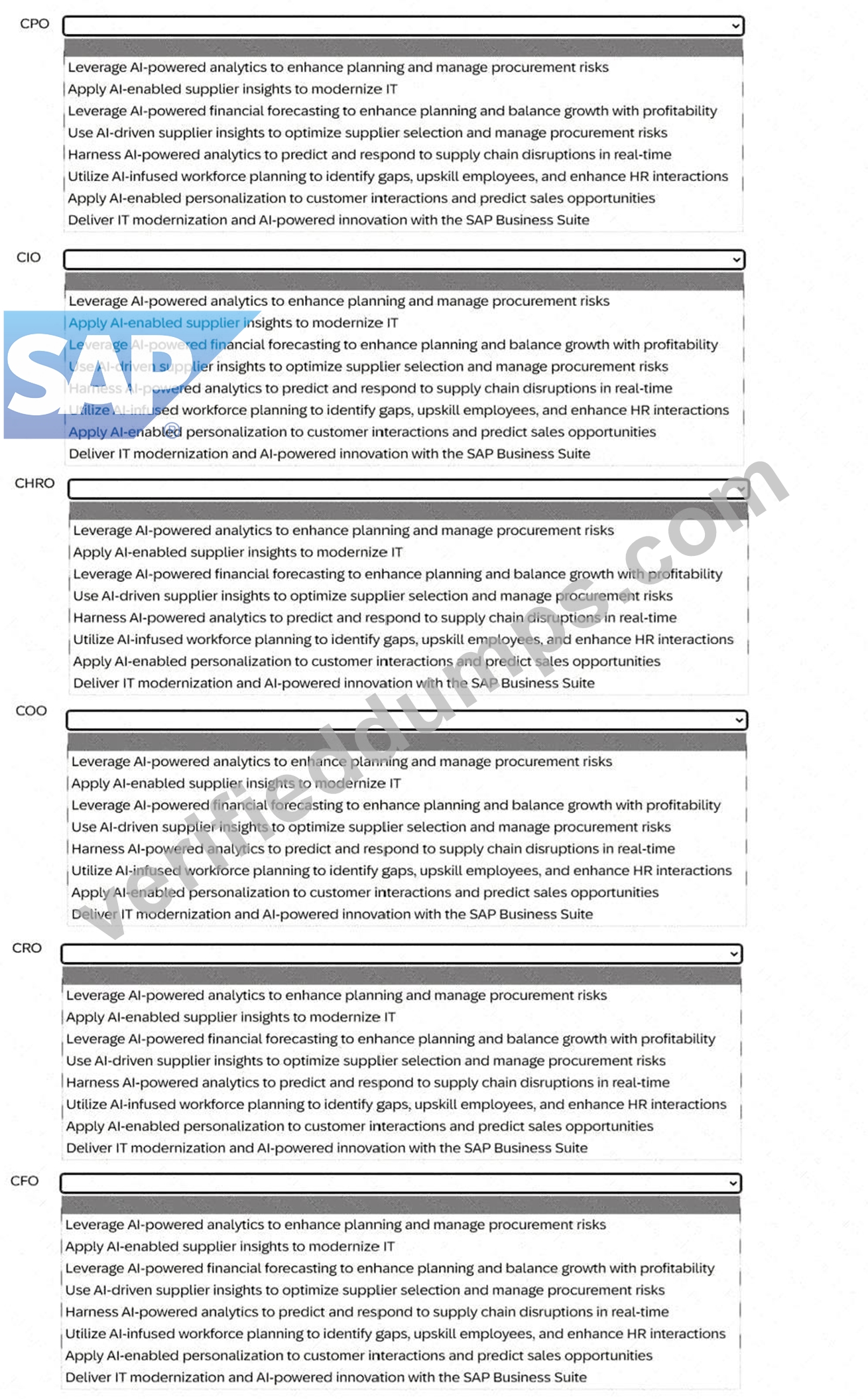
Answer:
Explanation: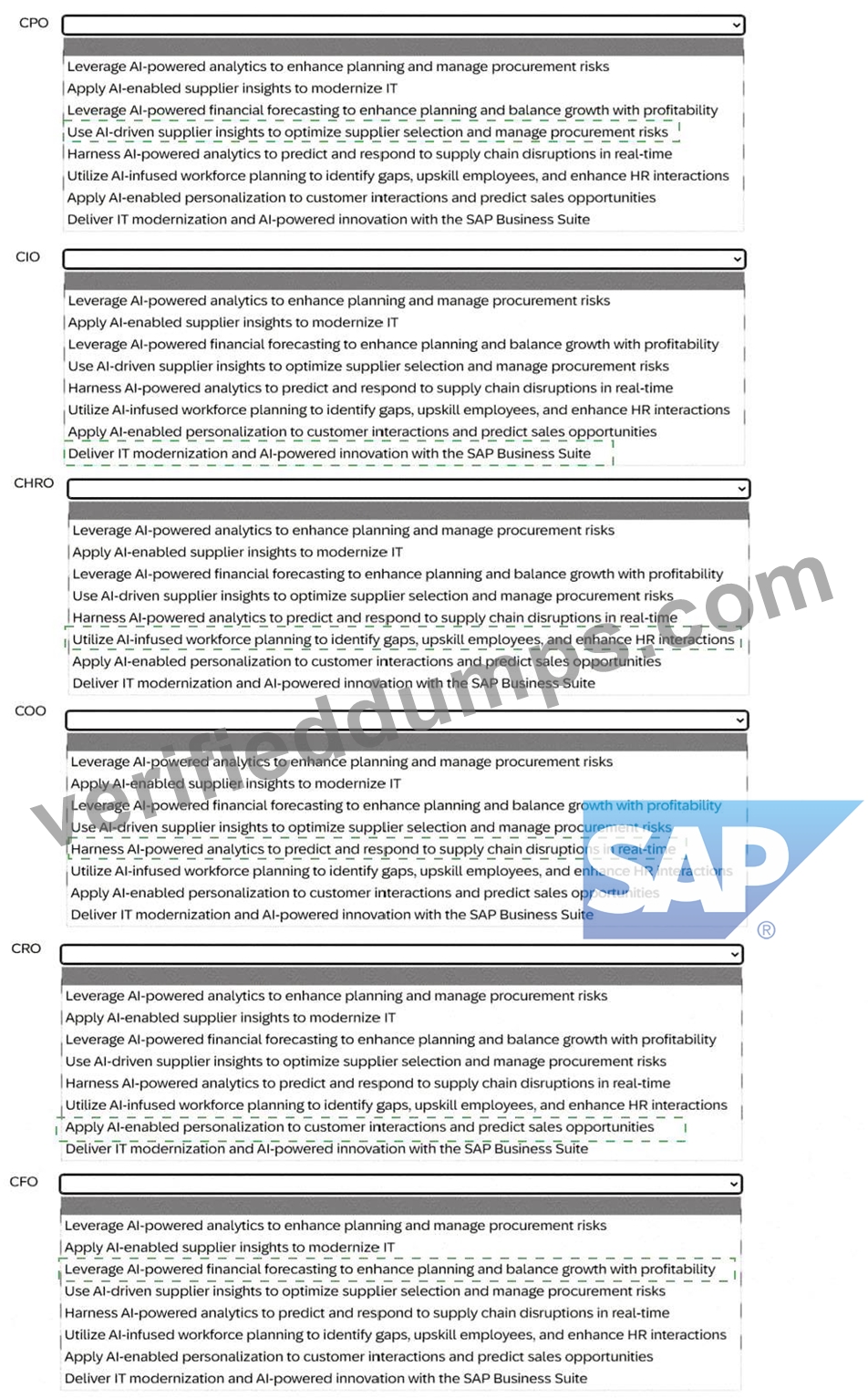
Explanation:
Step-by-Step Solution
1. CPO (Chief Procurement Officer)
Main Challenge: Procurement, supplier optimization, risk management.
Best Solution:
* Use AI-driven supplier insights to optimize supplier selection and manage procurement risks Reason:
CPOs focus on procurement efficiency, supplier management, and risk minimization. AI insights help select the best suppliers and mitigate procurement risks.
2. CIO (Chief Information Officer)
Main Challenge: IT modernization, technology innovation, and system integration.
Best Solution:
* Deliver IT modernization and AI-powered innovation with the SAP Business Suite Reason:
CIOs drive IT modernization and innovation. SAP Business Suite with AI powers digital transformation and future-ready IT infrastructure.
3. CHRO (Chief Human Resources Officer)
Main Challenge: Workforce planning, employee development, HR efficiency.
Best Solution:
* Utilize AI-infused workforce planning to identify gaps, upskill employees, and enhance HR interactions Reason:
CHROs want to optimize workforce management, fill talent gaps, and make HR processes smarter using AI.
4. COO (Chief Operating Officer)
Main Challenge: Operational efficiency, supply chain management, minimizing disruptions.
Best Solution:
* Harness AI-powered analytics to predict and respond to supply chain disruptions in real-time Reason:
COOs focus on ensuring smooth operations and a resilient supply chain; AI analytics help predict and manage disruptions.
5. CRO (Chief Revenue Officer)
Main Challenge: Customer experience, sales opportunities, revenue growth.
Best Solution:
* Apply AI-enabled personalization to customer interactions and predict sales opportunities Reason:
CROs are responsible for boosting revenue, improving customer relationships, and finding new sales opportunities through personalized experiences.
6. CFO (Chief Financial Officer)
Main Challenge: Financial forecasting, balancing growth with profitability.
Best Solution:
* Leverage AI-powered financial forecasting to enhance planning and balance growth with profitability Reason:
CFOs need accurate forecasting and strategic planning to maintain profitability and support sustainable growth.
NEW QUESTION # 34
How does SAP Business Suite support digital transformation? There are 2 correct answers to this question.
- A. Enables end-to-end process automation
- B. Provides real-time data insights
- C. Restricts integration with external platforms
- D. Eliminates cloud computing requirements
Answer: A,B
NEW QUESTION # 35
Which SAP Business Suite modules are essential for supply chain management? There are 2 correct answers to this question.
- A. SAP CRM
- B. SAP SCM (Supply Chain Management)
- C. SAP BusinessObjects
- D. SAP ERP
Answer: B,D
NEW QUESTION # 36
What does SAP do to help installed-base customers with their transformation journey to the SAP Business Suite?
- A. Support and accelerate their lift and shift efforts to cloud ERP only
- B. Move capabilities into the public cloud wherever possible
- C. Position and leverage the GROW with SAP transformation journey
Answer: C
Explanation:
GROW with SAP is SAP's official program designed to help customers (including existing or installed-base customers) transform and accelerate their move to SAP Business Suite (especially S/4HANA Cloud and cloud-based ERP) using best practices, ready-to-run cloud solutions, and guided transformation journeys.
It provides tools, services, and support to simplify and speed up the transition-not just "lift and shift" but true business transformation.
NEW QUESTION # 37
How does SAP Business Data Cloud facilitate the use of diverse data sources for AI-powered analytics?
- A. By transforming raw data from diverse sources into a standardized format
- B. By providing a secure platform for storing and managing diverse data sets
- C. By integrating diverse data sources through custom APIs
- D. By centralizing data from both SAP and non-SAP sources into a unified semantic layer
Answer: D
Explanation:
SAP Business Data Cloud (BDC) is a Software-as-a-Service (SaaS) solution that unifies and harmonizes data from SAP and non-SAP sources to enable advanced analytics and AI-driven insights. The question asks how SAP BDC facilitates the use of diverse data sources specifically for AI-powered analytics, with one correct answer. Below, each option is evaluated based on official SAP documentation and related materials, including SAP.com, SAP Learning, and web sources from the provided search results, ensuring alignment with the
"Positioning SAP Business Data Cloud" narrative.
* Option A: By centralizing data from both SAP and non-SAP sources into a unified semantic layerSAP BDC facilitates AI-powered analytics by centralizing data from SAP and non-SAP sources into a unified semantic layer, which preserves business context and ensures data consistency for advanced analytics and AI applications. This semantic layer is a core component of SAP BDC, enabling the platform to harmonize structured and unstructured data, making it readily accessible for AI and machine learning (ML) operations, such as those powered by SAP Databricks integration. The unified semantic layer is explicitly highlighted in SAP's documentation as the primary mechanism for enabling AI-powered analytics, as it provides a trusted data foundation that AI models can leverage for accurate and context-rich insights.Extract: "SAP Business Data Cloud is a data platform that harmonizes all data from SAP and non-SAP sources, into a unified semantic layer of trusted data, to power advanced analytics and AI. By integrating all types of cross-company data, which includes structured and non- structured data, businesses gain actionable intelligence to bridge transactional processes and drive AI- powered growth." Extract: "SAP Business Data Cloud is a fully managed SaaS solution that unifies and governs all SAP data and seamlessly connects with third-party data-giving line-of-business leaders context to make even more impactful decisions. ... Connect all your data: Harmonize all your mission- critical data with an open data ecosystem, leveraging a powerful semantic layer to give you an unmatched knowledge of your business." This option is correct.
* Option B: By transforming raw data from diverse sources into a standardized formatWhile SAP BDC does involve data transformation to ensure usability for analytics (e.g., through SAP Datasphere's data modeling capabilities), the process of transforming raw data into a standardized format is not the primary mechanism for facilitating AI-powered analytics. The emphasis in SAP BDC's architecture is on the unified semantic layer, which goes beyond standardization to include semantic enrichment and business context preservation. Standardization is a supporting function, but it is not explicitly highlighted as the key enabler for AI analytics in the documentation. The focus is on harmonization and integration into the semantic layer, making this option less accurate.Extract: "SAP Datasphere: This works as central component in BDC by creating consumption ready data models on top of Data Products while also managing analytical roles, access controls etc." This option is incorrect.
* Option C: By providing a secure platform for storing and managing diverse data setsSAP BDC does provide a secure platform for storing and managing data, leveraging features like SAP HANA Cloud and a data lakehouse architecture for governance and security. However, this capability is not the primary facilitator for AI-powered analytics. Security and data management are foundational requirements, but the documentation emphasizes the unified semantic layer and data harmonization as the key drivers for enabling AI analytics, rather than storage or management alone. This option is too general and does not directly address the AI analytics focus of the question.Extract: "SAP Business Data Cloud offers several capabilities for connecting and harmonizing data. By leveraging an SAP- managed Lakehouse, users can maintain rich business semantics for SAP-sourced data products right out-of-the-box. Additionally, the platform introduces a Data Foundation layer, which acts as a data lake to store both SAP and non-SAP data sources." This option is incorrect.
* Option D: By integrating diverse data sources through custom APIsSAP BDC integrates diverse data sources through prebuilt connectors, open data ecosystems, and partnerships (e.g., with Databricks), rather than relying primarily on custom APIs. While APIs may be used in some integration scenarios, the documentation does not highlight custom APIs as a key mechanism for facilitating AI-powered analytics. Instead, the platform's strength lies in its ability to seamlessly connect data sources via standardized integration frameworks and a unified semantic layer, making custom APIs a secondary or non-emphasized approach.Extract: "The partnership between SAP and Databricks enables customers to combine the benefits of SAP Business Data Cloud with Databricks' powerful AI and ML capabilities.
... SAP Business Data Cloud can now natively read data from and write data to Databricks, enabling customers to use the Databricks platform to build and deploy their own machine learning models and generative AI applications." This option is incorrect.
Summary of Correct answer:
* A: SAP BDC facilitates AI-powered analytics by centralizing SAP and non-SAP data into a unified semantic layer, which ensures trusted, context-rich data for AI and ML applications, enabling accurate and actionable insights.
References:
SAP.com: SAP Business Data Cloud
SAP Learning: Positioning SAP Business Data Cloud
SAP and Databricks Power New Era of Business Data and AI | Procurement Magazine SAP Launches Business Data Cloud to Transform Enterprise AI | Technology Magazine Delaware UK & Ireland: Unleash transformative insights with SAP Business Data Cloud SAP Business Data Cloud - Making Data Work Together | by Sandip Roy | Medium
NEW QUESTION # 38
Which SAP Business Suite component is primarily used for customer relationship management? Please choose the correct answer.
- A. SAP S/4HANA
- B. SAP Business Warehouse
- C. SAP CRM
- D. SAP SuccessFactors
Answer: C
NEW QUESTION # 39
What are some data challenges companies face that want to implement AI and insights for business transformation?
Note: There are 3 correct answers to this question.
- A. To harmonize data from multiple SAP applications
- B. To access SAP Line of Business (LOB) data consistently
- C. To integrate third-party applications
- D. To boost confidence in AI-generated content
- E. To simplify the data landscape
Answer: A,B,E
Explanation:
The question asks about data challenges companies face when implementing AI and insights for business transformation, particularly in the context ofSAP Business Suite. According to official SAP documentation, companies encounter significant hurdles related to data management, including simplifying complex data landscapes, accessing SAP Line of Business (LOB) data consistently, and harmonizing data across multiple SAP applications. These align with Options A, B, and E, making them the correct answers.
Explanation of Correct Answers:
Option A: To simplify the data landscape
This is correct because a complex and fragmented data landscape is a major challenge for companies seeking to implement AI and insights. Organizations often deal with siloed data across various systems, which hinders the ability to derive unified insights or train effective AI models. ThePositioning SAP Business Suite documentation on learning.sap.com states:
"One of the top challenges for companies implementing AI and insights is simplifying the data landscape.
Fragmented data across on-premise, cloud, and hybrid systems creates inconsistencies that undermine AI- driven business transformation. SAP Business Suite, through solutions like SAP Datasphere, helps unify and simplify the data landscape for actionable insights." Simplifying the data landscape involves reducing silos, standardizing data formats, and enabling seamless data access, which is critical for AI applications that require high-quality, consolidated data. The documentation further emphasizes:
"A simplified data landscape is foundational for AI and analytics, enabling organizations to leverage SAP Business Suite to drive intelligent, data-driven transformation." This confirms simplifying the data landscape as a key challenge.
Option B: To access SAP Line of Business (LOB) data consistently
This is correct because consistent access to SAP Line of Business (LOB) data (e.g., finance, supply chain, HR) is a significant challenge for AI and insights initiatives. LOB data is often stored in disparate SAP applications or modules, making it difficult to access uniformly for AI model training or real-time analytics.
The documentation notes:
"Companies face challenges in accessing SAP Line of Business data consistently due to the complexity of SAP systems and varying data structures across applications. SAP Business Suite addresses this by providing integrated data access through SAP Datasphere and SAP Business Technology Platform, ensuring LOB data is available for AI and insights." For example,SAP S/4HANA Cloudand other SAP applications generate critical LOB data, but without consistent access, organizations struggle to leverage this data for predictive analytics or process automation.
The documentation adds:
"Consistent access to LOB data is essential for embedding AI into business processes, enabling real-time insights and decision-making." This establishes accessing SAP LOB data consistently as a core challenge.
Option E: To harmonize data from multiple SAP applications
This is correct because harmonizing data from multiple SAP applications (e.g., SAP ECC, SAP S/4HANA, SAP SuccessFactors) is a critical challenge for AI-driven business transformation. Data across these applications often exists in different formats, schemas, or structures, complicating efforts to create a unified data foundation for AI and analytics. The documentation states:
"Harmonizing data from multiple SAP applications is a significant challenge for companies pursuing AI and insights. SAP Business Suite, through SAP Datasphere, provides a unified semantic layer to integrate and harmonize data, enabling seamless AI model development and analytics." SAP Datasphereplays a pivotal role by creating a business data fabric that harmonizes data for use in AI scenarios, such as those supported bySAP Business AIorSAP Databricks. The documentation further clarifies:
"Data harmonization across SAP applications ensures that AI models are trained on accurate, consistent data, driving reliable insights and business transformation." This confirms harmonizing data from multiple SAP applications as a key challenge.
Explanation of Incorrect Answers:
Option C: To integrate third-party applications
This is incorrect because, while integrating third-party applications can be a challenge in some contexts, it is not specifically highlighted as a primary data challenge for implementing AI and insights in the context ofSAP Business Suite. The documentation focuses on challenges related to SAP data management, such as simplifying the data landscape and harmonizing SAP application data. WhileSAP Business Technology Platform (BTP)supports integration with third-party applications, the primary data challenges for AI are internal to SAP systems:
"The key data challenges for AI and insights include simplifying the data landscape, ensuring consistent access to SAP LOB data, and harmonizing data across SAP applications." Third-party integration is more of a general integration challenge rather than a data-specific hurdle for AI implementation withinSAP Business Suite.
Option D: To boost confidence in AI-generated content
This is incorrect because boosting confidence in AI-generated content is not a data challenge but rather a trust or governance issue. While ensuring trust in AI outputs is important (e.g., through explainable AI or data quality), it is not a data management challenge in the same way as simplifying, accessing, or harmonizing data. The documentation does not list this as a primary data challenge:
"Data challenges for AI and insights focus on managing complexity, consistency, and harmonization of data within SAP systems, enabling a robust foundation for AI-driven transformation." Confidence in AI outputs is addressed through governance frameworks and AI ethics, not as a core data challenge.
Summary:
Companies implementing AI and insights for business transformation face data challenges, including simplifying the data landscape (to reduce silos and complexity), accessing SAP Line of Business (LOB) data consistently (to enable unified analytics), and harmonizing data from multiple SAP applications (to create a cohesive data foundation). These correspond to Options A, B, and E. Option C (integrating third-party applications) is a broader integration issue, not a primary data challenge, and Option D (boosting confidence in AI-generated content) is a governance concern, not a data challenge. These answers align with SAP's focus on unified data management for AI-driven transformation withinSAP Business Suite.
References:
Positioning SAP Business Suite, learning.sap.com
SAP Datasphere: Enabling AI and Insights, SAP Help Portal
SAP Business AI and Data Management Challenges, SAP Community Blogs
SAP Business Suite for Intelligent Enterprises, SAP Learning Hub
NEW QUESTION # 40
What is the key advantage of SAP data products?
- A. Consistency and business context embedded in SAP-managed dataset and semantics
- B. Ready-to-run insights that leverage planning and analysis
- C. Self-service analytical modeling within a data fabric architecture
Answer: A
Explanation:
SAP data products are standardized, curated datasets within SAP Business Data Cloud (BDC) that encapsulate business data with embedded semantics and context, designed to enable advanced analytics, AI, and seamless data sharing across SAP and non-SAP systems. The question asks for the key advantage of SAP data products, with one correct answer. Below, each option is evaluated based on official SAP documentation, SAP Learning materials, and relevant web sources from the provided search results, ensuring alignment with the "Positioning SAP Business Suite" and "SAP Business Data Cloud" narratives.
* Option A: Consistency and business context embedded in SAP-managed dataset and semanticsThe primary advantage of SAP data products is their ability to provide consistency and embedded business context within SAP-managed datasets and semantics. These data products are pre-curated, semantically rich datasets that preserve the business meaning and context of data from SAP applications (e.g., SAP S
/4HANA, SAP SuccessFactors) and integrate with non-SAP data. This ensures that data is consistent, trusted, and ready for analytics and AI without requiring extensive re-engineering or external transformation. The documentation explicitly highlights this as the key advantage, emphasizing how SAP data products eliminate the need to rebuild business logic and maintain data integrity across use cases.Extract: "SAP Business Data Cloud offers several capabilities for connecting and harmonizing data. By leveraging an SAP-managed Lakehouse, users can maintain rich business semantics for SAP- sourced data products right out-of-the-box. ... Data products are curated and managed by SAP, ensuring consistency and business context for advanced analytics and AI." Extract: "Built-In Business Semantics: Because SAP data already carries deep business context and semantics, Databricks can provide powerful analytics and machine learning without forcing customers to re-invent data pipelines or guess at the meaning of fields." Extract: "SAP data products provide a consistent, semantically rich foundation for data sharing, ensuring that business context is preserved across SAP and non-SAP systems, reducing complexity and enabling trusted insights." This option is correct.
* Option B: Ready-to-run insights that leverage planning and analysisWhile SAP Business Data Cloud provides ready-to-run insights through its Intelligent Applications, which combine planning and analysis, this is a feature of the broader SAP BDC platform, not a specific advantage of SAP data products. SAP data products are the underlying datasets that feed these applications, but their primary role is to provide a consistent, semantically rich data foundation, not to deliver insights directly. The documentation distinguishes between data products (data layer) and intelligent applications (analytics layer), making this option less accurate as the key advantage.Extract: "New to SAP Business Data Cloud (SAP BDC) are context-aware SAP Business Data Cloud Intelligent Applications. These pre- configured dashboards provide ready-to-run insights by combining planning and analysis, all infused with trusted Artificial Intelligence (AI) to drive smarter, faster decisions." This option is incorrect.
* Option C: Self-service analytical modeling within a data fabric architectureSAP Business Data Cloud supports self-service analytical modeling through SAP Datasphere, which operates within a data fabric architecture to enable business users to create data models. However, this capability is not a primary advantage of SAP data products themselves. SAP data products are focused on delivering curated, SAP- managed datasets with embedded semantics, not on enabling self-service modeling. The data fabric architecture is a broader feature of SAP BDC, and self-service modeling is a function of tools like SAP Datasphere, not the data products.Extract: "SAP Datasphere: This works as central component in BDC by creating consumption ready data models on top of Data Products while also managing analytical roles, access controls etc." This option is incorrect.
Summary of Correct answer:
* A: The key advantage of SAP data products is their consistency and business context embedded in SAP- managed datasets and semantics, ensuring trusted, semantically rich data for analytics and AI without the need for external re-engineering.
References:
SAP.com: SAP Business Data Cloud
SAP Learning: Positioning SAP Business Data Cloud
SAP Learning: Positioning SAP Business Suite
SAP.com: SAP Databricks in Business Data Cloud
SAP Business Data Cloud - Making Data Work Together | by Sandip Roy | Medium SAP Community: SAP Databricks in SAP Business Data Cloud: Unifying SAP Business Data with Lakehouse Intelligence Databricks Blog: Announcing the General Availability of SAP Databricks on SAP Business Data Cloud
NEW QUESTION # 41
A global manufacturing company wants to improve supplier collaboration, optimize procurement operations, and reduce manual processing errors. They need an SAP solution that enables spend management, contract lifecycle tracking, and supplier performance analysis. Which SAP solutions should they implement? There are 3 correct answers to this question.
- A. SAP Controlling (CO)
- B. SAP Ariba
- C. SAP Customer Relationship Management (CRM)
- D. SAP Business Network
- E. SAP Predictive Analytics
Answer: B,D,E
NEW QUESTION # 42
What are some key differentiators of SAP Business AI?
Note: There are 3 correct answers to this question.
- A. Ecosystem of Innovation
- B. Large foundation models
- C. Embedded AI
- D. AI Foundation
- E. Predictive Analytics
Answer: A,C,D
Explanation:
The question asks for the key differentiators ofSAP Business AI, which is a suite of AI capabilities integrated intoSAP Business Suiteto enhance business processes, decision-making, and automation. According to official SAP documentation and the provided search results, the key differentiators ofSAP Business AIinclude its ecosystem of innovation, embedded AI, and AI Foundation. These align with Options A, C, and E, making them the correct answers.
Explanation of Correct Answers:
Option A: Ecosystem of Innovation
This is correct becauseSAP Business AIis distinguished by its robust ecosystem of innovation, which includes partnerships with leading technology providers (e.g., NVIDIA, Google Cloud, Microsoft, AWS, Cohere) and implementation partners to deliver cutting-edge AI solutions. This ecosystem fosters collaborative innovation, enablingSAP Business AIto integrate advanced AI models, ensure interoperability, and address customer- specific needs through a network of expertise. TheSAP Business AIoverview onwww.sap.comstates:
"SAP's AI strategy includes a robust partner ecosystem with synergistic collaboration, partnering with industry leaders like NVIDIA, Google Cloud, and Cohere to deliver interoperable AI agents and scalable solutions. This ecosystem enables SAP Business AI to address unique customer challenges through combined expertise and innovation." sap.com Additionally, theSAP News Centeremphasizes the role of partners in driving innovation:
"A key element of SAP's AI strategy is leveraging partners' expertise. Partners develop innovative AI solutions and extensions, enhancing the SAP portfolio with customer-specific use cases built on SAP BTP." news.sap.com This ecosystem differentiatesSAP Business AIby combining SAP's deep business process knowledge with external AI advancements, ensuring flexibility and rapid adoption of new technologies.
Option C: Embedded AI
This is correct becauseSAP Business AIis uniquely differentiated by its embedded AI capabilities, which are seamlessly integrated into SAP applications (e.g.,SAP S/4HANA,SAP SuccessFactors,SAP Analytics Cloud) to enhance business processes directly within workflows. Unlike standalone AI solutions, embedded AI automates tasks, provides context-aware insights, and optimizes processes without requiring users to leave their SAP environment. TheExploring SAP's AI Strategylesson on learning.sap.com states:
"Embedded AI Capabilities enhance SAP products by automating tasks, analyzing data, improving user experience, optimizing processes, fostering innovation, and ensuring seamless integration. Joule, a generative AI copilot, is embedded within SAP applications, offering generative AI, predictive analytics, process automation, and context-aware recommendations." learning.sap.com For example,SAP S/4HANAuses embedded AI for predictive maintenance and supply chain optimization, whileSAP Concurautomates expense reporting. TheSAP Business AIpage onwww.sap.comfurther notes:
"Drive impact with AI grounded in your business data and embedded into every business function. ... With access to over 230 AI-powered scenarios-expanding to 400 by the end of 2025-SAP Business AI streamlines operations across finance, supply chain, and more." sap.com This embedded approach ensures that AI is relevant and immediately applicable, distinguishingSAP Business AIfrom generic AI platforms.
Option E: AI Foundation
This is correct because theAI FoundationonSAP Business Technology Platform (BTP)is a key differentiator, providing a comprehensive toolkit for developers to build, extend, and run custom AI solutions tailored to business needs. It includes services likeSAP AI Core,Generative AI Hub, and access to leading AI models, ensuring scalability, security, and integration with SAP and non-SAP data. TheAI Foundation, SAP's all-in- one AI toolkitarticle on community.sap.com states:
"AI Foundation is SAP's all-in-one AI toolkit, offering developers AI that's ready-to-use, customizable, grounded in business data, and supported by leading generative AI foundation models. It is also the basis for AI capabilities that SAP embeds across its portfolio." community.sap.com TheSAP Sapphire Innovation Guide 2025further elaborates:
"AI Foundation is the backbone of SAP's AI technologies and provides comprehensive developer tools to build, extend, and run custom AI solutions at scale-all in one system. It simplifies AI development and operations, offering tools like the Prompt Optimizer and access to models like GPT-4.1, Claude 3.7 Sonnet, and Gemini 2.5 Pro." sap.com This differentiatesSAP Business AIby enabling businesses to create bespoke AI applications while leveraging SAP's enterprise-grade infrastructure, ensuring flexibility and governance.
Explanation of Incorrect Answers:
Option B: Large foundation models
This is incorrect becauseSAP Business AIdoes not primarily differentiate itself through the development or use of large foundation models (e.g., large language models or LLMs). Instead, SAP partners with leading LLM providers (e.g., Cohere, Mistral AI, Meta) to integrate their models into theSAP BTP Generative AI Hub, focusing on business-contextualized AI rather than building proprietary LLMs. TheSAP Business AIarticle on community.sap.com clarifies:
"SAP leverages a rich ecosystem of technology partner LLM offerings through SAP BTP's AI Foundation and Generative AI Hub, rather than developing SAP-specific LLMs. This approach ensures access to the latest innovations while prohibiting partners from training on customer data." pages.community.sap.com While SAP plans to fine-tune generic LLMs and create proprietary foundation models for structured data (e.g., SAP Foundation Modelfor tabular data), these are not yet a primary differentiator compared to the ecosystem, embedded AI, and AI Foundation. learning.sap.com Option D: Predictive Analytics This is incorrect because, while predictive analytics is a significant capability ofSAP Business AI(e.g., forecasting demand inSAP Integrated Business Planningor predicting equipment failures inSAP S/4HANA), it is not a unique differentiator. Predictive analytics is a common feature in many AI platforms and is one of many capabilities withinSAP Business AI, not a defining characteristic. TheSAP Business AIdocumentation onwww.fingent.comnotes:
"SAP Business AI solutions use machine learning and advanced analytics, including predictive analytics, to gain insights into complex data. However, its differentiation lies in its integration with business processes and data, not the analytics techniques alone." fingent.com The unique value ofSAP Business AIcomes from its ecosystem, embedded nature, and developer-centric AI Foundation, rather than specific techniques like predictive analytics, which are widespread across AI solutions.
Summary:
The key differentiators ofSAP Business AIare its ecosystem of innovation (leveraging a robust partner network for collaborative AI solutions), embedded AI (seamlessly integrated into SAP applications for process optimization), and AI Foundation (providing a scalable toolkit for custom AI development), corresponding to Options A, C, and E. Option B is incorrect because SAP relies on partner LLMs rather than proprietary large foundation models as a differentiator. Option D is incorrect because predictive analytics, while important, is not a unique differentiator compared to the broader ecosystem and integration capabilities. These differentiators align with SAP's strategy to deliver relevant, reliable, and responsible AI withinSAP Business Suite, as supported by the provided search results and official documentation.
References:
Positioning SAP Business Suite, learning.sap.com
Exploring SAP's AI Strategy, learning.sap.com learning.sap.com
SAP Business AI: Release Highlights Q1 2025, SAP News Center news.sap.com SAP Sapphire Innovation Guide 2025,www.sap.comsap.com SAP Business AI,www.sap.comsap.comsap.com AI Foundation, SAP's all-in-one AI toolkit, SAP Community community.sap.com SAP Business AI: A Fundamental Change, IgniteSAP ignitesap.com SAP Business AI: Revolutionizing Enterprise Decisions,www.fingent.com
NEW QUESTION # 43
How does integrating SAP Databricks within SAP Business Data Cloud reduce IT overhead for customers?
- A. By streamlining data governance processes and minimizing the need for complex data security configurations
- B. By automating data ingestion pipelines
- C. By providing pre-built connectors to various data sources
- D. By eliminating the need for rebuilding data structures and business logic externally
Answer: D
Explanation:
SAP Business Data Cloud (BDC) is a fully managed Software-as-a-Service (SaaS) solution that unifies and governs SAP and non-SAP data, integrating SAP Databricks to enable advanced analytics and AI-driven insights. The question asks how the integration of SAP Databricks within SAP BDC reduces IT overhead for customers, with one correct answer. Below, each option is evaluated based on official SAP documentation, SAP Learning materials, and relevant web sources from the provided search results, ensuring alignment with the "Positioning SAP Business Data Cloud" narrative and focusing on the role of SAP Databricks.
* Option A: By automating data ingestion pipelinesWhile SAP BDC, including its SAP Datasphere component, supports data integration and pipeline management, the automation of data ingestion pipelines is not a primary focus of SAP Databricks' integration. SAP Databricks is designed to enhance AI/ML, data science, and data engineering capabilities, leveraging zero-copy data sharing via Delta Sharing to access data products. Although SAP BDC as a whole may reduce some pipeline management overhead, the specific role of SAP Databricks is not to automate ingestion pipelines but to utilize pre-curated data products without requiring complex ETL processes. The documentation does not emphasize automated ingestion pipelines as a key IT overhead reduction mechanism for SAP Databricks.Extract: "SAP Business Data Cloud is deeply integrated across SAP applications, so your most critical data retains its original business context and semantics and the hidden costs of data extracts are eliminated-saving you time, resources, and effort." This option is incorrect.
* Option B: By providing pre-built connectors to various data sourcesSAP BDC provides pre-built connectors to SAP and non-SAP data sources through its foundation services and SAP Datasphere, enabling seamless data integration. However, this capability is not specifically tied to the SAP Databricks component. SAP Databricks leverages these connections indirectly by accessing data products shared via Delta Sharing, but it does not provide the connectors itself. The documentation highlights SAP BDC's overall integration capabilities, not SAP Databricks' role in providing connectors, as the primary mechanism for reducing IT overhead.Extract: "Effortlessly connect to contextual SAP data and blend with third-party data-without managing pipelines and copying data." This option is incorrect.
* Option C: By streamlining data governance processes and minimizing the need for complex data security configurationsSAP Databricks integrates with Unity Catalog for governance, which enhances data management and security within the SAP BDC environment. SAP BDC itself provides unified provisioning, security, and compliance, reducing some governance overhead. However, while governance is improved, the primary IT overhead reduction from SAP Databricks comes from eliminating the need to replicate and re-engineer data externally, not from streamlining governance processes. The documentation emphasizes data sharing and semantic preservation over governance simplification as the key benefit of SAP Databricks integration.Extract: "SAP Databricks uses both generative and traditional AI to understand your organization's data, business terms, and key metrics, so teams can work with data using natural language. It makes it easier to find, organize, manage, and govern data through Unity Catalog..." This option is incorrect.
* Option D: By eliminating the need for rebuilding data structures and business logic externallyThe integration of SAP Databricks within SAP BDC significantly reduces IT overhead by eliminating the need to rebuild data structures and business logic externally. Traditionally, customers replicate SAP data into external platforms, requiring complex ETL processes to clean, transform, and recreate business logic, which increases costs and maintenance efforts. SAP Databricks, through native integration and zero-copy Delta Sharing, provides direct access to curated, semantically rich SAP data products (e.g., from SAP S/4HANA) within the SAP BDC environment. This preserves business context and semantics, avoiding the need to re-engineer data structures or logic, thus reducing development, maintenance, and operational overhead. This is explicitly highlighted in the documentation as a key benefit of the SAP-Databricks partnership.Extract: "Today, customers often replicate SAP data into external platforms to clean, train models, deploy them, run inference, and push results back-introducing complexity, higher costs, and governance gaps. SAP Databricks offers a better path. Customers can now run end-to-end AI, ML, and analytics directly within SAP Business Data Cloud-without needing separate platforms or physical data replication." Extract: "Built-In Business Semantics: Because SAP data already carries deep business context and semantics, Databricks can provide powerful analytics and machine learning without forcing customers to re-invent data pipelines or guess at the meaning of fields." Extract: "SAP Databricks also offers significantly improved data latency... This enhanced latency is possible due to the Delta Sharing approach which enables direct access to clean, curated and context-rich data products with business semantics already incorporated. ... [This] results in a reduction of processing costs and lowering the overheads for initial development and ongoing maintenance of ETL processes." This option is correct.
Summary of Correct answer:
* D: Integrating SAP Databricks within SAP BDC reduces IT overhead by eliminating the need to rebuild data structures and business logic externally, leveraging zero-copy Delta Sharing to access curated SAP data products with preserved business semantics, thus minimizing complex ETL processes and maintenance costs.
References:
SAP.com: SAP Business Data Cloud
SAP.com: SAP Databricks in Business Data Cloud
SAP Learning: Illustrating the Role of SAP Databricks in SAP Business Data Cloud Databricks Blog: Announcing the General Availability of SAP Databricks on SAP Business Data Cloud Advancing Analytics: SAP Databricks: Solving The SAP Interoperability Challenge?
SAP Community: SAP Databricks in SAP Business Data Cloud: Unifying SAP Business Data with Lakehouse Intelligence SAP Business Data Cloud - Making Data Work Together | by Sandip Roy | Medium
NEW QUESTION # 44
......
C-BCSBS-2502 Study Material, Preparation Guide and PDF Download: https://www.verifieddumps.com/C-BCSBS-2502-valid-exam-braindumps.html
C-BCSBS-2502 Actual Questions 100% Same Braindumps with Actual Exam: https://drive.google.com/open?id=12rAphwTtWJNTg9m16Uc3a2vUE6Z-yAX0
