

[Aug-2026] Use Real Databricks-Certified-Data-Engineer-Associate Dumps - 100% Free Databricks-Certified-Data-Engineer-Associate Exam Dumps
Databricks-Certified-Data-Engineer-Associate PDF Dumps Exam Questions – Valid Databricks-Certified-Data-Engineer-Associate Dumps
Databricks Certified Data Engineer Associate certification is designed to help professionals stay up-to-date with the latest data engineering trends and technologies. Databricks Certified Data Engineer Associate Exam certification exam is regularly updated to ensure that it reflects the latest developments in the field of data engineering. By earning this certification, professionals can demonstrate their commitment to professional development and their dedication to staying current in their field.
The GAQM Databricks-Certified-Data-Engineer-Associate (Databricks Certified Data Engineer Associate) Certification Exam is designed to validate the skills and knowledge of data engineers who work with the Databricks Unified Analytics Platform. Databricks Certified Data Engineer Associate Exam certification is ideal for professionals who want to demonstrate their expertise in building and optimizing data pipelines, data transformation, and data storage using Databricks.
NEW QUESTION # 28
A dataset has been defined using Delta Live Tables and includes an expectations clause:
CONSTRAINT valid_timestamp EXPECT (timestamp > '2020-01-01') ON VIOLATION FAIL UPDATE What is the expected behavior when a batch of data containing data that violates these constraints is processed?
- A. Records that violate the expectation are dropped from the target dataset and recorded as invalid in the event log.
- B. Records that violate the expectation are added to the target dataset and flagged as invalid in a field added to the target dataset.
- C. Records that violate the expectation are added to the target dataset and recorded as invalid in the event log.
- D. Records that violate the expectation are dropped from the target dataset and loaded into a quarantine table.
- E. Records that violate the expectation cause the job to fail.
Answer: E
Explanation:
The expected behavior when a batch of data containing data that violates the expectation is processed is that the job will fail. This is because the expectation clause has the ON VIOLATION FAIL UPDATE option, which means that if any record in the batch does not meet the expectation, the entire batch will be rejected and the job will fail. This option is useful for enforcing strict data quality rules and preventing invalid data from entering the target dataset.
Option A is not correct, as the ON VIOLATION FAIL UPDATE option does not drop the records that violate the expectation, but fails the entire batch. To drop the records that violate the expectation and record them as invalid in the event log, the ON VIOLATION DROP RECORD option should be used.
Option C is not correct, as the ON VIOLATION FAIL UPDATE option does not drop the records that violate the expectation, but fails the entire batch. To drop the records that violate the expectation and load them into a quarantine table, the ON VIOLATION QUARANTINE RECORD option should be used.
Option D is not correct, as the ON VIOLATION FAIL UPDATE option does not add the records that violate the expectation, but fails the entire batch. To add the records that violate the expectation and record them as invalid in the event log, the ON VIOLATION LOG RECORD option should be used.
Option E is not correct, as the ON VIOLATION FAIL UPDATE option does not add the records that violate the expectation, but fails the entire batch. To add the records that violate the expectation and flag them as invalid in a field added to the target dataset, the ON VIOLATION FLAG RECORD option should be used.
References:
* Delta Live Tables Expectations
* [Databricks Data Engineer Professional Exam Guide]
NEW QUESTION # 29
Which of the following statements regarding the relationship between Silver tables and Bronze tables is always true?
- A. Silver tables contain a less refined, less clean view of data than Bronze data.
- B. Silver tables contain more data than Bronze tables.
- C. Silver tables contain less data than Bronze tables.
- D. Silver tables contain a more refined and cleaner view of data than Bronze tables.
- E. Silver tables contain aggregates while Bronze data is unaggregated.
Answer: B
Explanation:
Explanation
https://www.databricks.com/glossary/medallion-architecture
NEW QUESTION # 30
A data engineer has configured a Structured Streaming job to read from a table, manipulate the data, and then perform a streaming write into a new table.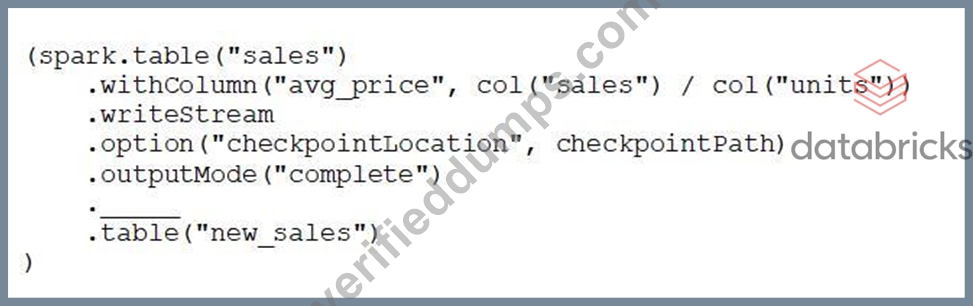
The code block used by the data engineer is below:
Which line of code should the data engineer use to fill in the blank if the data engineer only wants the query to execute a micro-batch to process data every 5 seconds?
- A. trigger(continuous= " 5 seconds " )
- B. trigger(processingTime= " 5 seconds " )
- C. trigger(once= " 5 seconds " )
- D. trigger( " 5 seconds " )
Answer: B
NEW QUESTION # 31
Which of the following must be specified when creating a new Delta Live Tables pipeline?
- A. A key-value pair configuration
- B. The preferred DBU/hour cost
- C. At least one notebook library to be executed
- D. A path to cloud storage location for the written data
- E. A location of a target database for the written data
Answer: C
Explanation:
Option E is the correct answer because it is the only mandatory requirement when creating a new Delta Live Tables pipeline. A pipeline is a data processing workflow that contains materialized views and streaming tables declared in Python or SQL source files. Delta Live Tables infers the dependencies between these tables and ensures updates occur in the correct order. To create a pipeline, you need to specify at least one notebook library to be executed, which contains the Delta Live Tables syntax. You can also specify multiple libraries of different languages within your pipeline. The other options are optional or not applicable for creating a pipeline. Option A is not required, but you can optionally provide a key-value pair configuration to customize the pipeline settings, such as the storage location, the target schema, the notifications, and the pipeline mode. Option B is not applicable, as the DBU/hour cost is determined by the cluster configuration, not the pipeline creation. Option C is not required, but you can optionally specify a storage location for the output data from the pipeline. If you leave it empty, the system uses a default location. Option D is not required, but you can optionally specify a location of a target database for the written data, either in the Hive metastore or the Unity Catalog.
NEW QUESTION # 32
A data engineer wants to create a relational object by pulling data from two tables. The relational object does not need to be used by other data engineers in other sessions. In order to save on storage costs, the data engineer wants to avoid copying and storing physical data.
Which of the following relational objects should the data engineer create?
- A. Spark SQL Table
- B. Delta Table
- C. Database
- D. View
- E. Temporary view
Answer: E
Explanation:
A temporary view is a relational object that is defined in the metastore and points to an existing DataFrame. It does not copy or store any physical data, but only saves the query that defines the view. The lifetime of a temporary view is tied to the SparkSession that was used to create it, so it does not persist across different sessions or applications. A temporary view is useful for accessing the same data multiple times within the same notebook or session, without incurring additional storage costs. The other options are either materialized (A, E), persistent (B, C), or not relational objects. References: Databricks Documentation - Temporary View, Databricks Community - How do temp views actually work?, Databricks Community - What's the difference between a Global view and a Temp view?, Big Data Programmers - Temporary View in Databricks.
NEW QUESTION # 33
A data engineer is onboarding a new Bronze ingestion pipeline in Databricks with Unity Catalog. The team wants Databricks to handle storage layout, apply platform optimizations over time, and simplify lifecycle management so that when a table is dropped, its underlying data is also cleaned up according to Databricks- managed retention policies.
Which table type should the data engineer create for these ingestion tables?
- A. Temporary views over files to avoid table-level governance and lifecycle coupling
- B. External tables with a LOCATION pointing to an external volume for full control of file layout
- C. Foreign tables federated from an external catalog to delegate optimization to the source system
- D. Managed tables so that Unity Catalog manages both metadata and underlying data lifecycle
Answer: D
NEW QUESTION # 34
A data engineer only wants to execute the final block of a Python program if the Python variable day_of_week is equal to 1 and the Python variable review_period is True.
Which of the following control flow statements should the data engineer use to begin this conditionally executed code block?
- A. if day_of_week = 1 & review_period: = "True":
- B. if day_of_week == 1 and review_period:
- C. if day_of_week == 1 and review_period == "True":
- D. if day_of_week = 1 and review_period:
- E. if day_of_week = 1 and review_period = "True":
Answer: C
NEW QUESTION # 35
A data engineer wants to schedule their Databricks SQL dashboard to refresh every hour, but they only want the associated SQL endpoint to be running when It is necessary. The dashboard has multiple queries on multiple datasets associated with it. The data that feeds the dashboard is automatically processed using a Databricks Job.
Which approach can the data engineer use to minimize the total running time of the SQL endpoint used in the refresh schedule of their dashboard?
- A. 0 They can ensure the dashboard's SQL endpoint matches each of the queries' SQL endpoints.
- B. O They can set up the dashboard's SQL endpoint to be serverless.
- C. O They can reduce the cluster size of the SQL endpoint.
- D. Q They can turn on the Auto Stop feature for the SQL endpoint.
Answer: D
Explanation:
To minimize the total running time of the SQL endpoint used in the refresh schedule of a dashboard in Databricks, the most effective approach is to utilize the Auto Stop feature. This feature allows the SQL endpoint to automatically stop after a period of inactivity, ensuring that it only runs when necessary, such as during the dashboard refresh or when actively queried. This minimizes resource usage and associated costs by ensuring the SQL endpoint is not running idle outside of these operations.
NEW QUESTION # 36
An organization has implemented a data pipeline in Databricks and needs to ensure it can scale automatically based on varying workloads without manual cluster management. The goal is to meet the company's Service Level Agreements (SLAs), which require high availability and minimal downtime, while Databricks automatically handles resource allocation and optimization.
Which approach fulfills these requirements?
- A. Use Serverless compute in Databricks to automatically scale and provision resources with minimal manual intervention
- B. Use spot instances to allocate resources dynamically while minimizing costs, with potential interruptions
- C. Deploy job clusters with fixed configurations, dedicated to specific tasks, without automatic scaling
- D. Use interactive clusters in Databricks, adjusting cluster sizes manually based on workload demands
Answer: A
Explanation:
Databricks documentation recommends serverless compute as the simplest and most reliable compute option when the workload is supported. Serverless compute is designed to automatically provision resources, scale with demand, reduce infrastructure management, and apply platform optimizations without requiring users to configure clusters manually. This directly supports the requirement for automatic scaling, reduced operational overhead, and better alignment with strict SLAs. Databricks also states that serverless compute is always available and scales according to workload, making it a strong fit for organizations seeking high availability and minimal downtime. Fixed-configuration job clusters in option B still require manual sizing decisions and do not meet the "no manual cluster management" requirement. Spot instances in option C may reduce costs but can be interrupted, which makes them a poor choice when reliability is a top requirement. Interactive clusters in option D are intended more for development and exploration and still need manual management. Based on Databricks guidance, serverless compute is the correct choice.
=========
NEW QUESTION # 37
A data engineer uses the Databricks workspace UI with Unity Catalog enabled. In Catalog Explorer, they select catalog corp_marketing, then schema campaigns, and see table email_stats. The engineer must let the growth-analysts group read email_stats from its SQL warehouses, but not create, alter, or delete any objects in corp_marketing or campaigns.
Which action sequence meets the requirement?
- A. On catalog corp_marketing, grant USE CATALOG; on schema campaigns, grant USE SCHEMA; then grant SELECT on email_stats.
- B. On schema campaigns, grant USE SCHEMA; then grant SELECT and MODIFY on email_stats.
- C. On catalog corp_marketing, grant USE CATALOG and CREATE SCHEMA; on schema campaigns, grant USE SCHEMA; then grant SELECT on email_stats.
- D. On schema campaigns, grant USE SCHEMA and SELECT; then grant SELECT on table email_stats.
Answer: A
NEW QUESTION # 38
A departing platform owner currently holds ownership of multiple catalogs and controls storage credentials and external locations. A data engineer has been asked to ensure continuity: transfer catalog ownership to the platform team group, delegate ongoing privilege management, and retain the ability to receive and share data via Delta Sharing.
Which role must be in place to perform these actions across the metastore?
- A. Account Admin, because account admins can only create metastores but cannot change ownership of catalogs.
- B. Catalog Owner, because catalog owners can transfer any object in any catalog in the metastore.
- C. Metastore Admin, because metastore admins can transfer ownership and manage privileges across all metastore objects, including shares and recipients.
- D. Workspace Admin, because workspace admins can transfer ownership of any Unity Catalog object.
Answer: C
Explanation:
Metastore Admins have the highest administrative privileges within a Unity Catalog metastore. They can transfer ownership of any Unity Catalog object, including catalogs, schemas, tables, storage credentials, and external locations. Metastore Admins are also required to manage Delta Sharing configurations such as creating or transferring shares and recipients.
Account Admins, by contrast, only create metastores and cannot change ownership or manage Delta Sharing objects. Workspace Admins have privileges limited to workspace-level management, not cross-metastore access.
Reference Source: Databricks Unity Catalog Administration Guide - "Metastore admin privileges and ownership transfer."
NEW QUESTION # 39
In which of the following scenarios should a data engineer select a Task in the Depends On field of a new Databricks Job Task?
- A. When another task needs to fail before the new task begins
- B. When another task needs to be replaced by the new task
- C. When another task needs to successfully complete before the new task begins
- D. When another task needs to use as little compute resources as possible
- E. When another task has the same dependency libraries as the new task
Answer: C
Explanation:
A data engineer can create a multi-task job in Databricks that consists of multiple tasks that run in a specific order. Each task can have one or more dependencies, which are other tasks that must run before the current task. The Depends On field of a new Databricks Job Task allows the data engineer to specify the dependencies of the task. The data engineer should select a task in the Depends On field when they want the new task to run only after the selected task has successfully completed. This can help the data engineer to create a logical sequence of tasks that depend on each other's outputs or results. For example, a data engineer can create a multi-task job that consists of the following tasks:
* Task A: Ingest data from a source using Auto Loader
* Task B: Transform the data using Spark SQL
* Task C: Write the data to a Delta Lake table
* Task D: Analyze the data using Spark ML
* Task E: Visualize the data using Databricks SQL
In this case, the data engineer can set the dependencies of each task as follows:
* Task A: No dependencies
* Task B: Depends on Task A
* Task C: Depends on Task B
* Task D: Depends on Task C
* Task E: Depends on Task D
This way, the data engineer can ensure that each task runs only after the previous task has successfully completed, and the data flows smoothly from ingestion to visualization.
The other options are incorrect because they do not describe valid scenarios for selecting a task in the Depends On field. The Depends On field does not affect the following aspects of a task:
* Whether the task needs to be replaced by another task
* Whether the task needs to fail before another task begins
* Whether the task has the same dependency libraries as another task
* Whether the task needs to use as little compute resources as possible References: Create a multi-task job, Run tasks conditionally in a Databricks job, Databricks Jobs.
NEW QUESTION # 40
An engineering manager uses a Databricks SQL query to monitor ingestion latency for each data source. The manager checks the results of the query every day, but they are manually rerunning the query each day and waiting for the results.
Which of the following approaches can the manager use to ensure the results of the query are updated each day?
- A. They can schedule the query to run every 12 hours from the Jobs UI.
- B. They can schedule the query to refresh every 1 day from the query's page in Databricks SQL.
- C. They can schedule the query to run every 1 day from the Jobs UI.
- D. They can schedule the query to refresh every 12 hours from the SQL endpoint's page in Databricks SQL.
- E. They can schedule the query to refresh every 1 day from the SQL endpoint's page in Databricks SQL.
Answer: B
Explanation:
Databricks SQL allows users to schedule queries to run automatically at a specified frequency and time zone.
This can help users to keep their dashboards or alerts updated with the latest data. To schedule a query, users need to do the following steps:
* In the Query Editor, click Schedule > Add schedule to open a menu with schedule settings.
* Choose when to run the query. Use the dropdown pickers to specify the frequency, period, starting time, and time zone. Optionally, select the Show cron syntax checkbox to edit the schedule in Quartz Cron Syntax.
* Choose More options to show optional settings. Users can also choose a name for the schedule, and a SQL warehouse to power the query.
* Click Create. The query will run automatically according to the schedule.
The other options are incorrect because they do not refer to the correct location or frequency to schedule the query. The query's page in Databricks SQL is the place where users can edit, run, or schedule the query. The SQL endpoint's page in Databricks SQL is the place where users can manage the SQL warehouses and SQL endpoints. The Jobs UI is the place where users can create, run, or schedule jobs that execute notebooks, JARs, or Python scripts. References: Schedule a query, What are Databricks SQL alerts?, Jobs.
NEW QUESTION # 41
A data engineer is designing a cost-optimized, event-driven pipeline. They configure a Lakeflow Job with a File Arrival trigger to watch an Amazon S3 bucket. The job runs a notebook that uses Auto Loader with trigger(availableNow=True) to ingest data into a Bronze table.
What is the technical relationship between the File Arrival trigger and Auto Loader in this integration pattern?
- A. Auto Loader must be configured in File Notification mode to work with a Lakeflow Job File Arrival trigger.
- B. The File Arrival trigger starts the job run, while Auto Loader uses its internal checkpoint to independently identify and process only the new files that have arrived since the last successful commit.
- C. Using a File Arrival trigger requires the engineer to disable Auto Loader checkpointing to prevent the job from processing the same file multiple times.
- D. The File Arrival trigger automatically passes the specific file path of the new arrival to Auto Loader, allowing the engineer to omit the source-path configuration from the code.
Answer: B
NEW QUESTION # 42
A data analysis team has noticed that their Databricks SQL queries are running too slowly when connected to their always-on SQL endpoint. They claim that this issue is present when many members of the team are running small queries simultaneously. They ask the data engineering team for help. The data engineering team notices that each of the team's queries uses the same SQL endpoint.
Which of the following approaches can the data engineering team use to improve the latency of the team's queries?
- A. They can increase the maximum bound of the SQL endpoint's scaling range.
- B. They can increase the cluster size of the SQL endpoint.
- C. They can turn on the Auto Stop feature for the SQL endpoint.
- D. They can turn on the Serverless feature for the SQL endpoint.
- E. They can turn on the Serverless feature for the SQL endpoint and change the Spot Instance Policy to
"Reliability Optimized."
Answer: A
NEW QUESTION # 43
A data engineer needs to create a table in Databricks using data from a CSV file at location /path/to/csv.
They run the following command: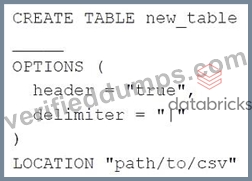
Which of the following lines of code fills in the above blank to successfully complete the task?
- A. USING CSV
- B. FROM "path/to/csv"
- C. FROM CSV
- D. None of these lines of code are needed to successfully complete the task
- E. USING DELTA
Answer: B
Explanation:
A data lakehouse is a new paradigm that can be used to simplify and unify siloed data architectures that are specialized for specific use cases. A data lakehouse combines the best of both data lakes and data warehouses, providing a single platform that supports diverse data types, open standards, low-cost storage, high-performance queries, ACID transactions, schema enforcement, and governance. A data lakehouse enables data engineers to build reliable and scalable data pipelines that can serve various downstream applications and users, such as data science, machine learning, analytics, and reporting. A data lakehouse leverages the power of Delta Lake, a storage layer that brings reliability and performance to data lakes. Reference: What is a data lakehouse?, Delta Lake, Lakehouse: A New Generation of Open Platforms that Unify Data Warehousing and Advanced Analytics
NEW QUESTION # 44
A data engineering team has noticed that their Databricks SQL queries are running too slowly when they are submitted to a non-running SQL endpoint. The data engineering team wants this issue to be resolved.
Which of the following approaches can the team use to reduce the time it takes to return results in this scenario?
- A. They can increase the cluster size of the SQL endpoint.
- B. They can turn on the Auto Stop feature for the SQL endpoint.
- C. They can turn on the Serverless feature for the SQL endpoint.
- D. They can turn on the Serverless feature for the SQL endpoint and change the Spot Instance Policy to
"Reliability Optimized." - E. They can increase the maximum bound of the SQL endpoint's scaling range
Answer: A
Explanation:
Explanation
https://www.databricks.com/blog/2022/03/10/top-5-databricks-performance-tips.html
NEW QUESTION # 45
A data engineer is designing a data pipeline. The source system generates files in a shared directory that is also used by other processes. As a result, the files should be kept as is and will accumulate in the directory. The data engineer needs to identify which files are new since the previous run in the pipeline, and set up the pipeline to only ingest those new files with each run.
Which of the following tools can the data engineer use to solve this problem?
- A. Databricks SQL
- B. Delta Lake
- C. Unity Catalog
- D. Auto Loader
- E. Data Explorer
Answer: D
NEW QUESTION # 46
......
The Databricks Databricks-Certified-Data-Engineer-Associate exam consists of 60 multiple-choice questions that must be completed in 90 minutes. The passing score for the exam is 70%, and candidates who pass the exam will receive a certificate that validates their knowledge and expertise in Databricks. Databricks Certified Data Engineer Associate Exam certification is recognized globally and is a valuable asset for data engineers who want to advance their careers and demonstrate their proficiency in Databricks.
Ultimate Databricks-Certified-Data-Engineer-Associate Guide to Prepare Free Latest Databricks Practice Tests Dumps: https://www.verifieddumps.com/Databricks-Certified-Data-Engineer-Associate-valid-exam-braindumps.html
