

Easily To Pass New Microsoft DP-700 Dumps with 112 Questions
Latest DP-700 Study Guides 2025 - With Test Engine PDF
Microsoft DP-700 Exam Syllabus Topics:
| Topic | Details |
|---|---|
| Topic 1 |
|
| Topic 2 |
|
| Topic 3 |
|
NEW QUESTION # 33
You have three users named User1, User2, and User3.
You have the Fabric workspaces shown in the following table.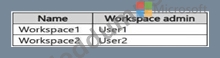
You have a security group named Group1 that contains User1 and User3.
The Fabric admin creates the domains shown in the following table.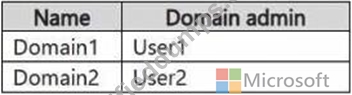
User1 creates a new workspace named Workspace3.
You add Group1 to the default domain of Domain1.
For each of the following statements, select Yes if the statement is true. Otherwise, select No.
NOTE: Each correct selection is worth one point.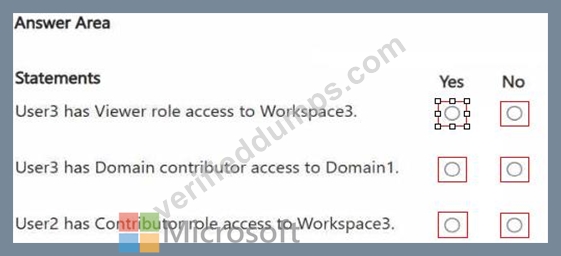
Answer:
Explanation: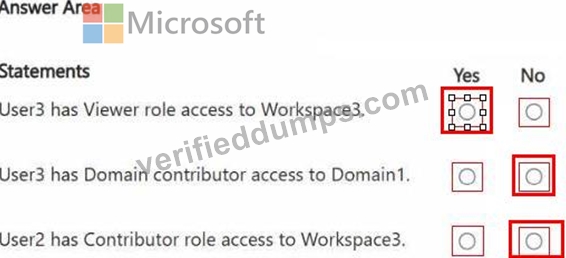
NEW QUESTION # 34
You have three users named User1, User2, and User3.
You have the Fabric workspaces shown in the following table.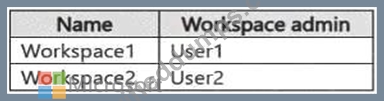
You have a security group named Group1 that contains User1 and User3.
The Fabric admin creates the domains shown in the following table.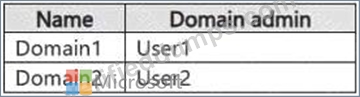
User1 creates a new workspace named Workspace3.
You add Group1 to the default domain of Domain1.
For each of the following statements, select Yes if the statement is true. Otherwise, select No.
NOTE: Each correct selection is worth one point.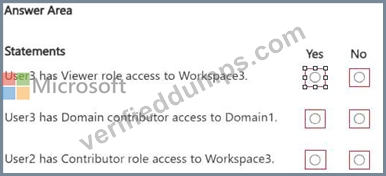
Answer:
Explanation: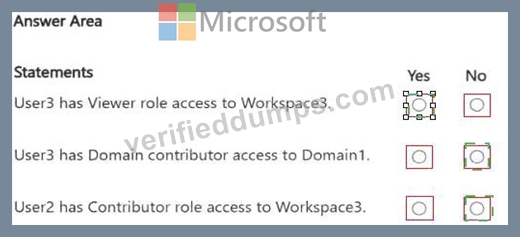
Explanation: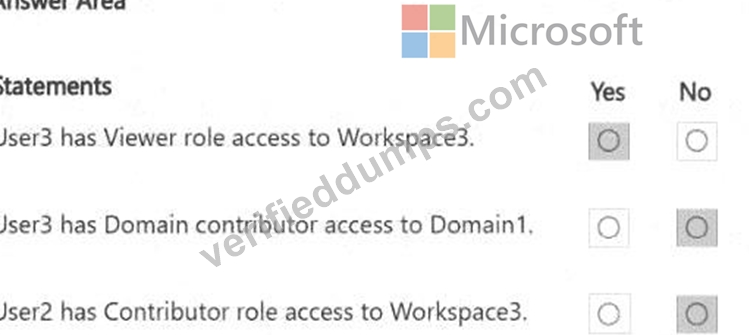
NEW QUESTION # 35
You have a KQL database that contains a table named Readings.
You need to build a KQL query to compare the Meter-Reading value of each row to the previous row base on the ilmestamp value A sample of the expected output is shown in the following table.
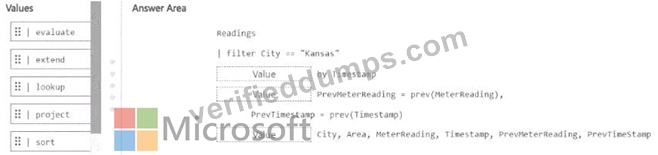
Answer:
Explanation: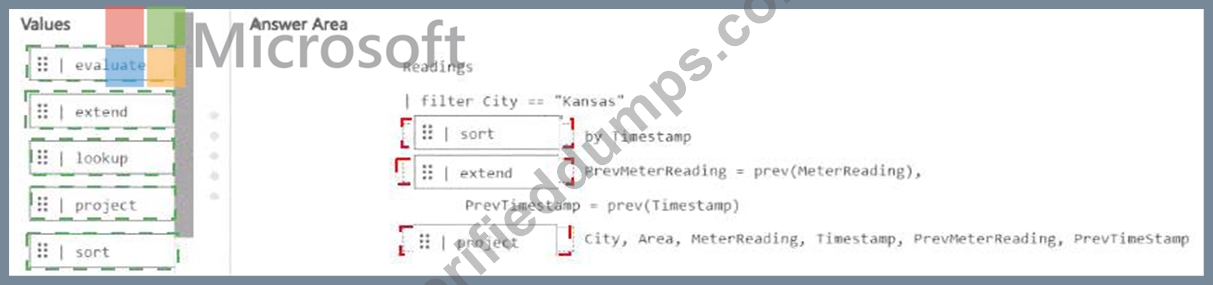
Explanation: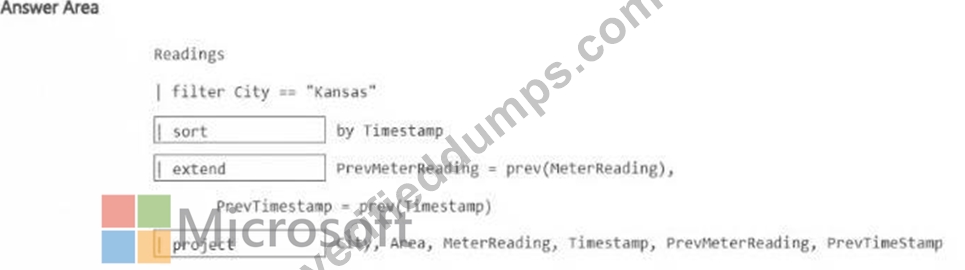
NEW QUESTION # 36
Your company has a sales department that uses two Fabric workspaces named Workspace1 and Workspace2.
The company decides to implement a domain strategy to organize the workspaces.
You need to ensure that a user can perform the following tasks:
Create a new domain for the sales department.
Create two subdomains: one for the east region and one for the west region.
Assign Workspace1 to the east region subdomain.
Assign Workspace2 to the west region subdomain.
The solution must follow the principle of least privilege.
Which role should you assign to the user?
- A. domain admin
- B. workspace Admin
- C. Fabric admin
- D. domain contributor
Answer: A
Explanation:
To implement a domain strategy and manage subdomains within Fabric, the domain admin role is the appropriate role for the user. A domain admin has the permissions necessary to:
Create a new domain (for the sales department).
Create subdomains (for the east and west regions).
Assign workspaces (such as Workspace1 and Workspace2) to the appropriate subdomains.
The domain admin role allows for managing the structure and organization of workspaces in the context of domains and subdomains while maintaining the principle of least privilege by limiting the user's access to managing the domain structure specifically.
NEW QUESTION # 37
You have a Fabric capacity that contains a workspace named Workspace1. Workspace1 contains a lakehouse named Lakehouse1, a data pipeline, a notebook, and several Microsoft Power BI reports.
A user named User1 wants to use SQL to analyze the data in Lakehouse1.
You need to configure access for User1. The solution must meet the following requirements:
What should you do?
- A. Share Lakehouse1 with User1 directly and select Build reports on the default semantic model.
- B. Share Lakehouse1 with User1 directly and select Read all SQL endpoint data.
- C. Assign User1 the Viewer role for Workspace1. Share Lakehouse1 with User1 and select Read all SQL endpoint data.
- D. Assign User1 the Member role for Workspace1. Share Lakehouse1 with User1 and select Read all SQL endpoint data.
Answer: C
Explanation:
To meet the specified requirements for User1, the solution must ensure:
Read access to the table data in Lakehouse1: User1 needs permission to access the data within Lakehouse1. By sharing Lakehouse1 with User1 and selecting the Read all SQL endpoint data option, User1 will be able to query the data via SQL endpoints.
Prevent Apache Spark usage: By sharing the lakehouse directly and selecting the SQL endpoint data option, you specifically enable SQL-based access to the data, preventing User1 from using Apache Spark to query the data.
Prevent access to other items in Workspace1: Assigning User1 the Viewer role for Workspace1 ensures that User1 can only view the shared items (in this case, Lakehouse1), without accessing other resources such as notebooks, pipelines, or Power BI reports within Workspace1.
This approach provides the appropriate level of access while restricting User1 to only the required resources and preventing access to other workspace assets.
NEW QUESTION # 38
You are implementing the following data entities in a Fabric environment:
Entity1: Available in a lakehouse and contains data that will be used as a core organization entity Entity2: Available in a semantic model and contains data that meets organizational standards Entity3: Available in a Microsoft Power BI report and contains data that is ready for sharing and reuse Entity4: Available in a Power BI dashboard and contains approved data for executive-level decision making Your company requires that specific governance processes be implemented for the data.
You need to apply endorsement badges to the entities based on each entity's use case.
Which badge should you apply to each entity? To answer, drag the appropriate badges the correct entities.
Each badge may be used once, more than once, or not at all. You may need to drag the split bar between panes or scroll to view content.
NOTE: Each correct selection is worth one point.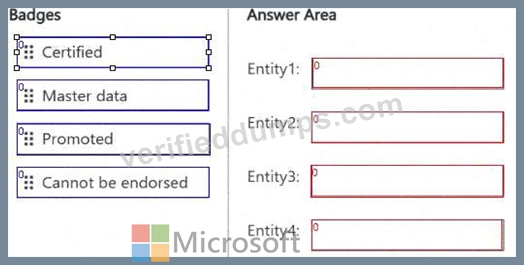
Answer:
Explanation: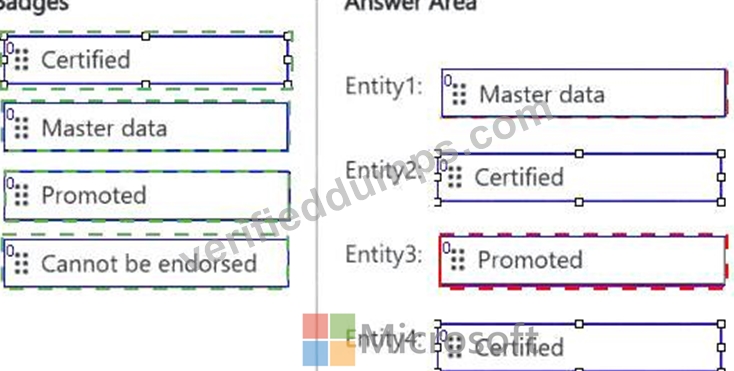
Explanation: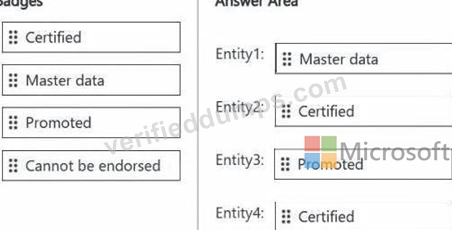
NEW QUESTION # 39
Note: This question is part of a series of questions that present the same scenario. Each question in the series contains a unique solution that might meet the stated goals. Some question sets might have more than one correct solution, while others might not have a correct solution.
After you answer a question in this section, you will NOT be able to return to it. As a result, these questions will not appear in the review screen.
You have a Fabric eventstream that loads data into a table named Bike_Location in a KQL database. The table contains the following columns:
You need to apply transformation and filter logic to prepare the data for consumption. The solution must return data for a neighbourhood named Sands End when No_Bikes is at least 15. The results must be ordered by No_Bikes in ascending order.
Solution: You use the following code segment:
Does this meet the goal?
- A. Yes
- B. no
Answer: A
Explanation:
Filter Condition: It correctly filters rows where Neighbourhood is "Sands End" and No_Bikes is greater than or equal to 15.
Sorting: The sorting is explicitly done by No_Bikes in ascending order using sort by No_Bikes asc.
Projection: It projects the required columns (BikepointID, Street, Neighbourhood, No_Bikes, No_Empty_Docks, Timestamp), which minimizes the data returned for consumption.
NEW QUESTION # 40
You need to ensure that the authors can see only their respective sales data.
How should you complete the statement? To answer, drag the appropriate values the correct targets. Each value may be used once, more than once, or not at all. You may need to drag the split bar between panes or scroll to view content NOTE: Each correct selection is worth one point.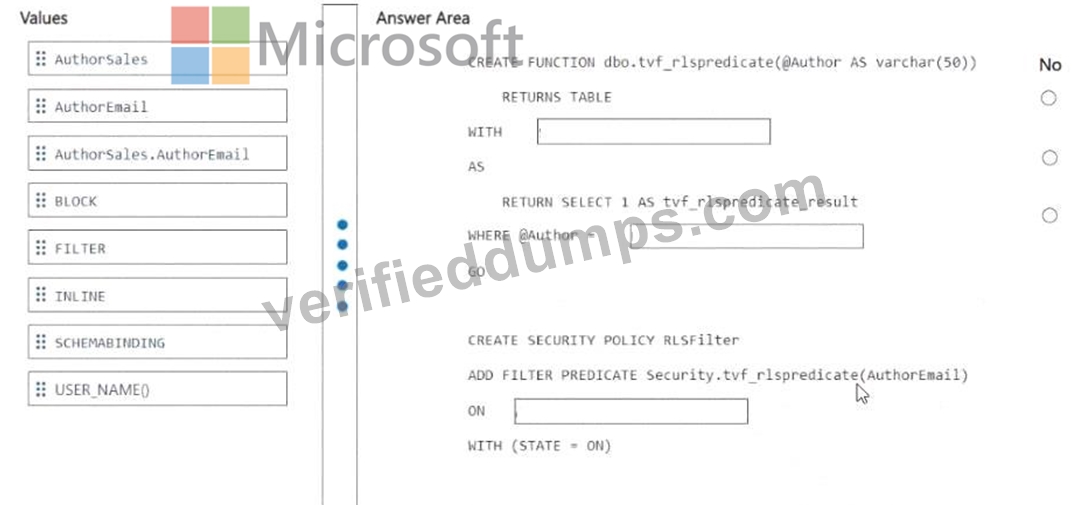
Answer:
Explanation: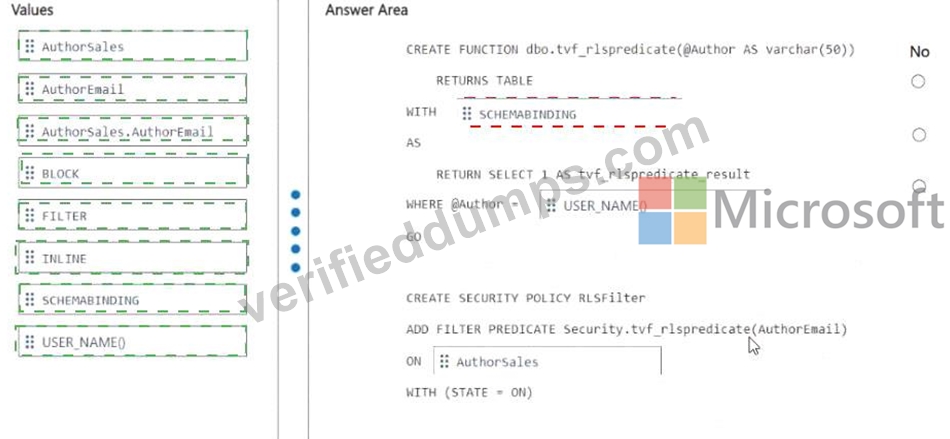
Explanation: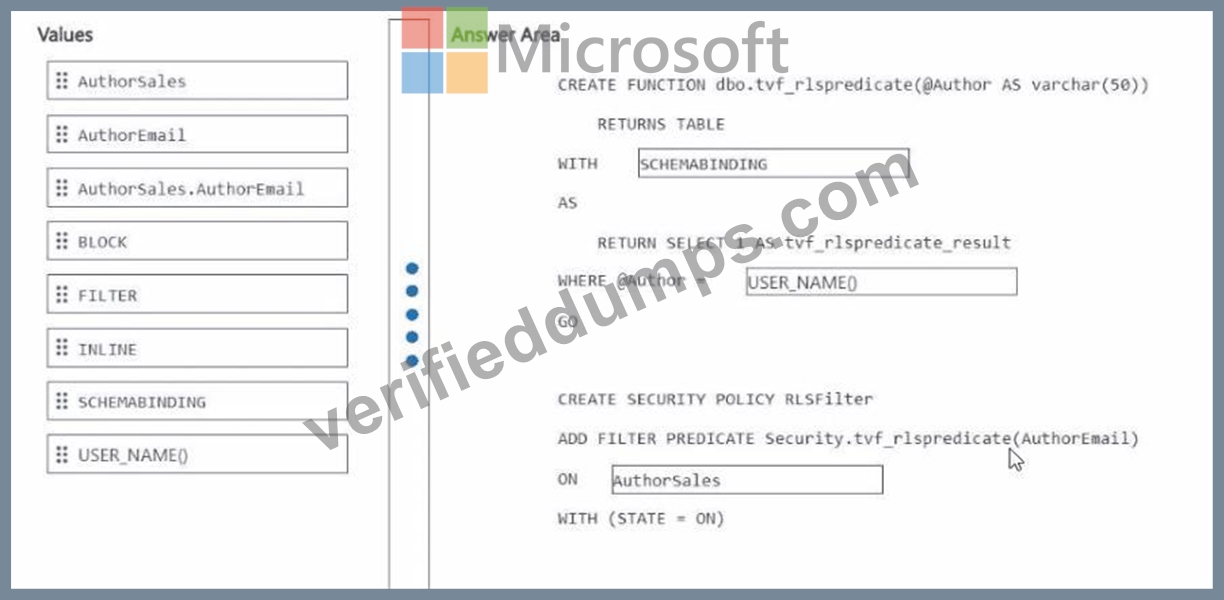
NEW QUESTION # 41
You have a Fabric workspace that contains a warehouse named Warehouse!. Warehousel contains a table named DimCustomers. DimCustomers contains the following columns:
* CustomerName
* CustomerlD
* BirthDate
* Email
You need to configure security to meet the following requirements:
* BirthDate in DimCustomer must be masked and display 1900-01-01.
* Email in DimCustomer must be masked and display only the first leading character and the last five characters.
How should you complete the statement? To answer, select the appropriate options in the answer area. NOTE:
Each correct selection is worth one point.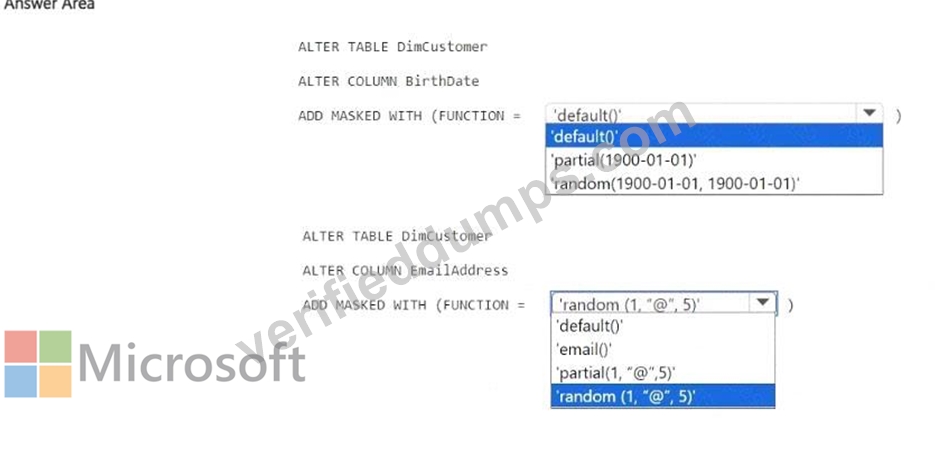
Answer:
Explanation: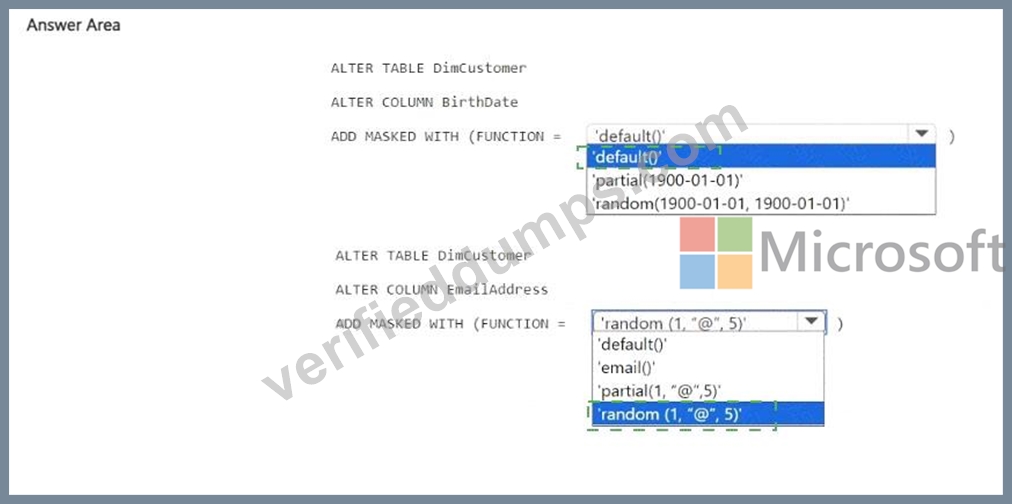
Explanation: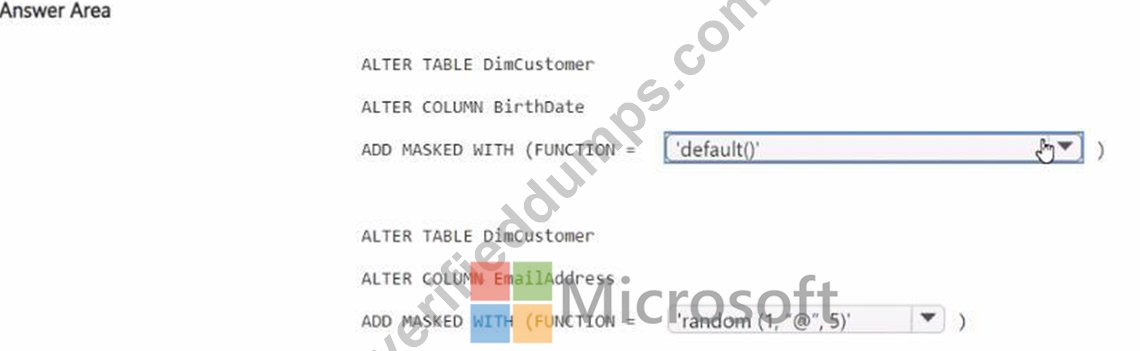
NEW QUESTION # 42
Note: This question is part of a series of questions that present the same scenario. Each question in the series contains a unique solution that might meet the stated goals. Some question sets might have more than one correct solution, while others might not have a correct solution.
After you answer a question in this section, you will NOT be able to return to it. As a result, these questions will not appear in the review screen.
You have a KQL database that contains two tables named Stream and Reference. Stream contains streaming data in the following format.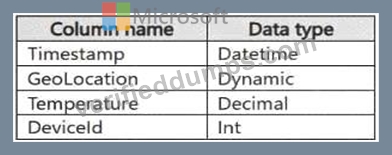
Reference contains reference data in the following format.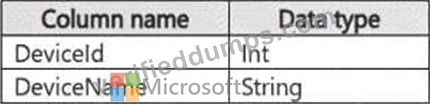
Both tables contain millions of rows.
You have the following KQL queryset.
You need to reduce how long it takes to run the KQL queryset.
Solution: You add the make_list() function to the output columns.
Does this meet the goal?
- A. Yes
- B. No
Answer: B
Explanation:
Adding an aggregation like make_list() would require additional processing and memory, which could make the query slower.
NEW QUESTION # 43
You have a Fabric workspace that contains an eventhouse and a KQL database named Database1. Database1 has the following:
Policy1 sends data from Table1 to Table2.
The following is a sample of the data in Table2.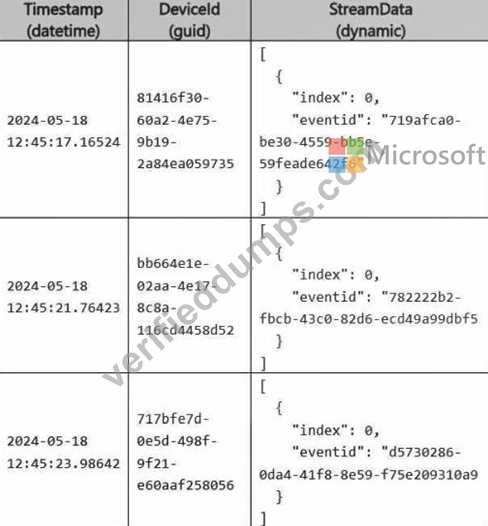
Recently, the following actions were performed on Table1:
You plan to load additional records to Table2.
Which two records will load from Table1 to Table2? Each correct answer presents a complete solution.
NOTE: Each correct selection is worth one point.
- A.

- B.
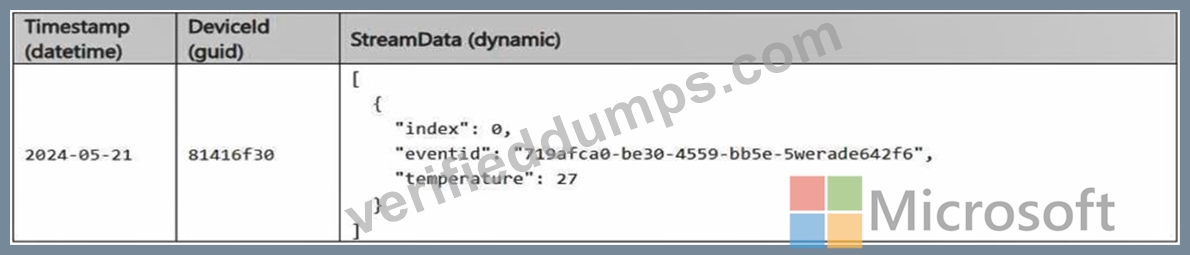
- C.
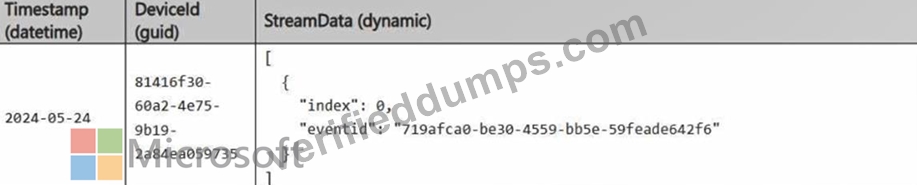
- D.
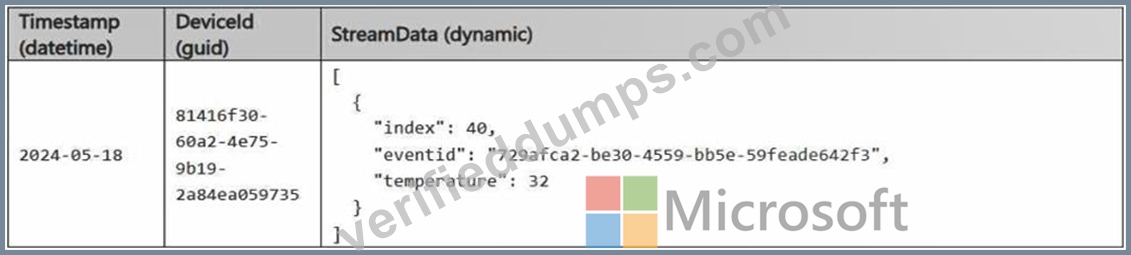
Answer: B,C
Explanation:
Changes to Table1 Structure:
Impact of Changes:
Record B:
Accepted because it fully matches Table2's structure and data types.
Record D:
Accepted because it fully matches Table2's structure and data types.
NEW QUESTION # 44
You have a Fabric workspace that contains a Real-Time Intelligence solution and an eventhouse.
Users report that from OneLake file explorer, they cannot see the data from the eventhouse.
You enable OneLake availability for the eventhouse.
What will be copied to OneLake?
- A. only data added to new databases that are added to the eventhouse
- B. both new data and existing data in the eventhouse
- C. only new data added to the eventhouse
- D. only the existing data in the eventhouse
- E. no data
Answer: C
Explanation:
When you enable OneLake availability for an eventhouse, both new and existing data in the eventhouse will be copied to OneLake. This feature ensures that data, whether newly ingested or already present, becomes available for access through OneLake, making it easier for users to interact with and explore the data directly from OneLake file explorer.
NEW QUESTION # 45
You need to ensure that the data engineers are notified if any step in populating the lakehouses fails. The solution must meet the technical requirements and minimize development effort.
What should you use? To answer, select the appropriate options in the answer area.
NOTE: Each correct selection is worth one point.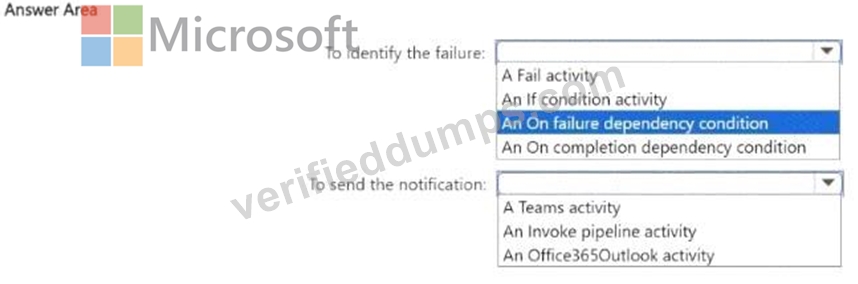
Answer:
Explanation: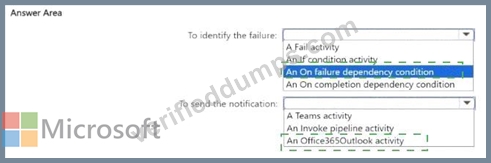
Explanation:
NEW QUESTION # 46
Exhibit.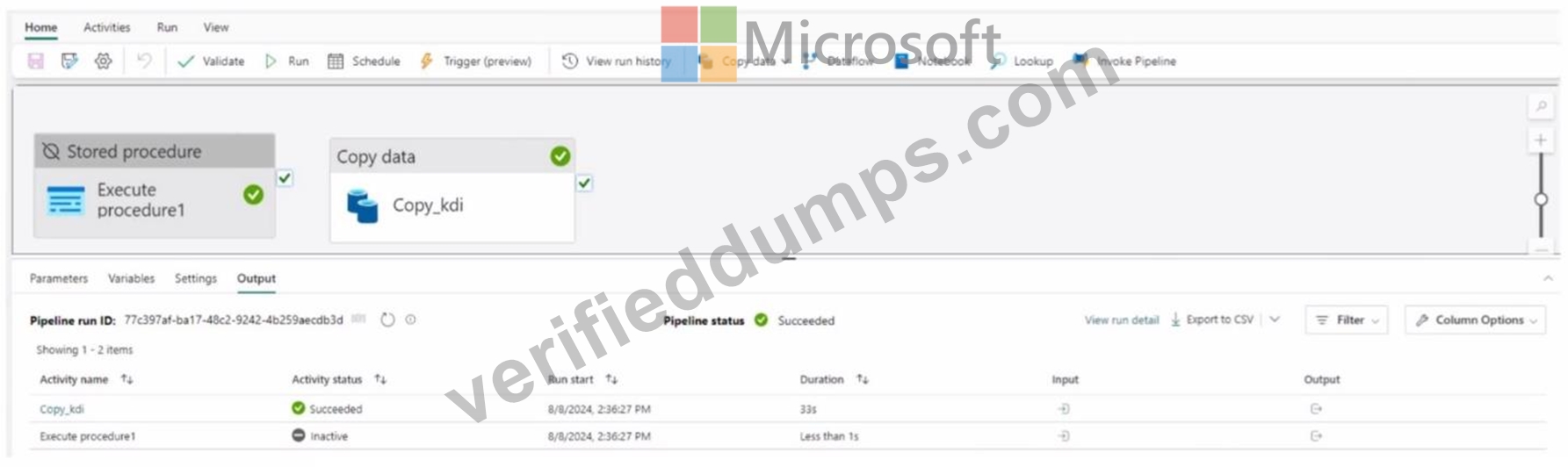
You have a Fabric workspace that contains a write-intensive warehouse named DW1. DW1 stores staging tables that are used to load a dimensional model. The tables are often read once, dropped, and then recreated to process new data.
You need to minimize the load time of DW1.
What should you do?
- A. Drop statistics.
- B. Enable V-O-der.
- C. Create statistics.
- D. Disable V-Order.
Answer: A
NEW QUESTION # 47
You have a Fabric workspace that contains a semantic model named Model1.
You need to dynamically execute and monitor the refresh progress of Model1.
What should you use?
- A. dynamic management views in Azure Data Studio
- B. dynamic management views in Microsoft SQL Server Management Studio
- C. Monitoring hub
- D. a semantic link in a notebook
Answer: D
Explanation:
Semantic models in Microsoft Fabric are part of Power BI datasets and require refreshes to stay updated with the latest data.
Dynamically executing and monitoring the refresh progress requires a tool or approach that integrates with Fabric's capabilities for semantic models.
NEW QUESTION # 48
HOTSPOT
You have a Fabric workspace that contains a warehouse named Warehouse1. Warehouse1 contains the following tables and columns.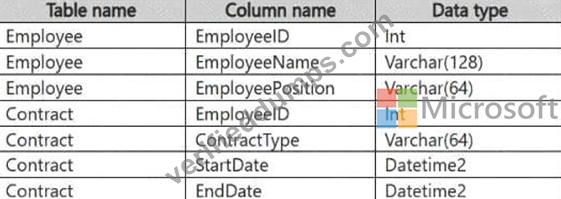
You need to denormalize the tables and include the ContractType and StartDate columns in the Employee table. The solution must meet the following requirements:
Ensure that the StartDate column is of the date data type.
Ensure that all the rows from the Employee table are preserved and include any matching rows from the Contract table.
Ensure that the result set displays the total number of employees per contract type for all the contract types that have more than two employees.
How should you complete the statement? To answer, select the appropriate options in the answer area.
NOTE: Each correct selection is worth one point.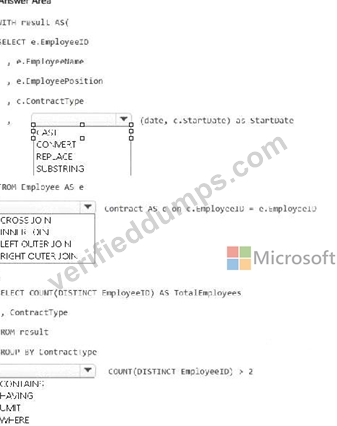
Answer:
Explanation: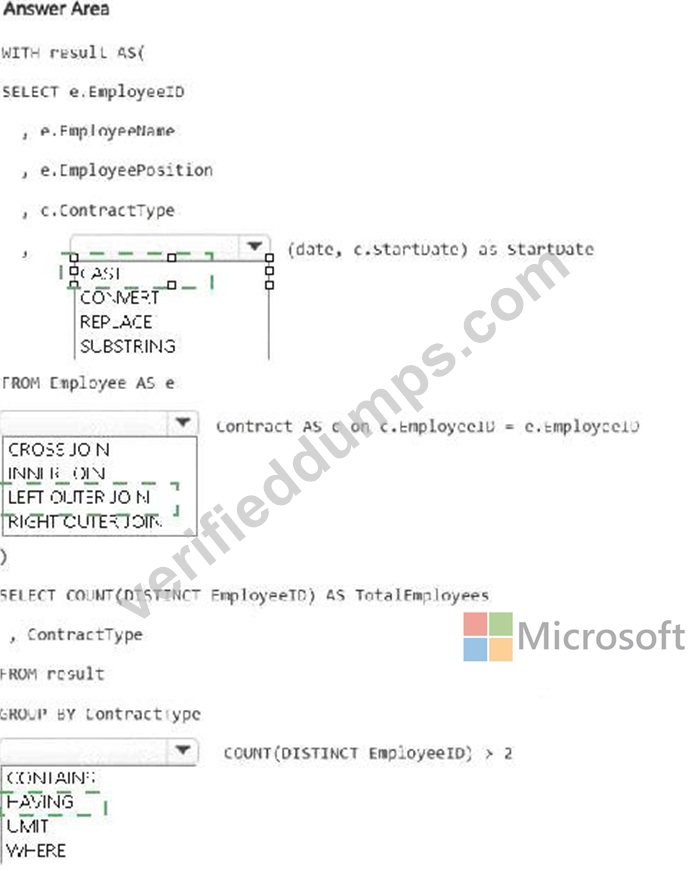
Explanation: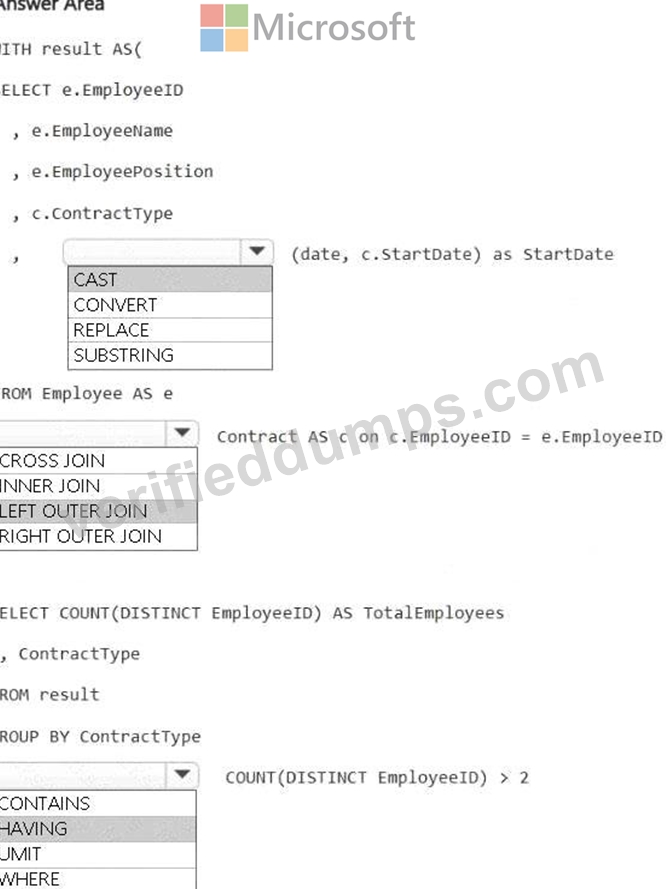
NEW QUESTION # 49
......
DP-700 Dumps and Exam Test Engine: https://www.verifieddumps.com/DP-700-valid-exam-braindumps.html
Get New DP-700 Practice Test Questions Answers: https://drive.google.com/open?id=1KiJiri-JbQZZxK07Ev4G49_Mo132BHDh
