

L5M5 Certification – Valid Exam Dumps Questions Study Guide! (Updated 91 Questions)
L5M5 Dumps are Available for Instant Access using VerifiedDumps
NEW QUESTION # 13
Which of the following standards is applicable to governments rather than private businesses?
- A. SA8000
- B. ILO Fundamental Principles of Human Rights
- C. UN Global Compact
- D. OECD Guidelines for MNEs
Answer: B
Explanation:
Comprehensive and Detailed Explanation From Exact Extract of Documents:
The ILO Fundamental Principles of Human Rights apply to governments, as ILO conventions must be ratified and enforced at the national level. The L5M5 study guide (p.271) contrasts this with frameworks aimed at businesses: UN Global Compact (A), SA8000 (C), and OECD Guidelines for Multinational Enterprises (D). Governments are responsible for implementing and enforcing ILO standards, while businesses align with other voluntary or certification frameworks. Procurement professionals must understand which standards apply to suppliers and which are obligations for governments when working internationally.
Reference: Managing Ethical Procurement and Supply (L5M5) Study Guide, p.271
NEW QUESTION # 14
A large retail chain, HyperMart, sources products from multiple suppliers, each specializing in different categories such as electronics, clothing, and groceries. To maintain a diverse selection, HyperMart has contracts with multiple suppliers for each product category. At the same time, these suppliers serve various large retailers and are not solely dependent on HyperMart for their sales.
In this scenario, how does the mutual independence between HyperMart and its suppliers illustrate the dynamics of the power dominance model?
- A. HyperMart has significant power over suppliers due to its large purchasing volume
- B. The dependence of HyperMart on suppliers for critical products increases supplier power
- C. Both HyperMart and its suppliers operate independently without significant power over each other
- D. Suppliers hold power over HyperMart because they provide unique products that are difficult to substitute
Answer: C
Explanation:
In this scenario, both HyperMart and its suppliers operate independently. HyperMart has multiple suppliers to choose from, limiting any single supplier's influence. Likewise, suppliers serve multiple large retailers, including HyperMart, preventing dependency on a single customer. This mutual independence creates a balanced power dynamic, where neither party holds significant control over the other.
Thus, the correct answer is Option C.
Reference:
LO-1.4; Page 128-129; Responsible use of power relationships
NEW QUESTION # 15
In 1999, the UN launched the Global Compact, a principle-based framework for sustainable business. Which of the following areas are covered by the Global Compact? Select THREE
- A. Human rights
- B. Anti-corruption
- C. Racism
- D. Environment
- E. Minimum wage
Answer: A,B,D
Explanation:
Comprehensive and Detailed Explanation From Exact Extract of Documents:
The UN Global Compact is based on ten principles derived from UN declarations. According to the L5M5 study guide (p.249), the areas covered are: human rights (A), labour standards, environment (B), and anti-corruption (C). "Racism" (D) is not listed specifically; instead, the Compact addresses non-discrimination as part of labour rights. "Minimum wage" (E) is not a universal standard in the Compact, though labour standards cover fair conditions of work. Procurement professionals should align supply strategies with these principles to support global sustainability and ethical practice.
Reference: Managing Ethical Procurement and Supply (L5M5) Study Guide, p.249
NEW QUESTION # 16
What are the two ways an item can be labelled as "Fair Trade" by the WFTO? Select TWO
- A. Manufacturer route
- B. Product certification route
- C. Integrated supply chain route
- D. Audit route
Answer: B,C
Explanation:
Comprehensive and Detailed Explanation From Exact Extract of Documents:
The World Fair Trade Organisation (WFTO) recognises Fair Trade items through either the product certification route (A), where only the product is certified, or the integrated supply chain route (C), where the entire supply chain is Fair Trade compliant. The L5M5 study guide (old p.223, new p.300) emphasises that these approaches provide flexibility for businesses while ensuring ethical standards are upheld. Manufacturer route (B) and audit route (D) are not official WFTO pathways. Procurement professionals should understand these routes when sourcing ethically certified goods.
Reference: Managing Ethical Procurement and Supply (L5M5) Study Guide, p.300
NEW QUESTION # 17
ABC Construction is in a contract with DEF Developers to deliver 40 houses. The contract includes a "Payment is of the Essence" clause. DEF fails to pay for completed work. ABC stops work. Are they allowed to do this?
- A. No - as long as payment is made eventually, ABC must keep working
- B. Yes - ABC have the right to stop work as non-payment is a breach of contract
- C. No - the contract has not been completed, so ABC must continue working
- D. Yes - it is a legal requirement to pay construction firms regularly
Answer: B
Explanation:
Comprehensive and Detailed Explanation From Exact Extract of Documents:
The correct answer is Yes, ABC can stop work. The L5M5 study guide (p.189) explains that where a clause states "of the essence," it means the condition is fundamental to the contract. Non-payment under a "Payment is of the Essence" clause is considered a material breach of contract. This allows the injured party (ABC) to terminate the agreement and/or claim damages. In construction contracts, timely payments are essential because they enable contractors to pay subcontractors. Historically, "pay when paid" clauses caused major problems for smaller firms, leading to reforms and the introduction of stricter "essence" clauses to protect them. Thus, DEF Developers' failure to pay entitles ABC to stop work legally.
Reference: Managing Ethical Procurement and Supply (L5M5) Study Guide, p.189
NEW QUESTION # 18
Liam, a Procurement Officer at Zenith Corp, oversees a contract with Apex Supplies, a key supplier of essential manufacturing components. After identifying a critical issue in Apex Supplies' delivery process, which TWO documents should Liam complete?
- A. Corrective Action Plan and SWOT Analysis
- B. KPI's and Root Cause Analysis
- C. SWOT Analysis and KPIs
- D. Root Cause Analysis and Corrective Action Plan
Answer: D
Explanation:
Choice B- Root Cause Analysis (RCA):This document identifies the underlying reasons for the issue in Spades Ltd's conduct. Conducting a thorough RCA ensures Ruby understands the cause of the problem, enabling effective solutions.
Incorrect answer:
Choice A- While Key Performance Indicators (KPIs) are useful for tracking performance, they do not directly address or resolve specific issues..
Corrective Action Plan (CAP): Once the root cause is identified, a CAP outlines specific steps Spades Ltd must take to address and resolve the issue. It also ensures that measures are put in place to prevent recurrence. Therefore option B is the answer.
Choice C- A SWOT analysis is more strategic, focusing on strengths, weaknesses, opportunities, and threats, rather than resolving specific conduct issues.
Choice D- Neither of these documents directly addresses identifying or fixing a conduct issue.
Reference:
LO-2.2; Page 202-203; Methods to correct non-compliance and create and monitor action plans
NEW QUESTION # 19
Which of the following is a requirement for an Environmental Management System (EMS) according to ISO 14001?
- A. Setting recycling targets
- B. An environmental policy statement
- C. A sustainability policy statement
- D. Periodic reviews conducted by external auditors
Answer: B
Explanation:
Choice B - Under ISO 14001: Environmental Management System (EMS), an organization is required to establish, implement, and maintain an environmental policy statement that reflects its commitment to environmental protection, regulatory compliance, and continuous improvement.
Incorrect answer:
Choice A - While sustainability is important, ISO 14001 specifically requires an environmental policy statement, not a sustainability policy. Sustainability encompasses a broader scope, including social and economic factors, whereas ISO 14001 focuses primarily on environmental aspects.
Choice C - ISO 14001 does not mandate specific recycling targets. Instead, it requires organizations to identify their environmental aspects and impacts, set environmental objectives, and develop action plans. Recycling may be one of the objectives, but it is not a mandatory requirement.
Choice D- While ISO 14001 requires periodic reviews (such as internal audits and management reviews), external audits are not mandatory unless the organization seeks ISO 14001 certification. Certification audits are conducted by third-party auditors, but internal audits and management reviews are the primary monitoring mechanisms required by the standard.
Reference:
LO-3.2; Page 284-285; Role of industry standards and frameworks used by organizations in securing ESG considerations and ethical standards
NEW QUESTION # 20
As a procurement manager with a focus on sustainability, your objective is to develop KPIs that assess the environmental impact of your suppliers and demonstrate their commitment to eco-friendly practices. What key performance indicators would be most effective in measuring these impacts?
- A. The ratio of recycled materials used in production versus virgin materials
- B. The percentage of shipments that are damaged during transit
- C. The total number of products the supplier offers
- D. The average response time to customer complaints
Answer: A
Explanation:
Choice A- This KPI directly measures the supplier's commitment to sustainability and their environmental impact by indicating how much they are utilizing recycled resources compared to new materials. The other options do not effectively reflect environmental practices.
Incorrect answer:
Choice B- This KPI measures the breadth of the supplier's offerings but does not provide any insight into their environmental practices or sustainability. A supplier could offer many products without any of them being eco-friendly.
Choice C- While important for customer service and supplier responsiveness, this KPI does not relate to environmental impact. A fast response time does not necessarily mean that the supplier is following sustainable practices.
Choice D- This metric focuses on logistics and supply chain efficiency rather than environmental sustainability. Although reducing damaged shipments can have some indirect environmental benefits, it doesn't directly measure the supplier's environmental practices or commitment to sustainability.
Reference:
LO-1.1; Page 16; The role of environmental considerations in securing ethical and sustainable procurement and supply arrangements
NEW QUESTION # 21
A retail company has recently faced supply chain fraud, including counterfeit products and inflated invoices from suppliers. To enhance its fraud prevention measures, the management team is considering various strategies. Which of the following would be the most effective approach to mitigating supply chain fraud?
- A. Establish a Diverse Supply Chain
- B. Keep Up to Date with Legislation
- C. Due Diligence on Suppliers
- D. Fact-Finding Questionnaires
Answer: C
Explanation:
Choice D- This is the correct option. Due diligence refers to the comprehensive assessment and verification of suppliers' backgrounds, financial health, and compliance with ethical standards. This includes checking for certifications, conducting audits, and evaluating their business practices. By thoroughly vetting suppliers, companies can significantly reduce the risk of partnering with those involved in fraudulent activities, making this the most direct and effective strategy against fraud.
Incorrect answer:
Choice A- Establishing a diverse supply chain involves engaging multiple suppliers across different regions and sectors. This approach reduces reliance on any single supplier, making it harder for fraudulent activities to go unnoticed. However, while diversification can reduce risk, it does not directly address the verification of supplier integrity or prevent fraud at individual supplier levels.
Choice B- Staying informed about relevant laws and regulations is crucial for compliance and avoiding legal issues. While this can help protect a company from legal repercussions related to fraud, it does not inherently prevent fraud itself. It's more about ensuring that the company operates within legal boundaries rather than directly addressing fraudulent practices.
Choice C- Fact-finding questionnaires are tools used to gather information from suppliers regarding their operations, risk management, and compliance measures. While this can provide insights into a supplier's practices and help identify potential risks, it may not be as thorough or effective as direct due diligence efforts. Suppliers might provide misleading information, so this method should complement more rigorous vetting processes.
Reference:
LO-1.1; Page 51; Issues impacting ethical and sustainable procurement and supply: modern slavery, bribery, corruption, fraud and human rights infringements
NEW QUESTION # 22
Which of the following form the 'Triple Bottom Line'? Select THREE
- A. People
- B. Planet
- C. Profit
- D. Product
- E. Placement
Answer: A,B,C
Explanation:
Comprehensive and Detailed Explanation From Exact Extract of Documents:
The concept of the Triple Bottom Line (TBL), also referred to as the "3Ps," is a framework that assesses organisational success through People, Planet, and Profit. These dimensions highlight the balance between social equity (people), environmental stewardship (planet), and economic performance (profit). According to the CIPS L5M5 study guide (p.3), procurement and supply professionals are expected to incorporate sustainability into decision-making processes, ensuring that business practices do not only create economic value but also deliver positive social and environmental impacts. "Product" and "Placement" are not part of the TBL model, as they are marketing-related concepts, not sustainability measures. This principle ensures procurement strategies align with corporate responsibility and long-term sustainable growth.
Reference: Managing Ethical Procurement and Supply (L5M5) Study Guide, p.3
NEW QUESTION # 23
The main aim of the ILO is to promote rights at work and improve social protection. Is this TRUE?
- A. Yes - the ILO sets trade rules between nations
- B. No - the purpose of the ILO is to increase international trade
- C. No - the ILO was formed in 1975 to encourage globalisation
- D. Yes - the ILO is an agency of the UN which deals with labour problems
Answer: D
Explanation:
Comprehensive and Detailed Explanation From Exact Extract of Documents:
The International Labour Organisation (ILO) is a specialised UN agency founded in 1919 to promote labour rights and improve social protection. The L5M5 study guide (p.87) confirms that the ILO's mission includes eliminating child labour, eradicating forced labour, and promoting fair wages and safe workplaces. It does not set trade rules (that is the WTO), nor was it created to drive globalisation. For procurement professionals, understanding the ILO is critical when assessing supplier practices against international labour standards, especially in global supply chains.
Reference: Managing Ethical Procurement and Supply (L5M5) Study Guide, p.87
NEW QUESTION # 24
Nahid Cotton Mills Ltd, a leading manufacturer and exporter of high-quality knitting and cotton yarn in Bangladesh, aims to expand internationally and grow its global market to increase profits. The STEEPLED analysis tool can help assess various macro-environmental factors affecting the business. Which of the following factors fall under the social element of this analysis?
- A. Level of corruption and bribery present
- B. Inflation and interest rates
- C. Waste management initiatives
- D. Fashion and trends led by local celebrities
Answer: D
Explanation: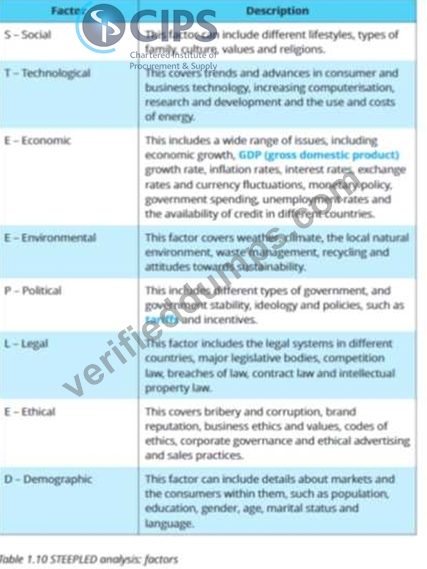
Choice A- Waste management initiatives is an Environmental factor. Choice B- Fashion and trend led by celebrities is a social factor as a it includes different lifestyles, types of family, culture, values and religions. Therefore is the correct answer. Choice C- Is an economic factor. Choice D- Corruption and bribery is a part of government idealogy and policies thus is a political factor. Reference: LO-1.2; Page 55; Use of STEEPLED analysis to explain the factors driving globalization
NEW QUESTION # 25
McKesson is a leading healthcare company specializing in wholesale medical supplies and equipment, pharmaceutical distribution, and healthcare technology solutions. Recently, public hospitals placed an urgent request for medical supplies. Which of the following is NOT a method for identifying urgent orders?
- A. Establish economic order quantities (EOQ) based on profit margins
- B. Identify strategically important customers and leverage goodwill for commercial renegotiations
- C. Develop a standardized order policy to manage urgent requests, including appropriate cost allocation
- D. Assess supply chain capability
Answer: A
Explanation:
The correct answer is Option B. A company should establish a minimum order quantity (MOQ) rather than an economic order quantity (EOQ) based on profit margin. MOQ is the minimum order amount set by a supplier or retailer, whereas EOQ determines the optimal order quantity to meet customer demand while minimizing holding and ordering costs.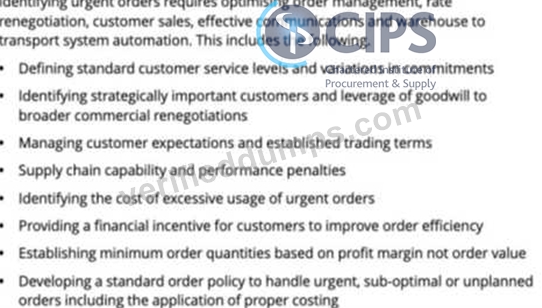
Reference: LO-1.4; Page 113; Demand Management and the need for urgent orders
NEW QUESTION # 26
A company frequently ships high-value goods internationally, and the logistics team identifies a significant risk of financial loss due to potential cargo theft or damage during transit. To mitigate this risk, the company hires an external freight forwarder who provides insurance coverage and assumes full responsibility for the goods while in transit.
What is the most appropriate risk management strategy in this scenario?
- A. Treat
- B. Tolerate
- C. Transfer
- D. Terminate
Answer: C
Explanation:
Option B- By hiring the external freight forwarder with insurance coverage, the company shifts the responsibility and potential financial loss to a third party. Thus, the correct answer is B.
Incorrect answer:
Option A- "Treat" involves taking action to mitigate the risk internally. For example, the company could implement its own security measures, such as using GPS tracking, enhanced packaging, or employing in-house logistics staff. In this scenario, the company is not mitigating the risk itself but instead transferring the responsibility to the freight forwarder.
Option C- The risk of theft or damage is significant in this scenario, and ignoring it would likely result in substantial financial losses. Hence, tolerating the risk is not a viable strategy.
Option D- Terminating the activity is not practical for the business, as shipping goods internationally is likely critical to operations. Instead, transferring the risk to the freight forwarder is a more reasonable approach.
Reference:
LO-2.1; Page 166; Use of risk mitigation strategies to achieve ESG objectives to secure ethical and sustainable procurement and supply arrangements
NEW QUESTION # 27
The Payra 1320MW Thermal Power Plant, one of the largest power producers in Bangladesh, recently halted production due to worker strikes over poor working conditions. This situation is a consequence of which of the following?
- A. Human rights
- B. Corruption
- C. Fraud
- D. Bribery
Answer: A
Explanation: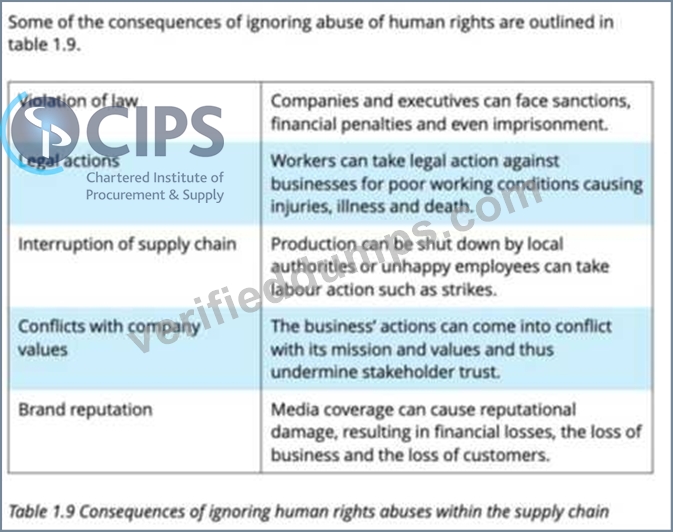
Choice A is the answer as we can see from above interruption of supply chain is a consequence of human rights abuse. The other factors are not directly related to production stoppage due to poor working conditions. Reference: LO-1.1; Page 52; Issues impacting ethical and sustainable procurement and supply: modern slavery, bribery, corruption, fraud and human rights infringements
NEW QUESTION # 28
Which of the following ISO standards relates to Environmental Management Systems?
- A. ISO31000
- B. ISO28000
- C. ISO9001
- D. ISO14001
Answer: D
Explanation:
Comprehensive and Detailed Explanation From Exact Extract of Documents:
ISO14001 is the international standard for Environmental Management Systems (EMS). The L5M5 study guide (p.277) explains that it requires organisations to establish frameworks for monitoring and improving their environmental impact. ISO9001 (A) relates to quality management, ISO28000 (C) to supply chain security, and ISO31000 (D) to risk management. For procurement, suppliers certified with ISO14001 demonstrate a commitment to reducing waste, emissions, and environmental risks, making this highly relevant to CSR and ESG.
Reference: Managing Ethical Procurement and Supply (L5M5) Study Guide, p.277
NEW QUESTION # 29
EcoSmart Solutions, a company specializing in sustainable construction materials, intends to make a sustainability claim for their product. They are aware of the ISEAL Alliance's guidelines for valid sustainability claims. Which of the following would be considered a valid sustainability claim according to ISEAL Alliance standards?
- A. The product claims to improve sustainability, but the claims are solely based on anecdotal evidence and not on any recognized environmental criteria or certification
- B. The product is marketed as "eco-friendly" based on internal environmental policies without any external certification
- C. The product reduces carbon emissions, but the claim is not supported by any third-party audits or verifications
- D. The product is made using 100% recycled materials, with claims verified by third-party certification from a recognized sustainability standard
Answer: D
Explanation:
Choice A- This is the correct answer. According to ISEAL Alliance guidelines, a valid sustainability claim must be supported by third-party certification from a credible and recognized sustainability standard, ensuring the claim is verifiable and transparent.
Incorrect answer:
Choice B- This is not a valid claim under ISEAL guidelines because third-party verification is necessary to substantiate any claims related to carbon emissions.
Choice C- This is not a valid claim under ISEAL guidelines. Claims need to be independently verified, and internal policies alone do not provide credibility to the sustainability claim.
Choice D- This is not a valid claim according to ISEAL standards. Claims should be based on verifiable evidence and supported by recognized sustainability standards.
Reference:
LO-3.2; Page 291; Role of industry standards and frameworks used by organizations in securing ESG considerations and ethical standards and Charter of Fair Trade and implications for procurement and supply
NEW QUESTION # 30
A large electronics company uses third-party audits to ensure supplier compliance with labor standards. However, one supplier has raised concerns about undergoing multiple audits from different buyers, each with varying requirements. The supplier argues that this is diverting resources from making meaningful labor condition improvements.
Which issue is most relevant to the electronics company?
- A. Risk of audit fraud
- B. Box ticking
- C. Audit fatigue
- D. Hidden issues
Answer: C
Explanation:
Option A- The supplier's complaint about being overwhelmed by repeated audits from multiple buyers aligns with the concept of audit fatigue. This issue arises when frequent and overlapping audits burden suppliers, making it harder for them to implement sustainable improvements.
Incorrect answer:
Option B- This refers to a superficial approach to compliance, where suppliers focus on meeting the minimum requirements on paper rather than making meaningful, lasting improvements in working conditions. The scenario focuses on the supplier being overwhelmed by frequent audits, not on them meeting requirements superficially.
Option C- Risk of Audit Fraud arises when suppliers deliberately falsify records, misrepresent practices, or hide non-compliance to pass audits. There's no indication in the scenario that the supplier is misrepresenting their compliance or engaging in fraudulent activities.
Option D- This refers to problems that remain undetected during audits due to ineffective audit processes or deliberate concealment by suppliers. The scenario does not mention undetected issues or gaps in identifying non-compliance; the focus is on the supplier's challenges with repeated audits.
Reference:
LO-3.1; Page 273; Labor codes of conduct: Ethical Trading Initiative (ETI) and Social Accountability International's standard SA8000
NEW QUESTION # 31
A leading coffee retailer has launched an initiative to purchase raw materials, such as coffee beans, directly from farmers instead of through intermediaries like exporters. By adopting a partnership approach and investing in the local community, what is this practice called?
- A. Trade Initiative
- B. World Trade
- C. Fair Trade
- D. Direct Trade
Answer: D
Explanation:
Choice C - The above practice is known as Direct Trade, where the buyer (in this case, the coffee retailer) works directly with the producers (farmers) without intermediaries such as exporters or traders. Direct Trade focuses on building strong relationships, ensuring fairer pricing for farmers, and often includes investments in the local community.
Incorrect answer:
Choice A - World Trade is a broad term that refers to the global exchange of goods and services and does not describe the specific practice of eliminating intermediaries.
Choice B - Fair Trade, while similar in its focus on ethical sourcing, operates under specific certification standards and often involves a governing body overseeing the supply chain.
Choice D- Trade Initiative is a general term and not a recognized practice like Direct Trade or Fair Trade.
Reference:
LO-3.3; Page 309; Fairtrade standards that affect the workplace and producers and their implications for procurement and supply
NEW QUESTION # 32
......
CIPS L5M5 Exam Practice Test Questions: https://www.verifieddumps.com/L5M5-valid-exam-braindumps.html
L5M5 Dumps 2026 - New CIPS L5M5 Exam Questions: https://drive.google.com/open?id=1xqTp6GyBqD8ylWIgrGRGWt2RBoNw5yUE
