

[Mar-2026] Download Real Fortinet NSE5_FSW_AD-7.6 Exam Dumps Test Engine Exam Questions
New NSE5_FSW_AD-7.6 exam dumps Use Updated Fortinet Exam
Fortinet NSE5_FSW_AD-7.6 Exam Syllabus Topics:
| Topic | Details |
|---|---|
| Topic 1 |
|
| Topic 2 |
|
| Topic 3 |
|
| Topic 4 |
|
NEW QUESTION # 48
To enhance service in emergency situations, to which LLDP-MED Type-Length-Values does Forti-Switch advertise to IP phones?
- A. Inventory management
- B. Location
- C. Network policy
- D. Power management
Answer: B
Explanation:
Location (C): FortiSwitch uses LLDP-MED (Link Layer Discovery Protocol - Media Endpoint Discovery) to advertise various attributes to IP phones, among which "Location" is crucial in emergency situations. This information helps emergency responders to determine the physical location of the calling device, which is vital for prompt response in critical situations.
NEW QUESTION # 49
Refer to the diagnostic output: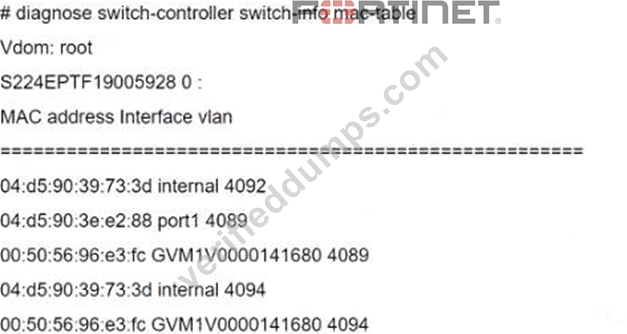
Two entries in the exhibit show that the same MAC address has been used in two different VLANs. Which MAC address is shown in the above output?
- A. It is a MAC address of FortiGate in HA configuration.
- B. It is a MAC address of a switch that accepts multiple VLANs.
- C. It is a MAC address of an upstream FortiSwitch.
- D. It is a MAC address of FortiLink interface on FortiGate.
Answer: B
Explanation:
The MAC address "00:50:56:96:e3:fc" appearing in two different VLANs (4089 and 4094) in the diagnostic output indicates it is a MAC address associated with a device that supports traffic from multiple VLANs.
Such a behavior is typical of network infrastructure devices like switches or routers, which are configured to allow traffic from various VLANs to pass through a single physical or logical interface. This is essential in network designs that utilize VLANs to segregate network traffic for different departments or use cases while using the same physical infrastructure.
References:
For more detailed information on MAC table diagnostics and VLAN configurations in FortiGate devices, refer to the official Fortinet documentation:Fortinet Product Documentation.
NEW QUESTION # 50
Refer to the exhibits.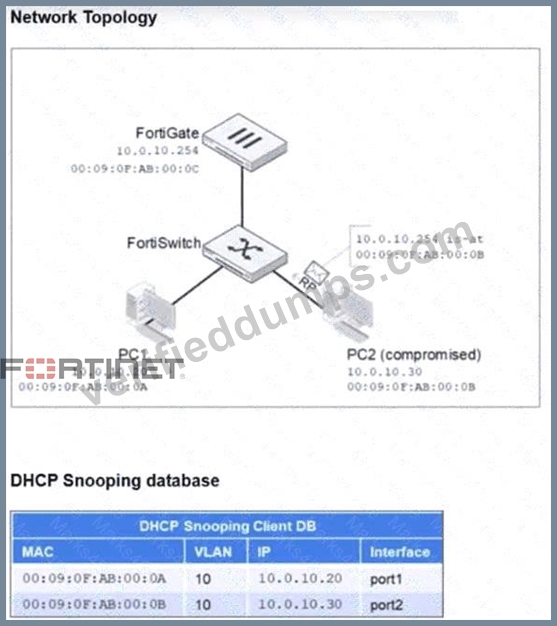
All three FortiSwitch-connected ports are configured in VLAN 10. FortiGate acts as the Dynamic Host Configuration Protocol (DHCP) server and is connected to a DHCP snooping trusted trunk port. PC1 and PC2 are connected to ports configured as untrusted for Dynamic ARP Inspection (DAI), and no static bindings are configured in the IP source guard (IPSG) database. PC2 is compromised and attempts to spoof the FortiGate IP address by sending forged Address Resolution Protocol (ARP) replies with its own MAC address. What will FortiSwitch do with the ARP packets from PC2? (Choose one answer)
- A. Forward the ARP replies because there are no IPSG bindings blocking them.
- B. Accept the ARP replies because the VLAN has DAI enabled and FortiGate is a trusted DHCP server.
- C. Forward the ARP replies to all VLAN 10 ports because DAI is only active on trusted ports.
- D. Drop the ARP replies because they fail DAI validation against the DHCP snooping database.
Answer: D
Explanation:
According to theFortiSwitchOS 7.6 Administration Guideand theFortiSwitch 7.6 Study Guide, Dynamic ARP Inspection (DAI) is a security feature used to intercept, log, and discard ARP packets with invalid IP-to- MAC address bindings. DAI is primarily used to prevent "Man-in-the-Middle" attacks, such as ARP spoofing or ARP cache poisoning.
In this scenario, DAI is active on VLAN 10. When DAI is enabled, the FortiSwitch intercepts all ARP packets on untrusted ports and validates them against a trusted source-most commonly theDHCP snooping database
. As shown in the "DHCP Snooping database" exhibit, PC2 is correctly mapped to IP 10.0.10.30 and MAC 00:
09:0F:AB:00:0B.
When PC2 attempts to send a forged ARP reply claiming that IP 10.0.10.254 (the FortiGate's IP) is located at its own MAC address (00:09:0F:AB:00:0B), the FortiSwitch's DAI engine inspects the packet. It checks the DHCP snooping database for a binding that matches IP 10.0.10.254 to MAC 00:09:0F:AB:00:0B. Finding no such valid entry (because the database correctly identifies the MAC 00:09:0F:AB:00:0B as belonging to IP
10.0.10.30), the switch identifies the ARP packet as illegitimate.
Consequently, the FortiSwitch willdrop the ARP repliesbecause they fail the DAI validation check against the established DHCP snooping bindings. Option A is incorrect as DAI functions independently of IPSG once the database is populated. Option B is incorrect because "accepting" the spoofed packet is the opposite of DAI's purpose. Option C is incorrect because DAI is specifically designed to run on untrusted ports to protect the network from client-side attacks.
NEW QUESTION # 51
What feature can network administrators use to segment network operations and the administration of managed FortiSwitch devices on FortiGate?
- A. FortiLink split interface
- B. Multi-chassis link aggregation trunk
- C. FortiGate clustering protocol
- D. FortiGate multi-tenancy
Answer: D
Explanation:
FortiGate's multi-tenancy feature, specifically Virtual Domains (VDOMs), is the most appropriate tool for segmenting network operations and the administration of managed FortiSwitch devices on FortiGate. Here's why:
* VDOMs as Virtual Firewalls:VDOMs function as independent virtual firewalls within a single FortiGate device. Each VDOM can have its own:
* Security policies
* Interfaces (Including FortiLink interfaces for FortiSwitch management)
* Routing table
* Administrative access
* Segmenting Network Operations:By assigning different FortiSwitch devices (or groups of ports) to separate VDOMs, you effectively partition your network. Network administrators can manage specific FortiSwitches through their assigned VDOMs, maintaining operational isolation.
* Enhanced Administration:VDOMs offer granular administrative control. Different administrators can be assigned to specific VDOMs, limiting their management scope and reducing the risk of accidental configuration changes.
Why Other Options Are Less Suitable:
* B. Multi-chassis link aggregation trunk:This focuses on link redundancy and bandwidth aggregation, not network segmentation.
* C. FortiGate clustering protocol:This is aimed at high availability and scalability of the firewall functions themselves, not the management of switches.
* D. FortiLink split interface:This allows dividing a FortiLink interface on the FortiGate for managing multiple FortiSwitches, but it doesn't provide the true segmentation and administrative isolation that VDOMs offer.
References:
Fortinet Document Library - VDOMs:[invalid URL removed]
Fortinet Document Library - FortiSwitch Multi-tenancy (using VDOMS):https://docs.fortinet.com/document
/fortiswitch/7.4.2/fortilink-guide/801172/multitenancy-and-vdoms
NEW QUESTION # 52
In which two ways can you assign a FortiSwitch port to a VDOM using a multi-tenancy setup? (Choose two answers)
- A. Switch the FortiLink interface to the target VDOM.
- B. Assign the switch port to a VLAN on FortiGate and perform VDOM mapping.
- C. Assign a port to a VDOM directly on the managed FortiSwitch.
- D. Create a virtual port pool on the FortiGate CLI.
Answer: B,D
Explanation:
According to theFortiOS 7.6 Administration Guideand theFortiSwitch 7.6 Study Guide, multi-tenancy in a FortiLink-managed environment allows a central FortiGate to partition a managed FortiSwitch fabric so that different ports can belong to different Virtual Domains (VDOMs). This is essential for Managed Service Providers (MSPs) who need to isolate client traffic at the hardware layer.
The documentation identifies two primary methods for achieving this assignment:
* Assign to a VLAN and Perform VDOM Mapping (Option A):This is the most common method. The administrator creates a VLAN on the FortiLink interface and assigns it to a specific VDOM on the FortiGate. By assigning a physical FortiSwitch port to that specific VLAN, the port's traffic is logically terminated within the target VDOM. TheVDOM mappingensures that the switch-controller identifies which VDOM "owns" the traffic originating from that specific port/VLAN combination.
* Create a Virtual Port Pool (Option B):For more advanced multi-tenancy, administrators can use the FortiGate CLI to create aVirtual Port Pool. This feature allows the FortiGate to "pool" physical switch ports and present them as logical resources that can be distributed across various VDOMs. This method provides greater flexibility in resource allocation without requiring the entire FortiLink interface to be moved.
Regarding the incorrect options:Option Cis incorrect because in a managed environment, the FortiSwitch CLI is not used for VDOM assignments; all orchestration must happen from the FortiGate.Option Dis incorrect because while you can move a FortiLink interface to a VDOM, this would move theentireswitch management and all its ports to that VDOM, which does not support a multi-tenant setup where different ports need to reside in different VDOMs.
NEW QUESTION # 53
Refer to the exhibits.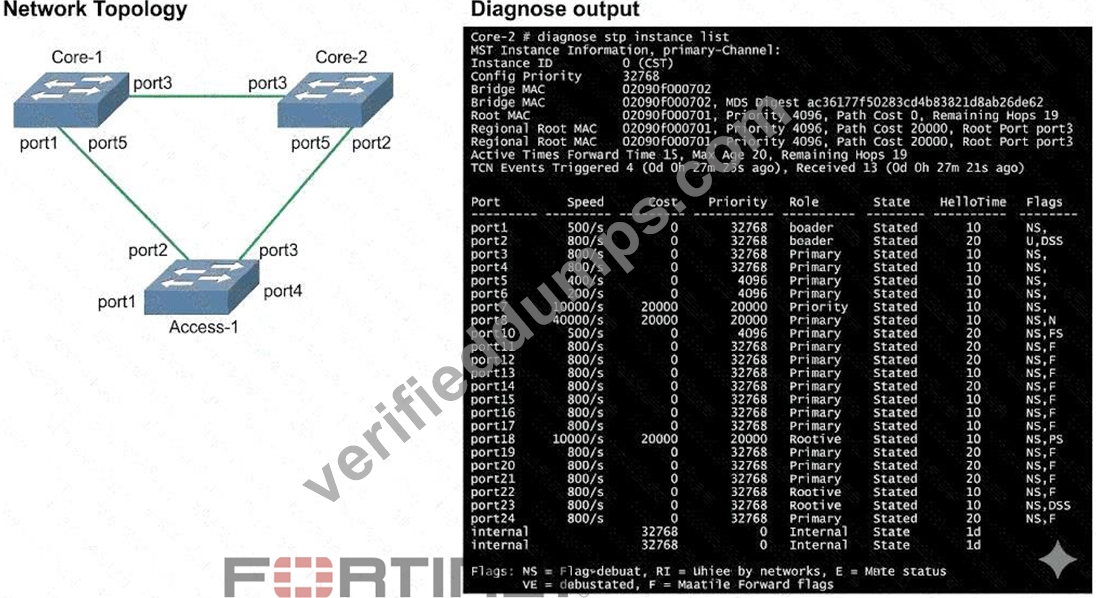
Three FortiSwitch devices in standalone mode are interconnected. The CLI command diagnose stp instance list is executed on Core-2. Based on the output shown in the exhibit, what can you conclude about Core-2?
(Choose one answer)
- A. Core-2 has received Bridge Protocol Data Unit (BPDU) from the root bridge.
- B. Core-2 is the designated bridge for all VLANs.
- C. Core-2 is blocking all ports in the Spanning Tree Protocol (STP) topology.
- D. Core-2 provides an alternate path to the root bridge.
Answer: A
Explanation:
According to theFortiSwitchOS 7.6 Administration Guideand theFortiSwitch 7.6 Study Guide, the output of the diagnose stp instance list command provides critical information about the Spanning Tree Protocol (STP) state of a switch within a given instance. In the provided exhibit, the output forInstance ID 0 (CST)on Core-2shows several key indicators of its role and connectivity within the STP topology.
First, the output explicitly identifies aRootbridge with MAC address 02090f000701 and a priority of 4096.
Core-2 itself has a MAC address of 02090f000702 and a priority of 32768. Because Core-2 knows the MAC address and priority of the Root bridge, it must have received this information viaBridge Protocol Data Units (BPDUs). Furthermore, the port table shows thatport3on Core-2 has been assigned the role ofROOT and is in theFORWARDINGstate. In STP/RSTP, a Root Port is the port on a non-root switch that has the lowest path cost to the root bridge. To elect a Root Port and maintain its state, the switch must continuously receive BPDUs from the root bridge (or a bridge closer to the root) on that port.
Option B is incorrect because Core-2 has aRoot Port, which is only present on non-root bridges. Option C is incorrect because ports 1, 2, 4, 5, and the internal port are all in theFORWARDINGstate. Option D is incorrect as the output does not show any ports in anALTERNATErole; all active ports are either ROOT or DESIGNATED. Therefore, the most accurate conclusion is that Core-2 has successfully received BPDUs to identify the root and determine its own port roles.
NEW QUESTION # 54
(Full question statement start from here)
How does FortiSwitch determine the route for traffic traversing its interfaces? (Choose one answer)
- A. FortiSwitch forwards all traffic to FortiGate for routing decisions.
- B. ASIC hardware routing can handle only dynamic routing, if supported.
- C. Hardware-based routing on FortiSwitch is handled by the CPU.
- D. FortiSwitch looks up the hardware routing table and then the forwarding information base (FIB).
Answer: D
Explanation:
FortiSwitch determines how traffic is routed by leveraging atwo-tier routing lookup mechanismthat prioritizes hardware-based forwarding before software-based processing. According to theFortiSwitchOS 7.6 Administrator Guide, FortiSwitch first checks thehardware routing table, which is populated with a subset of routes installed from the Forwarding Information Base (FIB) and programmed directly into the switch ASIC.
The hardware routing table contains routes that are eligible for ASIC acceleration. When a packet arrives on a FortiSwitch interface, the switch performs a lookup in this hardware routing table. If a matching route is found, the packet is forwarded at wire speed using ASIC-based forwarding, which provides optimal performance and minimal latency. This process is referred to ashardware-based routing.
If no matching route exists in the hardware routing table, FortiSwitch then performs a lookup in the Forwarding Information Base (FIB), which resides in the kernel. Routes in the FIB are handled by the CPU and processed throughsoftware-based routing. This fallback mechanism ensures correct forwarding behavior even when routes cannot be offloaded to hardware.
The FortiSwitchOS documentation explicitly states that the hardware routing table indicates which routes in the FIB are installed in hardware. This confirms that routing decisions are not exclusively offloaded to FortiGate, nor are they limited to CPU-based processing alone. Instead, FortiSwitch uses ahierarchical lookup order: hardware routing table first, followed by the FIB.
Therefore, the correct and fully documented answer isC. FortiSwitch looks up the hardware routing table and then the forwarding information base (FIB).
NEW QUESTION # 55
Refer to the exhibit.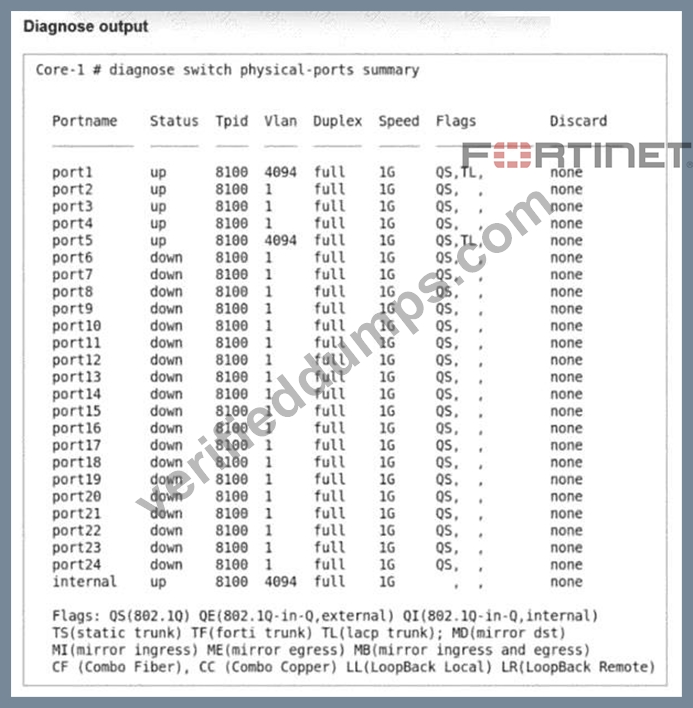
The command diagnose switch physical-ports summary is executed on FortiSwitch.
Based on the VLAN assignments shown in the output, what is the most likely management configuration of this FortiSwitch? (Choose one answer)
- A. FortiSwitch is managed by FortiSwitch Cloud.
- B. FortiSwitch is managed by FortiGate.
- C. FortiSwitch is operating in local mode.
- D. FortiSwitch is operating in standalone mode.
Answer: B
Explanation:
The output of the diagnose switch physical-ports summary command provides critical insight into how a FortiSwitch is being managed by examiningVLAN assignments,tag protocol identifiers (TPID), and internal port behavior. In the provided exhibit, several ports-includingport1,port5, and theinternalport- are assigned toVLAN 4094.
According to the FortiSwitchOS 7.6 Administrator Guide,VLAN 4094 is reserved for FortiLink management trafficwhen a FortiSwitch is managed by a FortiGate. FortiLink uses this dedicated VLAN to carry control-plane traffic such as configuration synchronization, monitoring data, LLDP-based discovery, and keepalive messages between the FortiGate and FortiSwitch. The presence of VLAN 4094 on physical interfaces is a strong and explicit indicator ofFortiGate-managed mode.
In standalone or local management mode, FortiSwitch ports typically default toVLAN 1or administrator- defined VLANs, andVLAN 4094 is not automatically assigned. Similarly, FortiSwitch Cloud-managed devices do not use VLAN 4094 in this manner, as cloud management relies on IP connectivity to FortiEdge Cloud rather than FortiLink encapsulation.
Additionally, the internal port showing VLAN 4094 further confirms FortiLink operation, as this internal interface is used by the switch ASIC to communicate with the FortiGate over the FortiLink tunnel. This behavior is documented in FortiOS 7.6 and FortiSwitchOS 7.6 design guides as characteristic of FortiGate- managed FortiSwitch deployments.
Therefore, based on the VLAN assignments shown-specifically the use ofVLAN 4094-the most accurate and fully verified conclusion is thatthe FortiSwitch is managed by FortiGate, makingOption Bthe correct answer.
NEW QUESTION # 56
Refer to the exhibits.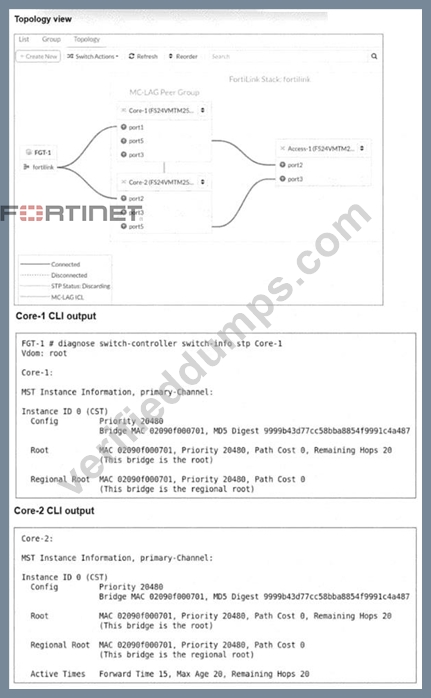
An administrator has deployed two FortiSwitch devices, Core-1 and Core-2, as multichassis link aggregation group (MCLAG) peers. These switches are connected to FortiGate for FortiLink and to an access switch (Access-1) using an inter-switch link (ISL). After configuration, the administrator notices that both Core-1 and Core-2 are claiming to be the root bridge in the Multiple Spanning Tree Protocol (MSTP) topology. What explains this behavior? (Choose one answer)
- A. MCLAG automatically disables STP on all peer switches.
- B. The ISL was not configured correctly, leading to MSTP inconsistency.
- C. Both switches share the same bridge ID because MCLAG treats them as one logical switch.
- D. FortiGate participates in MSTP and causes both switches to assume the root bridge role.
Answer: C
Explanation:
According to theFortiSwitchOS 7.6 Administration Guideand theFortiSwitch 7.6 Study Guide, Multichassis Link Aggregation (MCLAG) provides node-level redundancy by grouping two physical switches together so that theyappear as a single logical switchto the rest of the network. This logical representation is critical for preventing Spanning Tree Protocol (STP) from blocking redundant uplinks from downstream client switches.
To achieve this "single switch" appearance, the MCLAG peer switches synchronize their STP state andshare the same Bridge ID, which consists of a synchronized bridge MAC address and the same bridge priority. As shown in the exhibits for Core-1 and Core-2, both switches are configured with aBridge MAC of
02090f000701and aPriority of 20480. Because they possess identical identification parameters, each physical switch in the peer group locally recognizes itself as part of the root bridge entity for the MSTP region.
This behavior is intentional and is a fundamental characteristic of MCLAG design in FortiSwitchOS. It ensures that any downstream device, such as Access-1, receives BPDUs with the same bridge ID from both Core-1 and Core-2, thereby treating them as a single high-availability neighbor rather than two separate devices. Option A is incorrect as FortiGate typically does not participate in STP calculations. Option B is incorrect because this "duplicate" root behavior is the expected sign of acorrectlyfunctioning MCLAG control plane. Option D is incorrect as STP remains active to prevent loops elsewhere in the fabric; it is merely logically simplified for the MCLAG domain.
NEW QUESTION # 57
What are two ways in which automatic MAC address quarantine works on FortiSwitch? (Choose two.)
- A. FortiAnalyzer with a threat detection services license is required.
- B. FortiSwitch supports only by VLAN quarantine mode.
- C. FortiGate applies the quarantine-related configuration only on FortiGate.
- D. MAC address quarantine can be enabled through the FortiGate CLI only.
Answer: A,D
Explanation:
Reference: FortiSwitch 7.2 Study Guide, page 263
NEW QUESTION # 58
Exhibit.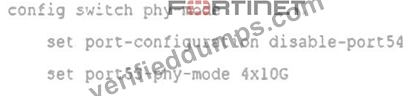
What conditions does a FortiSwitch need to have to successfully configure the options shown in the exhibit above? (Choose two.)
- A. The port full speed prior the split was 100G SFP+
- B. The FortiSwitch model is equipped with a maximum of 54 interfaces.
- C. The CLI commands are enabling a splitpo rt into four 10Gbps interfaces.
- D. The split port can be assigned to native VLAN
Answer: A,C
Explanation:
Regarding the configuration of a FortiSwitch to split a port into multiple smaller interfaces:
* The CLI commands are enabling a split port into four 10Gbps interfaces (Option B): The command shown in the exhibit is typically used to configure a high-speed port (like a 40Gbps or 100Gbps interface) to be divided into smaller, independent 10Gbps interfaces. This feature allows more flexible use of the switch's physical resources.
* The port full speed prior to the split was 100G SFP+ (Option C): Given the context of splitting the port into multiple 10Gbps interfaces, the original port configuration likely supported a high-speed transceiver such as 100G SFP+. This would make it technically feasible to divide the interface into multiple 10Gbps channels, enhancing connectivity options without requiring additional physical interfaces.
These configurations and capabilities are typical in modern network setups, especially in environments requiring high density and flexibility in connectivity, allowing network administrators to optimize physical infrastructure efficiently.
NEW QUESTION # 59
Which two statements about DHCP snooping enabled on a FortiSwitch VLAN are true? (Choose two.)
- A. switch-controller-dhcp-snooping-verify-mac verifies the destination MAC address to protect against DHCP exhaustion attacks.
- B. By default, all FortiSwitch ports are set to forward client DHCP requests to untrusted ports.
- C. Enabling DHCP snooping on a FortiSwitch VLAN ensures requests and replies are seen by all DHCP servers.
- D. Settings related to DHCP option 82 are only configurable through the CLI
Answer: A,D
Explanation:
* Switch-controller-dhcp-snooping-verify-mac verifies the destination MAC address to protect against DHCP exhaustion attacks (B): This feature of DHCP snooping helps prevent DHCP exhaustion attacks by ensuring that the destination MAC addresses in DHCP packets match the MAC addresses learned by the switch. This check helps prevent attackers from overwhelming the DHCP server with requests from spoofed MAC addresses.
* Settings related to DHCP option 82 are only configurable through the CLI (D): DHCP Option 82 is used for "agent information," and it's typically used in network environments where additional information between DHCP clients and servers is necessary for policy and billing purposes.
Configuration of these settings in FortiSwitch is only available through the Command Line Interface (CLI), not the Graphical User Interface (GUI).
NEW QUESTION # 60
FortiGate is unable to establish a tunnel with the FortiSwitch device it is supposed to manage Based on the debug output shown in the exhibit, what is the reason for the failure?
- A. The handshake process timed out before FortiSwitch responded.
- B. DTLS client hello had the incorrect pre-shared key.
- C. The CAPWAP tunnel failed to come up due to a mismatch in time.
- D. FortiSwitch has disabled FortiLink and is only managed as a standalone.
Answer: C
Explanation:
The issue described pertains to the establishment of a tunnel (likely a CAPWAP tunnel for management purposes between FortiGate and FortiSwitch).Based on typical error analysis in tunnel setup scenarios:
* The CAPWAP tunnel failed to come up due to a mismatch in time (Option C): This answer is plausible because time synchronization is crucial for security protocols that underpin tunnel establishments, such as DTLS (Datagram Transport Layer Security) used within CAPWAP tunnels. If the clocks on FortiGate and FortiSwitch are significantly out of sync, the security handshake (which can include timestamp validation) could fail, preventing the tunnel from coming up.
References:
Fortinet's technical documentation typically outlines the importance of time synchronization for secure communications. In CAPWAP/DLTS scenarios, precise time matching is crucial to ensure that the cryptographic parameters align correctly during the handshake process.
NEW QUESTION # 61
(Full question statement start from here)
You are deploying a FortiSwitch virtual stack in a network that contains Cisco devices. You want the Cisco devices toautomatically discover the FortiSwitch devices and exchange device information. Which two protocols must be enabled on the FortiSwitch devices to achieve this? (Choose two answers)
- A. Cisco Discovery Protocol
- B. Link Layer Discovery Protocol
- C. Unidirectional Link Detection
- D. LLDP - Media Endpoint Discovery
Answer: A,B
Explanation:
In mixed-vendor network environments, such as deployments that include bothFortiSwitchandCiscodevices, properLayer 2 discovery protocolsmust be enabled to allow devices to automatically discover neighbors and exchange essential device and interface information. FortiSwitchOS 7.6 supports bothCisco Discovery Protocol (CDP)andLink Layer Discovery Protocol (LLDP)to ensure interoperability.
Cisco Discovery Protocol (CDP)is a Cisco-proprietary Layer 2 discovery protocol widely used by Cisco switches, routers, and IP phones. When CDP is enabled on FortiSwitch interfaces, Cisco devices can discover FortiSwitch neighbors and receive information such as device ID, port ID, platform, and capabilities. This is particularly important in Cisco-centric networks where CDP is the primary discovery mechanism.
Link Layer Discovery Protocol (LLDP), defined by IEEE 802.1AB, is a vendor-neutral discovery protocol supported by both Fortinet and Cisco devices. Enabling LLDP allows FortiSwitch and Cisco devices to exchange standardized information including system name, port description, VLAN information, and management address. LLDP is essential for cross-vendor compatibility and is commonly enabled by default in modern enterprise networks.
The remaining options are incorrect.Unidirectional Link Detection (UDLD)is used to detect unidirectional fiber or copper link failures and does not provide device discovery or information exchange.LLDP-MEDis an extension of LLDP specifically designed for media endpoints such as IP phones and is not required for general switch-to-switch discovery.
Therefore, to ensure automatic discovery and information exchange between FortiSwitch and Cisco devices, both CDP and LLDP must be enabled, makingOptions B and Cthe correct and fully verified answers based on FortiSwitchOS 7.6 documentation.
NEW QUESTION # 62
(Full question statement start from here)
You enable Dynamic Host Configuration Protocol (DHCP) snooping on a VLAN and configure a FortiSwitch port astrustedfor DHCP snooping. What additional step is required to configure the port as trusted for Dynamic ARP Inspection (DAI)? (Choose one answer)
- A. DAI implicitly trusts the port.
- B. Enable static MAC learning on the port.
- C. Enable IP Source Guard (IPSG) on the port.
- D. Manually set the port as trusted for DAI through the CLI.
Answer: A
Explanation:
In FortiSwitchOS 7.6,Dynamic ARP Inspection (DAI)is tightly integrated withDHCP snoopingto provide Layer 2 protection against ARP spoofing and man-in-the-middle attacks. DAI relies on theDHCP snooping binding table, which contains trusted IP-to-MAC-to-port mappings learned from legitimate DHCP transactions. Because of this dependency, the trust model for DAI is directly inherited from DHCP snooping.
According to the FortiSwitchOS 7.6 Administrator Guide, when a switch port is configured astrusted for DHCP snooping, that same port isautomatically treated as trusted by DAI. No additional configuration is required. This implicit trust relationship exists because trusted DHCP snooping ports are assumed to be connected to legitimate infrastructure devices such as DHCP servers, routers, or upstream network devices that must be allowed to send valid ARP replies.
On untrusted ports, DAI inspects ARP packets and validates them against the DHCP snooping database. If an ARP packet does not match an existing binding, it is dropped. On trusted ports, ARP packets bypass DAI inspection to ensure normal network operation and to avoid blocking valid infrastructure traffic.
The other options are incorrect. There is no separate CLI command required to trust a port for DAI (Option A). IP Source Guard (Option C) is another Layer 2 security feature that also depends on DHCP snooping but is not required to establish DAI trust. Static MAC learning (Option D) is unrelated to DAI trust behavior.
Therefore, once a port is configured as trusted for DHCP snooping,DAI implicitly trusts the port, making Option Bthe correct and fully verified answer based on FortiSwitchOS 7.6 documentation.
NEW QUESTION # 63
How does FortiGate handle configuration of flow tracking sampling if you export the settings to a managed FortiSwitch stack with sampling mode set to perimeter is true?
- A. FortiGate configures FortiSwitch to perform ingress sampling on all switch interfaces, except ICL and ISL interfaces.
- B. FortiGate configures and enables flow sampling on FortiSwitch but does not change existing sampling settings of interfaces.
- C. FortiGate configures FortiSwitch to perform ingress sampling on all switch interfaces.
- D. FortiGate configures and enables egress sampling on all management interfaces.
Answer: A
Explanation:
When FortiGate exports configuration settings to a managed FortiSwitch stack with sampling mode set to
"perimeter is true," the behavior is:
* B. FortiGate configures FortiSwitch to perform ingress sampling on all switch interfaces, except ICL and ISL interfaces.This setting ensures that all incoming traffic on normal operational ports is sampled for monitoring and analysis purposes, but it excludes the inter-chassis link (ICL) and inter- switch link (ISL) interfaces from sampling. These exclusions are typically made to prevent the duplication of sampled data and to reduce unnecessary load on the monitoring system, as these links often carry traffic already monitored at other points.
Options A and D are incorrect because they either generalize the sampling across all interfaces without exceptions or incorrectly specify egress sampling on management interfaces. Option C is also incorrect as FortiGate can modify existing sampling settings to fit the perimeter-based configuration requirement.
NEW QUESTION # 64
Which LLDP-MED Type-Length-Values does FortiSwitch collect from endpoints to track network devices and determine their characteristics?
- A. Network policy
- B. Power management
- C. Inventory management
- D. Location
Answer: C
Explanation:
While FortiSwitch can collect all the listed LLDP-MED TLVs (Network Policy, Power Management, Location, and Inventory Management), the primary focus for tracking and identifying network devices is on theInventory ManagementTLV.
This TLV carries critical details such as:
* Manufacturer
* Model
* Hardware/Firmware versions
* Serial/Asset numbers
This information provides a granular understanding of the devices on your network.
NEW QUESTION # 65
Which statement best describes a benefit of using MAC, IP address, or protocol-based VLAN assignments on FortiSwitch? (Choose one answer)
- A. It offers dynamic segmentation benefits similar to 802.1X authentication.2
- B. It assigns ports to VLANs regardless of device type or traffic.
- C. It requires devices to authenticate through a RADIUS server before VLAN tagging.
- D. It disables 802.1X authentication while preserving user access control.1
Answer: A
Explanation:
According to theFortiSwitchOS 7.6 Administration Guideand theFortiSwitch 7.6 Study Guide, MAC- based, IP-based, and protocol-based VLAN assignments are methods ofdynamic VLAN assignment. These features allow the switch to categorize incoming traffic and assign it to a specific VLAN based on the packet's attributes rather than just the physical port it is connected to.3 The primary benefit of these methods is that theyoffer dynamic segmentation benefits similar to 802.1X authentication (Option D). In a modern network, devices with different security requirements (such as IoT devices, printers, and workstations) often connect to the same physical switch ports. 802.1X is the "gold standard" for dynamic segmentation but requires a supplicant on the client device.4For devices that do not support 802.1X, MAC or protocol-based assignments provide a similar result: they ensure the device is automatically placed into its designated secure segment (VLAN) the moment it is identified by the switch.
* MAC-based:Assigns a VLAN based on the source MAC address.
* IP-based:Assigns a VLAN based on the source IP address or subnet.
* Protocol-based:Assigns a VLAN based on the Ethernet type (e.g., IPv4, IPv6, or AppleTalk).
Option A is incorrect because these features complement rather than "disable" 802.1X. Option B is incorrect because these specific assignment types can be configured locally on the switch without a RADIUS server.
Option C is the opposite of how these features work, as they explicitly look at the device type or traffic to make an assignment.
NEW QUESTION # 66
......
Pass Your NSE5_FSW_AD-7.6 Dumps as PDF Updated on 2026 With 115 Questions: https://www.verifieddumps.com/NSE5_FSW_AD-7.6-valid-exam-braindumps.html
