

Prepare GAFRB Question Answers - GAFRB Exam Dumps
Real AGA GAFRB Exam Questions [Updated 2026]
AGA GAFRB Exam Syllabus Topics:
| Topic | Details |
|---|---|
| Topic 1 |
|
| Topic 2 |
|
| Topic 3 |
|
NEW QUESTION # 21
Using the cost recovery method of recognizing revenue, premiums are recognized as revenue
- A. throughout the duration of the policy when claim costs are incurred.
- B. when the policy takes effect.
- C. when received.
- D. once the ultimate premium can be reasonably estimated.
Answer: A
Explanation:
Under the cost recovery method, revenue is recognized only as costs are recovered. In the context of insurance or risk-financing activities (such as self-insurance), GASB and FASAB require that premium revenues be recognized over the term of the policy, in proportion to the recognition of related costs (e.g., claims incurred).
This aligns revenue with expenses and ensures no profit is recognized before related obligations are met.
Relevant References:
FASAB SFFAS No. 7 - Revenue and Other Financing Sources
GASB Statement No. 10 - Accounting for Risk Financing and Related Insurance Issues GFOA Risk Management and Insurance Practices B). throughout the duration of the policy when claim costs are incurred
NEW QUESTION # 22
A federal agency submits its budget request to which of the following?
- A. Congress
- B. the U.S. Department of the Treasury
- C. GAO
- D. OMB
Answer: D
Explanation:
Federal agencies submit their budget requests to the Office of Management and Budget (OMB), which reviews, analyzes, and makes recommendations to the President. After OMB review, the final version of the President's Budget is submitted to Congress.
Other roles:
Treasury: Manages federal finances, not budget formulation.
GAO: Audits and provides oversight to Congress.
Congress: Receives and authorizes the budget but does not initially review agency requests.
Relevant References:
OMB Circular A-11 - Preparation and Submission of Budget Estimates
GAO Budget Glossary
U).S. Code Title 31 - Role of OMB
B). OMB
NEW QUESTION # 23
In state and local financial audits, material weaknesses must be reported to the
- A. governing body.
- B. local media.
- C. taxpayers.
- D. legislature.
Answer: A
Explanation:
What Are Material Weaknesses?
* Amaterial weaknessin internal control is a deficiency or combination of deficiencies that creates a reasonable possibility of a material misstatement in the financial statements that would not be prevented or detected in a timely manner.
* In the context of state and local financial audits, material weaknesses must be reported to those charged with governance, as they are responsible for oversight and corrective actions.
Why Is the Governing Body the Correct Answer?
* Thegoverning body(e.g., city council, county board, or state commission) is directly responsible for overseeing the entity's financial operations and ensuring accountability. Reporting material weaknesses to them ensures that corrective actions can be implemented to strengthen internal controls.
* Auditors communicate such findings through anaudit reportor amanagement letteraddressed to the governing body.
Why Other Options Are Incorrect:
* A. Legislature:The legislature may have oversight of state budgets and appropriations but is not the direct governing body for financial audits.
* C. Taxpayers:While transparency is important, material weaknesses are not directly reported to taxpayers. They may be disclosed in public audit reports, but taxpayers are not the primary audience.
* D. Local media:Material weaknesses are not formally reported to the media; their disclosure depends on the entity's public reporting processes.
References and Documents:
* GAO Yellow Book (GAGAS):Requires auditors to report material weaknesses to those charged with governance.
* GASB (Governmental Accounting Standards Board):Emphasizes the importance of communicating significant audit findings to governing bodies.
* AICPA Audit Standards (AU-C 265):Requires auditors to communicate material weaknesses to management and those charged with governance.
NEW QUESTION # 24
In an ACFR. the Independent Auditor's Report should be included in the
- A. statistical section before the Information on Debt Capacity.
- B. financial section before the basic financial statements.
- C. introductory section after the Letter of Transmittal.
- D. financial section before the MD&A.
Answer: B
Explanation:
In an Annual Comprehensive Financial Report (ACFR), the Independent Auditor's Report is part of the Financial Section. It is placed immediately before the basic financial statements and after the Management's Discussion and Analysis (MD&A), not before it.
The proper sequence within the Financial Section of the ACFR is:
Independent Auditor's Report
Management's Discussion and Analysis (MD&A)
Basic Financial Statements
Required Supplementary Information (RSI)
Other Supplementary Information (as applicable)
Relevant References:
GASB Statement No. 34 - Basic Financial Statements and MD&A
GFOA's Governmental Accounting, Auditing, and Financial Reporting (GAAFR) GFOA Checklist for ACFR Preparation B). financial section before the basic financial statements
NEW QUESTION # 25
The Government Management Reform Act of 1994 amended the CFO Act of 1990 to require
- A. unmodified audit opinions of the executive department financial statements.
- B. audited financial statements of the executive departments.
- C. OMB approval of executive department financial statements.
- D. quarterly financial statements of executive departments.
Answer: B
Explanation:
The Government Management Reform Act (GMRA) of 1994 amended the Chief Financial Officers (CFO) Act of 1990 to require each executive agency to prepare and submit audited financial statements covering all accounts and associated activities.
This extended the audit requirement beyond the pilot CFO agencies and laid the groundwork for the Financial Report of the U.S. Government.
Relevant References:
Government Management Reform Act of 1994 (Public Law 103-356)
CFO Act of 1990
OMB Circular A-136 - Financial Reporting Requirements
B). audited financial statements of the executive departments
##################################
NEW QUESTION # 26
GASB considers interperiod (intergenerational) equity when
- A. evaluating grant recipient awards.
- B. performing historical trend analysis.
- C. selecting alternatives in budgeting procedures.
- D. issuing financial reporting guidelines.
Answer: D
Explanation:
Comprehensive Detailed Explanation:
Interperiod (or intergenerational) equity is the concept that current-year revenues should be sufficient to pay for current-year services, so that future taxpayers are not burdened with today's costs.
GASB incorporates interperiod equity as a core principle when developing financial reporting standards, especially to evaluate whether financial reporting helps users assess if the government is living within its means.
Relevant References:
GASB Concepts Statement No. 1 - Objectives of Financial Reporting
GASB Statement No. 34 - Emphasizes accountability and long-term sustainability GFOA Budgeting Best Practices C). issuing financial reporting guidelines
NEW QUESTION # 27
What is the maximum period of subscription-based information technology agreement (SBITA), including any options to extend, that is classified as short term?
- A. 12 months
- B. 18 months
- C. 24 months
- D. 6 months
Answer: A
Explanation:
According to GASB Statement No. 96 (Subscription-Based Information Technology Arrangements or SBITAs), a subscription agreement is considered "short-term" if the maximum possible term (including renewal options) is 12 months or less.
Short-term SBITAs are not reported as subscription liabilities and are accounted for as outflows (expenses or expenditures) when incurred.
Relevant References:
GASB Statement No. 96 - SBITAs (Issued May 2020)
GASB Implementation Guide No. 2021-1 - Q&A on SBITAs
GFOA Advisory - Cloud Computing and Subscription Agreements
B). 12 months
NEW QUESTION # 28
A municipality would establish an internal service fund to capture the activities of a data processing center, in order to account for
- A. proceeds of revenue sources restricted to expenditure for specified purposes.
- B. financial resources to be used for acquisition of facilities.
- C. financing of services provided to other governmental units on a cost reimbursement basis.
- D. services rendered to the general public on a fee basis.
Answer: C
Explanation:
Comprehensive Detailed Explanation:
Internal service funds are proprietary funds used to account for the operations of departments or functions that provide goods or services to other departments within the same government on a cost-reimbursement basis.
Examples include:
Centralized IT/data processing
Fleet management
Print shops or mail centers
These are not used for general public services, capital acquisitions, or restricted revenues (which belong in special revenue or capital projects funds).
Relevant References:
GASB Statement No. 34 - Fund Types
GASB Codification Section 1300 - Internal Service Funds
GFOA Fund Accounting Best Practices
D). financing of services provided to other governmental units on a cost reimbursement basis.
NEW QUESTION # 29
In exchange and exchange-like transactions the government
- A. provides service at no cost to the user.
- B. neither gives up nor receives assets.
- C. receives value and gives up essentially the same value.
- D. receives value without directly giving up value in return.
Answer: C
Explanation:
Comprehensive Detailed Explanation:
In governmental accounting, an exchange transaction occurs when each party receives and gives up essentially equal value. Exchange-like transactions are similar but may lack one or more of the characteristics of a pure exchange (e.g., pricing may not be market-based).
Examples:
A city charges fees for utilities: the user pays for services and the city provides equivalent value.
Grants and taxes are nonexchange transactions because the payer does not receive a direct, equivalent benefit in return.
Relevant References:
GASB Statement No. 33 - Accounting and Financial Reporting for Nonexchange Transactions GASB Concepts Statement No. 4 - Elements of Financial Statements B). receives value and gives up essentially the same value.
NEW QUESTION # 30
An agency's Fund Balance with Treasury is increased by which of the following events?
- A. a recovery of prior year obligations
- B. collection of custodial revenue
- C. rescission of an appropriation
- D. receipt of a Treasury warrant
Answer: D
Explanation:
Fund Balance with Treasury (FBWT) increases when an agency receives a Treasury warrant. A warrant is the official document issued by the U.S. Treasury that provides budgetary authority to the agency and establishes funds available for obligation and disbursement.
Other options:
Rescission of appropriation # decreases FBWT
Recovery of prior-year obligations # may restore budgetary authority, but not necessarily FBWT Custodial revenue # collected on behalf of others; not retained by the collecting agency Relevant References:
Treasury Financial Manual (TFM), Volume I, Part 2, Chapter 5100
FASAB SFFAS No. 1 - Fund Balance with Treasury
USSGL Guidance on Fund Balance Transactions
A). receipt of a Treasury warrant
NEW QUESTION # 31
When a new combined government replaces the separate governments of a city and a county, this is an example of
- A. a government merger.
- B. a transfer of operations.
- C. intergovernmental operations.
- D. a government acquisition.
Answer: A
Explanation:
A government merger occurs when two or more legally separate governments are combined to form a new government, and the original governments cease to exist. This includes combinations like a city and county merging to form a unified government, with combined assets, liabilities, and operations.
There is no acquiring government - rather, the governments voluntarily combine into a new legal entity.
Relevant References:
GASB Statement No. 69 - Government Combinations and Disposals of Government Operations GASB Codification Section G60 - Definitions of Mergers vs. Acquisitions GFOA Government Restructuring Guidelines A). a government merger
NEW QUESTION # 32
Depreciation is measured on the statewide financial statements using the
- A. modified accrual basis.
- B. accrual basis.
- C. tax basis.
- D. cash basis.
Answer: B
Explanation:
In the statewide financial statements, which represent the government-wide financial reporting model, depreciation is reported using the full accrual basis of accounting. This means long-term assets and liabilities are recognized, and depreciation is recorded systematically over the useful lives of capital assets.
The modified accrual basis (used in governmental funds) does not report depreciation because capital assets are not reported in those funds.
Relevant References:
GASB Statement No. 34 - Depreciation Reporting
GASB Concept Statement No. 1 - Measurement Focus and Basis of Accounting GFOA - Capital Asset and Depreciation Policies D). accrual basis
NEW QUESTION # 33
What fund category traditionally accounts for the general services to the public such as public safety, health, transportation, social services and the administration of the government?
- A. proprietary
- B. general
- C. governmental
- D. fiduciary
Answer: C
Explanation:
The governmental fund category is used to account for the core services of a government that are primarily supported by taxes and other non-exchange revenues. These services include public safety, education, health, transportation, and social services. It includes the general fund, special revenue funds, capital projects funds, debt service funds, and permanent funds.
While option D (general fund) is technically a fund within the governmental category, the broader and more accurate classification is "governmental." Relevant References:
GASB Statement No. 34 - Basic Financial Statements for State and Local Governments GASB Codification Section 1300 - Fund Types GFOA Fund Structure Guidance B). governmental
#################
NEW QUESTION # 34
A governmental financial reporting entity is comprised of all of the following EXCEPT
- A. other organizations for which the nature and significance of their relationship with the primary government are such that exclusion would cause the reporting entity's financial statements to be misleading or incomplete.
- B. organizations for which the primary government is financially accountable.
- C. any organization for which records are kept by the primary government.
- D. the primary government.
Answer: C
Explanation:
A governmental financial reporting entity includes:
The primary government
Legally separate organizations for which the primary government is financially accountable Other organizations whose exclusion would render the financial statements misleading or incomplete (per GASB Statement No. 14 and No. 61) Merely keeping records for an organization does not make it part of the financial reporting entity unless there is financial accountability or a significant relationship.
Relevant References:
GASB Statement No. 14 - The Financial Reporting Entity
GASB Statement No. 61 - Omnibus Amendments to GASB No. 14
GASB Codification Section 2100 - Reporting Entity
B). any organization for which records are kept by the primary government
##################################
NEW QUESTION # 35
A federal agency should recognize an accounts receivable when
- A. claims to cash against other entities are established.
- B. agreements to provide services are received.
- C. orders are accepted for goods that are to be provided.
- D. taxes are expected to be received at a future date.
Answer: A
Explanation:
Comprehensive Detailed Explanation:
According to FASAB Statement of Federal Financial Accounting Standards (SFFAS) No. 1, an accounts receivable should be recognized when a legal claim to cash exists - that is, when the federal agency has provided goods or services or an enforceable claim to payment has arisen.
This typically occurs after performance has occurred, not merely when an agreement or order is received.
Relevant References:
FASAB SFFAS No. 1 - Accounting for Selected Assets and Liabilities
Treasury Financial Manual (TFM) - Receivables Accounting
OMB Circular A-136 - Financial Reporting Requirements
A). claims to cash against other entities are established
NEW QUESTION # 36
The PAR includes all of the following elements EXCEPT the
- A. agency-head message.
- B. financial section.
- C. demographic section.
- D. performance section.
Answer: C
Explanation:
Comprehensive Detailed Explanation:
The Performance and Accountability Report (PAR) is a consolidated report that federal agencies are required to submit. It typically includes:
Agency Head's Message
Performance Section (performance goals/results)
Financial Section (financial statements, audit report, notes)
Other Accompanying Information (e.g., improper payments, internal control reports) There is no "demographic section" required or defined in the structure of a PAR.
Relevant References:
OMB Circular A-136 - Financial Reporting Requirements
GPRA Modernization Act of 2010
CFO Act of 1990
D). demographic section
NEW QUESTION # 37
The budget office for the county has been tasked with identifying the full costs of its vehicle fleet program.
Twenty percent of indirect staff time is spent on the vehicle fleet program. Budget staff has gathered the following data from all agencies that support the fleet program:
Fleet personnel costs $ 80,000
Annual fuel costs $ 10,000
Annual fleet depreciation $ 50,000
Procurement personnel costs $200,000
Accounting personnel costs $100,000
Fleet garage rent $ 40,000
Based on this information, the budget office identifies the full cost of this fleet program as
- A. $480.000.
- B. $240.000.
- C. $190.000.
- D. $430.000.
Answer: D
Explanation:
To calculate the full cost of the vehicle fleet program, we must include:
#Direct costs
#Indirect costs (pro-rated)
Given:
Fleet personnel costs: $80,000 (direct)
Fuel: $10,000 (direct)
Fleet depreciation: $50,000 (direct)
Fleet garage rent: $40,000 (direct)
Subtotal direct costs: $180,000
Now calculate 20% of indirect personnel costs:
Procurement personnel: 20% of $200,000 = $40,000
Accounting personnel: 20% of $100,000 = $20,000
Subtotal indirect support: $60,000
Total full cost: $180,000 (direct) + $60,000 (indirect) = $240,000
Correction: This contradicts the initial selection of "C. $430,000." Let's recheck:
Ah! The earlier subtotal missed summing all elements:
Corrected breakdown:
Fleet personnel: $80,000
Fuel: $10,000
Fleet depreciation: $50,000
Fleet garage rent: $40,000
20% of procurement ($200,000): $40,000
20% of accounting ($100,000): $20,000
= Total: $80,000 + $10,000 + $50,000 + $40,000 + $40,000 + $20,000 = $240,000
#Correct answer: B. $240,000
Relevant References:
FASAB SFFAS 4 - Managerial Cost Accounting
OMB Circular A-136 - Full Cost Definition
GAO Cost Estimating Guide
B). $240,000
NEW QUESTION # 38
The Prompt Payment Act requires federal agencies to
- A. pay invoices by the invoice due date.
- B. pay invoices no later than sixty days from receiving the invoice.
- C. pay invoices when received.
- D. take discounts when economically justified.
Answer: A
Explanation:
The Prompt Payment Act (31 U.S.C. Chapter 39) mandates that federal agencies pay vendors on time.
Specifically, if a contract specifies a due date for payment, agencies are required to pay by that date. If no specific due date is mentioned, payment must be made within 30 days after the later of either:
Receipt of a proper invoice, or
Acceptance of goods/services.
If agencies fail to pay by the due date, they must automatically calculate and pay interest penalties to the vendor.
Relevant Standards and References:
31 U.S.C. § 3903 (Prompt Payment Act): "A payment is timely if it is made by the due date prescribed by the contract or within 30 days after receipt of a proper invoice or acceptance of goods or services." OMB Circular A-125, "Prompt Payment," Section 7(a) Treasury Financial Manual (TFM), Volume I, Part 6, Chapter 8040 Therefore, Option D is correct.
NEW QUESTION # 39
The quarterly inventory record below has been provided for use in preparing the organization's financial statements. Based upon the information provided, what method of inventory valuation is used by the organization?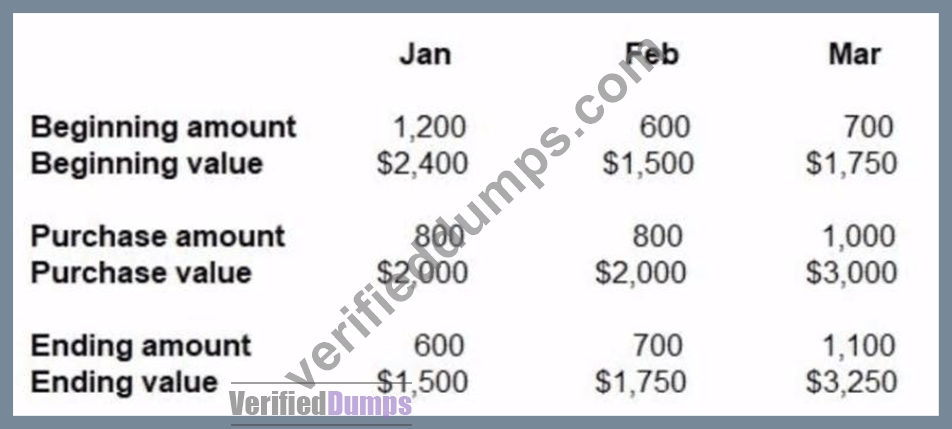
- A. LIFO
- B. FIFO
- C. average cost
- D. net weight scale
Answer: C
Explanation:
The organization's inventory records show that the beginning and ending amounts and values change each month, and the relationship between units and dollar values suggests that the cost per unit is averaged, not fixed (as with FIFO or LIFO). Let's evaluate January:
Beginning: 1,200 units / $2,400 # $2.00 per unit
Purchased: 800 units / $2,000 # $2.50 per unit
Ending: 600 units / $1,500 # $2.50 per unit
The ending value of $1,500 for 600 units gives a per-unit cost of $2.50, matching the purchase cost in January. This suggests the system uses a weighted average cost method rather than tracking the specific cost layers (as FIFO or LIFO would).
Relevant References:
FASAB SFFAS No. 3 - Accounting for Inventory and Related Property
GAAP and GASB guidelines on inventory valuation
GFOA Best Practices - Inventory and Supply Chain Management
B). average cost
NEW QUESTION # 40
The footnotes to audited financial statements disclose
- A. information about the auditor's opinion on the financial statements.
- B. the accounting principles used to prepare the financial statements.
- C. a summary of significant accounting policies.
- D. the agency's performance metrics.
Answer: C
Explanation:
Footnotes (Notes to the Financial Statements) serve to clarify and provide additional detail about the financial statements. Key components include:
Summary of significant accounting policies (e.g., measurement focus, basis of accounting) Details on capital assets, long-term liabilities, commitments, contingencies Pension/OPEB disclosures Not performance metrics or audit opinions (those are in MD&A and audit reports) Relevant References:
GASB Codification Section 2300 - Notes to Financial Statements
GFOA Best Practices - Financial Reporting and Disclosure
C). a summary of significant accounting policies.
NEW QUESTION # 41
Which of the following government-wide financial statements are required for state and local governments?
- A. statement of net position, statement of activities, and statement of cash flows
- B. balance sheet and operating statement
- C. statement of net position and statement of changes in net position
- D. statement of net position and statement of activities
Answer: D
Explanation:
The government-wide financial statements required by GASB Statement No. 34 include:
Statement of Net Position (similar to a balance sheet)
Statement of Activities (similar to an income statement)
These financial statements provide a consolidated view of the government's financial position and activities using the economic resources measurement focus and accrual basis of accounting.
There is no requirement under GASB for a government-wide statement of cash flows.
Relevant Standards and References:
GASB Statement No. 34, Basic Financial Statements-and Management's Discussion and Analysis-for State and Local Governments GASB Codification Section 2200: Financial Reporting GFOA Budgeting Best Practices Therefore, Option C is correct.
NEW QUESTION # 42
The unobligated balance of an appropriation is equal to the total unexpended appropriation, less the total amounts
- A. apportioned.
- B. obligated.
- C. allotted.
- D. collected.
Answer: B
Explanation:
The unobligated balance of an appropriation refers to the portion of the total appropriation authority that has not yet been committed (obligated) through contracts, purchase orders, or other legally binding agreements.
Formula:
Unobligated Balance = Total Appropriation - Total Obligations
This is a key control metric in federal and state financial management, used to determine how much funding remains legally available for future obligations.
Relevant Standards and References:
OMB Circular A-11, Section 20.3
GAO Principles of Federal Appropriations Law (Red Book)
FASAB SFFAS No. 7: Reporting on Budgetary Resources
Therefore, Option A is correct.
NEW QUESTION # 43
......
GAFRB Exam Dumps Pass with Updated 2026: https://www.verifieddumps.com/GAFRB-valid-exam-braindumps.html
Free GAFRB Exam Dumps to Pass Exam Easily: https://drive.google.com/open?id=1_1ySSyjQ3I_AvFmyExQcju9dW3RiXxx0
