

Pass ATLASSIAN ACP-120 Exam in First Attempt Guaranteed [Jan-2026]
Exam Sure Pass ATLASSIAN Certification with ACP-120 exam questions
The ACP-120 certification is a valuable credential that can help IT professionals demonstrate their expertise in Jira Cloud administration. Jira Cloud Administrator certification is recognized by many organizations and can open up new job opportunities and career paths. Additionally, the certification demonstrates an individual's commitment to professional development and continuous learning.
The ACP-120 exam is designed for individuals who are looking to become certified Jira Cloud Administrators. ACP-120 exam is intended for those who have experience with Jira Cloud and are familiar with its various features and functionalities. Candidates who pass the exam will be recognized as certified Jira Cloud Administrators, which can help to boost their career prospects in the field.
NEW QUESTION # 10
You receive workflow configuration requirements for issues in the Closed status. They are as follows:
Users must NOT be able to edit issues in this status.
Jira administrators must be able to edit issues in this status.
Only users in the release-managers group should see the transition to the Re-opened status Which combination of two workflow configuration items should you use to meet these requirements?
(Choose two.)
- A. Post functions
- B. Validators
- C. Triggers
- D. Conditions
- E. Properties
Answer: B,D
NEW QUESTION # 11
Your HR project has two issue types:
- Join
- Leave
Both issue types share a field configuration, screens and the workflow.
You currently use the Due Date system field to indicate when someone actually joins or leaves.
New HR staff members complain that using the Due Date field is not very intuitive.
How can you help your HR team?
- A. - Rename the Due Date field to Join Date and create a separate Leave Date custom field.
- Create new screens for the Leave issue type and replace the Due Date field with the newly created field.
- Migrate existing field values to the new Leave Date field. - B. - Create individual Join Date and Leave Date custom fields to replace the Due Date field.
- Create separate screens for each issue operation and issue type.
- Delete the Due Date field. - C. - Create individual field contexts for each issue type.
- Label the Due Date field as Join Date and Leave Date in their respective contexts.
- Associate each context with its matching issue type. - D. - Create individual Join Date and Leave Date custom fields to replace the Due Date field.
- Appropriately migrate existing data from the Due Date field to the new custom fields.
- Remove the Due Date field from all project screens.
Answer: C
NEW QUESTION # 12
Martin has Create Attachments permission in a software project, but he cannot attach anything to issues in Approved status.
What is the problem?
- A. There is a workflow condition configured.
- B. He is not a member of a security level.
- C. He does not have the correct project permission.
- D. The Attachment field is missing from the screen for that issue type.
- E. There is a workflow step property configured.
Answer: C
Explanation:
Reference: https://confluence.atlassian.com/adminjiracloud/configuring-file-attachments-818578880.html
NEW QUESTION # 13
A custom field was just added to Jira and made available to all issue types and all projects. You want to use the field in your company-managed project. Identify one configuration you must modify.
- A. Issue layout
- B. Screen
- C. Field configuration
- D. Custom field context
Answer: B
Explanation:
To use a newly added custom field in a company-managed project, you must ensure it appears on the appropriate screens (e.g., Create, Edit, View) for the project's issue types. The configuration that must be modified is thescreen(Option B), as the field needs to be added to the screen(s) used by the project.
* Explanation of the Correct Answer (Option B):
* The custom field is already available to all issue types and projects, meaning itscontextis configured globally. To make the field usable in your company-managed project, it must be added to thescreenassociated with the project's issue types (via thescreen scheme). Screens determine which fields are displayed during issue operations (Create, Edit, View), and adding the custom field to the relevant screen ensures users can interact with it.
* Exact Extract from Documentation:
Add a custom field to a screen
To use a custom field in a project, it must be added to the screens used for Create, Edit, or View operations.
To add a field:
* Go toSettings > Issues > Screens.
* Select the screen associated with the project's issue types.
* Add the custom field to the screen.Note: Ensure the screen is part of the project's screen scheme (Project settings > Screens). If the field is not on the screen, it will not appear during issue operations.(Source: Atlassian Support Documentation, "Configure screens in Jira Cloud")
* Why This Fits: Adding the custom field to the project's screen is a necessary configuration to make it usable, as it ensures the field is visible and editable, meeting the requirement to use the field in the project.
* Why Other Options Are Incorrect:
* Field configuration (Option A):
* Field configurationscontrol whether a field is required, optional, or hidden. While you might later adjust the field's behavior (e.g., make it required), the field is already available and does not require field configuration changes to be used initially. Adding it to a screen is the primary step.
* Extract from Documentation:
Field configurations manage field behavior (e.g., required, hidden). Adding a field to a screen is required before configuring its behavior.
(Source: Atlassian Support Documentation, "Configure field settings")
* Custom field context (Option C):
* The custom field'scontextis already configured to include all issue types and projects, so no changes are needed here. Contexts define the projects and issue types a field applies to, and this is already set correctly.
* Extract from Documentation:
Custom field contexts define where a field is available. If a field is already available to all projects and issue types, no context changes are needed.
(Source: Atlassian Support Documentation, "Manage custom fields in Jira Cloud")
* Issue layout (Option D):
* Theissue layoutcontrols which fields are displayed or hidden in the issue view and filter results. While you might later adjust the issue layout to show the field in the issue view, the initial step to use the field is adding it to the screen for Create/Edit operations. The screen configuration is more fundamental.
* Extract from Documentation:
Issue layouts control field visibility in the issue view. Fields must first be added to screens for Create/Edit operations before appearing in the issue layout.
(Source: Atlassian Support Documentation, "Configure issue layouts in Jira Cloud")
* Additional Notes:
* Steps to configure:
* Identify the screen(s) used by the project's issue types inProject settings > Screens.
* Go toSettings > Issues > Screens, select the relevant screen, and add the custom field.
* Configuring screens requiresJira administratorprivileges.
* After adding the field to the screen, you may also configure theissue layoutorfield configuration for additional control, but the screen is the first required step.
:
Atlassian Support Documentation:Configure screens in Jira Cloud
Atlassian Support Documentation:Configure field settings
Atlassian Support Documentation:Manage custom fields in Jira Cloud
Atlassian Support Documentation:Configure issue layouts in Jira Cloud
NEW QUESTION # 14
A company-managed project uses a single issue type. When must a second issue type be added to the project?
- A. When adding a new status
- B. When adding a new custom field
- C. When adding a new workflow
- D. When adding a new security level
- E. When adding a new resolution
Answer: C
Explanation:
In a company-managed project with a single issue type, adding a second issue type is necessary when a configuration requires issue type-specific behavior that cannot be applied to the existing issue type. The requirement that necessitates a second issue type iswhen adding a new workflow(Option B), as different workflows for different issue types require separate issue types to be mapped in the project's workflow scheme.
* Explanation of the Correct Answer (Option B):
* In a company-managed project, aworkflow schememaps workflows to issue types. If the project currently uses a single issue type with one workflow, adding a new workflow (e.g., for a different process) requires a second issue type to associate with the new workflow. Without a second issue type, the new workflow cannot be applied, as a single issue type can only be mapped to one workflow in a given scheme. Adding a second issue type allows the project to use both the existing workflow (for the current issue type) and the new workflow (for the new issue type).
* Exact Extract from Documentation:
Configure workflow schemes
A workflow scheme maps workflows to issue types in a company-managed project.
To use a new workflow:
* Create or select a new workflow inSettings > Issues > Workflows.
* Update the project's workflow scheme inProject settings > Workflowsto assign the new workflow to a specific issue type.Note: To use multiple workflows in a project, you must have multiple issue types, as each issue type can only be associated with one workflow in a scheme.(Source: Atlassian Support Documentation, "Configure workflow schemes")
* Why This Fits: Adding a new workflow requires a second issue type to map the new workflow in the workflow scheme, as a single issue type cannot use multiple workflows, making Option B the correct answer.
* Why Other Options Are Incorrect:
* When adding a new resolution (Option A):
* Resolutionsare global settings (Settings > Issues > Resolutions) that apply to all issues in a project, regardless of issue type. Adding a new resolution does not require a new issue type, as resolutions are managed at the workflow level and can be used by the existing issue type.
* Extract from Documentation:
Resolutions are global and apply to all issue types. Adding a new resolution does not require new issue types.
(Source: Atlassian Support Documentation, "Manage resolutions in Jira Cloud")
* When adding a new status (Option C):
* A newstatuscan be added to the existing workflow for the single issue type without needing a new issue type. Statuses are part of a workflow, and the existing issue type can use the updated workflow with the new status.
* Extract from Documentation:
Statuses are added to workflows, not issue types. A new status can be used by the existing issue type's workflow.
(Source: Atlassian Support Documentation, "Configure advanced work item workflows")
* When adding a new custom field (Option D):
* A newcustom fieldcan be applied to the existing issue type via itscustom field contextor screen configuration. It does not require a new issue type, as fields can be shared across or restricted to specific issue types within the same project.
* Extract from Documentation:
Custom fields can be added to existing issue types via contexts or screens. New issue types are not required.
(Source: Atlassian Support Documentation, "Manage custom fields in Jira Cloud")
* When adding a new security level (Option E):
* A newsecurity levelin the issue security scheme applies to all issues in the project, regardless of issue type. It does not require a new issue type, as security levels are project- wide and not tied to specific issue types.
* Extract from Documentation:
Security levels apply to all issues in a project and are not issue type-specific. Adding a new level does not require new issue types.
(Source: Atlassian Support Documentation, "Configure issue security schemes")
* Additional Notes:
* Steps to add a second issue type for a new workflow:
* Add a new issue type to the project's issue type scheme inProject settings > Issue types.
* Create or select a new workflow inSettings > Issues > Workflows.
* Update the workflow scheme inProject settings > Workflowsto map the new workflow to the new issue type.
* These changes requireJira administratorprivileges.
* The need for a second issue type arises specifically from the workflow scheme's one-to-one mapping of workflows to issue types.
:
Atlassian Support Documentation:Configure workflow schemes
Atlassian Support Documentation:Manage resolutions in Jira Cloud
Atlassian Support Documentation:Configure advanced work item workflows
Atlassian Support Documentation:Manage custom fields in Jira Cloud
Atlassian Support Documentation:Configure issue security schemes
NEW QUESTION # 15
Mira is working on a story. All of a sudden, the links to all three bugs related to the story disappeared. All issues including the story and the three bugs are tracked in the DEV project, which is a classic Software project.
Which four can explain the situation (Choose four)
- A. Link issues permission was revoked for Mira
- B. The links to the bugs were deleted
- C. A security level was applied to the linked bugs
- D. Browse Projects permission was revoked for Mira
- E. Issue linking was disabled globally
- F. The linked bugs were deleted
Answer: B,C,E,F
NEW QUESTION # 16
You are the site and organization admin of a Jira Software and Confluence instance.
You are the only administrator and you don't have any Trusted users.
Users currently cannot send invitations to anyone. You need to control the number of licenses used.
Therefore, you want to either invite individual users or approve individual user requests.
Which site access setting will meet this requirement? (Choose one)
- A. Enable existing users to send invitations to anyone
- B. Approve any domain
- C. Don't approve any domain
- D. Enable Jira Software and Confluence invite links
- E. Approve your organization domain only
Answer: B
NEW QUESTION # 17
Users have been adding sensitive information into the Description field of issues in a particular project. You must secure the project by any means necessary so that only members of the Managers group can view the contents of the Description field.
Which approach will definitively satisfy this requirement? (Choose one)
- A. Hide the description field in the field configuration
- B. Remove the description field from the screen used by the view operation
- C. Remove everyone except the managers group from every project role
- D. Remove everyone except the managers group from every project permission
- E. Remove everyone from the browse projects permission
Answer: B
NEW QUESTION # 18
After a recent upgrade to your Jira system, one of the apps your organization depends on is not working reliably.
Which two methods can you use to debug and resolve this issue? (Choose two.)
- A. Ask the System Administrator to set package com.atlassian to Trace logging level.
- B. Ask the System Administrator to set the logging level to FATAL on all package names, Under Logging
& Profiling. - C. Ask the System Administrator to enable the SQL log.
- D. Ask the System Administrator to add the app to the logger.
- E. Ask the System Administrator for catalina.out logs and inspect for stack traces.
Answer: A,B
Explanation:
Reference: https://confluence.atlassian.com/adminjiraserver/logging-and-profiling-938847671.html
https://confluence.atlassian.com/crowd/logging-and-profiling-24248601.html
NEW QUESTION # 19
Max wants you to change the way the system fields Created or Updated are being displayed when viewing an issue.
How can this be achieved?
- A. Adjust the jira.date.picker.java.format in the advanced settings configuration.
- B. Adjust the Day Format in the Jira look and Feel configuration.
- C. Adjust the jira.date.time.picker.java.format in the advanced settings configuration.
- D. Adjust the language and time zone preferences in Max's user profile.
- E. Adjust the Complete Date/Time Format in the Jira Look and Feel configuration.
Answer: D
Explanation:
Reference: https://virginpulse.zendesk.com/hc/en-us/articles/206180140-The-time-on-my-Max-is-wrong-
NEW QUESTION # 20
You are configuring an issue layout in a company-managed project. Which statement is true?
- A. You can move any field to the Hidden fields section.
- B. You can reuse fields from a team-managed project.
- C. You can move any field to the Context fields section.
- D. You can copy a layout to another project using the same screen.
Answer: D
Explanation:
In a company-managed project, theissue layoutdetermines how fields are displayed in the issue view (e.g., which fields are visible, hidden, or in the context panel). The true statement is thatyou can copy a layout to another project using the same screen(Option B), as Jira allows copying issue layouts to streamline configuration across projects.
* Explanation of the Correct Answer (Option B):
* Theissue layoutin a company-managed project is configured inProject settings > Issue layout and is tied to a screen (via the screen scheme). Jira allows copying an issue layout to another project that uses the same screen, ensuring consistent field arrangements across projects.
* Exact Extract from Documentation:
Configure issue layouts in company-managed projects
Issue layouts define which fields are displayed, hidden, or placed in the context panel in the issue view.
To copy a layout:
* Go toProject settings > Issue layout.
* SelectCopy layoutand choose another project that uses the same screen.Note: The target project must use the same screen (via its screen scheme) for the layout to be compatible.
(Source: Atlassian Support Documentation, "Configure issue layouts in Jira Cloud")
* Why This Fits: Copying an issue layout to another project using the same screen is a supported feature, making Option B the correct answer.
* Why Other Options Are Incorrect:
* You can reuse fields from a team-managed project (Option A):
* Fields in team-managed projects are project-specific and cannot be reused in company- managed projects. Company-managed projects use global custom fields or system fields, managed inSettings > Issues > Custom fields. Fields from team-managed projects are isolated and not accessible.
* Extract from Documentation:
Custom fields in team-managed projects are project-specific and cannot be reused in company-managed projects. Company-managed projects use global custom fields.
(Source: Atlassian Support Documentation, "Manage custom fields in Jira Cloud")
* You can move any field to the Hidden fields section (Option C):
* Not all fields can be moved to theHidden fieldssection. System fields likeSummary,Issue Type, andStatusare required and cannot be hidden. Only non-mandatory fields (e.g., custom fields, non-required system fields) can be hidden.
* Extract from Documentation:
In the issue layout, you can hide non-mandatory fields by moving them to theHidden fieldssection. Required fields like Summary, Issue Type, and Status cannot be hidden.
(Source: Atlassian Support Documentation, "Configure issue layouts in Jira Cloud")
* You can move any field to the Context fields section (Option D):
* TheContext fieldssection (right panel in the issue view) has restrictions on which fields can be placed there. Fields likeSummary,Description, and certain system fields cannot be moved to the context panel, as they are designed for the main issue view. Only eligible fields (e.g., custom fields, Labels, Components) can be moved to theContext fieldssection.
* Extract from Documentation:
TheContext fieldssection is for fields like Labels, Components, or custom fields. Core fields like Summary and Description cannot be moved to the context panel.
(Source: Atlassian Support Documentation, "Configure issue layouts in Jira Cloud")
* Additional Notes:
* Configuring issue layouts requiresproject adminprivileges for the project (Project settings > Issue layout).
* Copying layouts is useful for maintaining consistency across projects with similar configurations.
:
Atlassian Support Documentation:Configure issue layouts in Jira Cloud
Atlassian Support Documentation:Manage custom fields in Jira Cloud
NEW QUESTION # 21
You are the project administrator in a team-managed project and a company-managed project. You have no other administrative privileges. Identify the action you definitely cannot perform in a company-managed project.
- A. Restrict who can see certain issues.
- B. Create automation rules.
- C. Manage notifications and recipients.
- D. Restrict who can use workflow transitions.
- E. Manage project access.
Answer: D
Explanation:
As a project administrator in a company-managed project with no other administrative privileges (e.g., Jira admin or system admin), your permissions are limited to specific project-level settings defined by the permission schemeand other configurations. The action youdefinitely cannot performin a company- managed project isrestrict who can use workflow transitions(Option B), as this requires editing the workflow, which is a Jira admin privilege.
* Explanation of the Correct Answer (Option B):
* Restricting who can use workflow transitions involves addingconditionsto transitions in a workflow (e.g., restricting a transition to specific users, roles, or groups). In company-managed projects, workflows are managed at the system level, and editing them requiresJira admin permissions. Project admins cannot modify workflows or their conditions.
* Exact Extract from Documentation:
Edit workflows in company-managed projects
Workflows define the statuses and transitions for issues in a project. To edit a workflow (e.g., add conditions, validators, or post functions):
* Go toSettings > Issues > Workflows.
* Select the workflow and make changes.Note: Only Jira administrators can edit workflows.
Project administrators can view the workflow inProject settings > Workflowsbut cannot modify it. To restrict transitions, add conditions like "Only users in a specific role" or
"Only the assignee."(Source: Atlassian Support Documentation, "Configure advanced work item workflows")
* Why This Fits: As a project admin in a company-managed project, you lack the permission to edit workflows, including adding conditions to restrict who can use transitions. This makes Option B the action you definitely cannot perform.
* Why Other Options Are Incorrect:
* Restrict who can see certain issues (Option A):
* Project admins in company-managed projects can restrict who can see issues by configuring issue security levels(if an issue security scheme is assigned to the project). They can manage security levels inProject settings > Issue securityand assign users, roles, or groups to specific levels.
* Extract from Documentation:
Configure issue security
Issue security levels restrict who can view issues. Project administrators can manage security levelsinProject settings > Issue security, provided an issue security scheme is assigned to the project.
(Source: Atlassian Support Documentation, "Configure issue security schemes")
* Manage project access (Option C):
* Project admins can manage project access by adding or removing users, groups, or roles in Project settings > People. This controls who has access to the project based on the permission scheme'sBrowse Projectspermission.
* Extract from Documentation:
Manage project access
Project administrators can add or remove users, groups, or roles inProject settings > Peopleto control project access, as defined by the permission scheme.
(Source: Atlassian Support Documentation, "Manage project permissions")
* Manage notifications and recipients (Option D):
* Project admins can manage notifications by configuring thenotification schemeinProject settings > Notifications(if permitted by the permission scheme). They can add or remove recipients for events, such as users, roles, or groups.
* Extract from Documentation:
Configure notifications
Project administrators can edit the notification scheme inProject settings > Notificationsto define who receives notifications for specific events, provided they have theAdminister Projectspermission.
(Source: Atlassian Support Documentation, "Configure notification schemes")
* Create automation rules (Option E):
* Project admins can createproject-level automation rulesin company-managed projects usingProject settings > Automation. These rules are limited to the project and do not require Jira admin permissions.
* Extract from Documentation:
Create automation rules
Project administrators can create automation rules inProject settings > Automationto automate tasks within their project. Global automation rules require Jira admin permissions, but project-level rules do not.
(Source: Atlassian Support Documentation, "Automate your Jira Cloud instance")
* Additional Notes:
* Inteam-managed projects, project admins have broader control, including the ability to configure workflows and restrict transitions, as workflows are project-specific. However, the question specifies acompany-managed project, where workflow management is restricted to Jira admins.
* TheAdminister Projectspermission (granted to project admins) allows managing most project settings, but workflow editing is a system-level task requiring higher privileges.
:
Atlassian Support Documentation:Configure advanced work item workflows
Atlassian Support Documentation:Configure issue security schemes
Atlassian Support Documentation:Manage project permissions
Atlassian Support Documentation:Configure notification schemes
Atlassian Support Documentation:Automate your Jira Cloud instance
NEW QUESTION # 22
What is the impact of changing the name of a project?
- A. The URL for issues will change.
- B. The old name can no longer be reused.
- C. Issue filters may need to be updated.
- D. The project key will also change.
- E. Jira will need to be reindexed.
Answer: C
Explanation:
Changing the name of a project in Jira Software Cloud affects how the project is displayed and referenced in certain contexts, but it does not have significant system-wide impacts like reindexing or changing URLs. The primary impact is thatissue filters may need to be updated(Option E), as filters often reference the project name.
* Explanation of the Correct Answer (Option E):
* In Jira, issue filters (created using JQL, Jira Query Language) can include the project name to scope the search (e.g., project = "Old Project Name"). If the project name changes, any filters that explicitly reference the old project name will no longer return the correct results and must be updated to use the new project name.
* Exact Extract from Documentation:
Change a project's name
To change the name of a project:
* Go toProject settings > Details.
* Update theNamefield and save changes.Impact: Changing the project name does not affect the project key, issue keys, or URLs. However, JQL queries, filters, or dashboards that reference the project by name (e.g., project = "Old Name") may need to be updated to reflect the new name.Note: Use the project key in JQL queries to avoid issues with name changes, as the key remains constant.(Source: Atlassian Support Documentation, "Manage project settings in Jira Cloud")
* Why This Fits: The documentation explicitly states that changing a project's name impacts JQL- based filters and dashboards that reference the project name, making Option E the correct choice.
* Why Other Options Are Incorrect:
* Jira will need to be reindexed (Option A):
* Changing a project name is a metadata update that does not affect the search index.
Reindexing is required for changes like modifying field configurations or schemes, but not for renaming a project.
* Extract from Documentation:
Reindexing is required when you make changes to field configurations, schemes, or indexing settings.
Changing a project's name or key does not trigger a reindex.
(Source: Atlassian Support Documentation, "Reindex Jira Cloud")
* The URL for issues will change (Option B):
* Issue URLs in Jira are based on the project key and issue key (e.g., https://<site>.atlassian.
net/browse/KEY-123), not the project name. Changing the project name does not affect URLs.
* Extract from Documentation:
Issue URLs are constructed using the project key and issue key, which remain unchanged when the project name is updated.
(Source: Atlassian Support Documentation, "Manage projects in Jira Cloud")
* The old name can no longer be reused (Option C):
* There is no restriction in Jira preventing the reuse of a previous project name. Project names are not required to be unique, and the old name can be reused for another project or reverted if needed.
* Extract from Documentation:
Project names can be reused across projects, as they are not required to be unique. The project key, however, must be unique.
(Source: Atlassian Support Documentation, "Create and configure projects")
* The project key will also change (Option D):
* The project key is a separate attribute from the project name and remains unchanged when the name is updated. Changing the project key is a distinct operation that requires admin permissions and affects issue keys and URLs.
* Extract from Documentation:
The project key is a unique identifier for the project and does not change when you update theproject name.
To change the project key, use theChange project keyoption, which updates all issue keys and URLs.
(Source: Atlassian Support Documentation, "Edit a project key")
* Additional Notes:
* To minimize the impact of project name changes, it's recommended to use the project key in JQL queries (e.g., project = KEY) instead of the project name, as the key is immutable unless explicitly changed.
* Changing the project name requires project admin permissions and is done inProject settings > Details.
:
Atlassian Support Documentation:Manage project settings in Jira Cloud
Atlassian Support Documentation:Create and configure projects
Atlassian Support Documentation:Reindex Jira Cloud
Atlassian Support Documentation:Edit a project key
NEW QUESTION # 23
You created a new "Create a new issue or add a comment to an existing issue" mail handler. What two fields have specific settings in the handler? (Choose two.)
- A. Epic Link
- B. Reporter
- C. Custom Field
- D. Watchers
- E. Priority
Answer: B,E
Explanation:
The question pertains to configuring a"Create a new issue or add a comment to an existing issue" mail handlerin Jira Software Cloud. Mail handlers process incoming emails to create issues or add comments, and certain fields can be specifically configured to control how the handler behaves. According to Jira Cloud documentation, the two fields with specific settings in this type of mail handler areReporterandPriority.
* Explanation of the Correct Answers:
* Reporter (Option C):
* TheReporterfield specifies the user who is set as the reporter of the issue created by the mail handler. In the mail handler configuration, you can define whether the reporter is set to a default user, derived from the email's "From" address (if the email address matches a Jira user), or another specified user.
* Exact Extract from Documentation:
Configuring an email handler
When setting up a mail handler like "Create a new issue or add a comment to an existing issue," you can configure the following settings:
* Reporter: Specify the user who will be set as the reporter for new issues. Options include:
* The user associated with the email's "From" address (if they have a Jira account).
* A default user (e.g., a project lead or a specific user account).
* If no valid user is found, the handler can be configured to reject the email or use a fallback user.This setting ensures that the issue is attributed to the correct user as the reporter.(Source: Atlassian Support Documentation, "Configure email handlers in Jira Cloud")
* Why This Fits: The Reporter field is a critical setting in the mail handler, as it determines who is recorded as creating the issue, which affects permissions, notifications, and reporting.
* Priority (Option D):
* ThePriorityfield allows you to set a default priority for issues created by the mail handler if the email does not explicitly specify a priority. This ensures that new issues have a consistent priority unless overridden by the email content.
* Exact Extract from Documentation:
Field settings for mail handlers
For the "Create a new issue or add a comment to an existing issue" handler, you can specify default values for certain fields, including:
* Priority: Set a default priority for new issues (e.g., Medium, High). If the email contains a specific priority value (e.g., via a keyword or mapping), it can override the default.These settings allow you to control the behavior of issue creation and ensure consistency in field values.(Source: Atlassian Support Documentation, "Configure email handlers in Jira Cloud")
* Why This Fits: The Priority field is explicitly configurable in the mail handler to ensure that new issues are assigned an appropriate priority, making it one of the two fields with specific settings.
* Why Other Options Are Incorrect:
* Epic Link (Option A):
* TheEpic Linkfield is not specifically configurable in the mail handler settings. While you can map email content to fields like Epic Link using advanced configurations (e.g., regex or scripting in Automation), it is not a standard field with specific settings in the mail handler configuration interface.
* Extract from Documentation:
Mail handlers allow mapping of email content to standard fields like Summary, Description, or Priority.
Advanced field mappings, such as Epic Link, require custom automation rules or third-party apps.
(Source: Atlassian Support Documentation, "Automate email processing with Jira Automation")
* Custom Field (Option B):
* While custom fields can sometimes be populated via email content (e.g., through regex or automation), the mail handler's standard configuration does not provide specific settings for custom fields. The handler focuses on system fields like Reporter and Priority.
* Extract from Documentation:
Custom fields are not directly supported in the default mail handler settings. To populate custom fields, you may need to use Jira Automation or a third-party mail handler app.
(Source: Atlassian Support Documentation, "Configure email handlers in Jira Cloud")
* Watchers (Option E):
* TheWatchersfield is not a configurable setting in the mail handler. You cannot specify default watchers or automatically add watchers based on email content in the standard mail handler configuration. Watchers are typically managed manually or via automation rules.
* Extract from Documentation:
Watchers are not a configurable field in mail handlers. To add watchers automatically, use JiraAutomation or a workflow post function.
(Source: Atlassian Support Documentation, "Configure notifications and watchers")
* Additional Notes:
* The"Create a new issue or add a comment to an existing issue" mail handleris one of several mail handler types in Jira Cloud. Its configuration focuses on ensuring that issues are created with the correct metadata (e.g., Reporter, Priority) and that comments are added to existing issues based on issue keys in the email subject.
* Configuring the Reporter and Priority fields ensures that issues created via email align with project workflows and notification schemes.
:
Atlassian Support Documentation:Configure email handlers in Jira Cloud
Atlassian Support Documentation:Automate email processing with Jira Automation Atlassian Support Documentation:Configure notifications and watchers
NEW QUESTION # 24
In project ENG, components are configured as shown: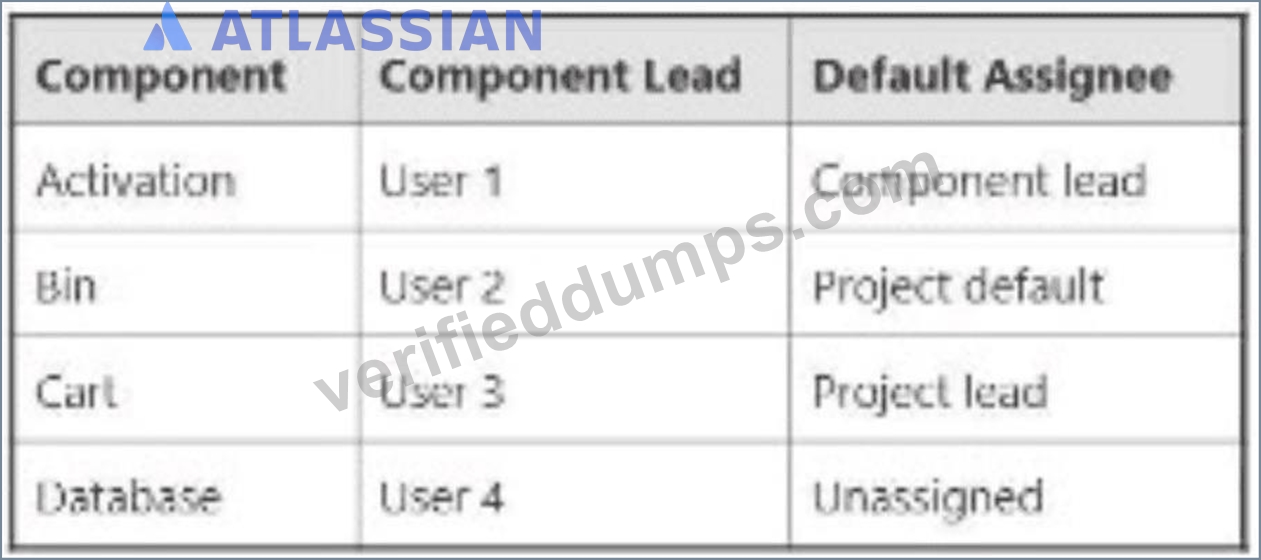
The Default Assignee for ENG is the Project Lead. You select all four components on a new issue and leave Assignee as Automatic. To whom will the issue be assigned?
- A. User 4
- B. Unassigned
- C. User 2
- D. User 3
- E. User 1
- F. Project Lead
Answer: F
Explanation:
In Jira Software Cloud, theAssigneefield for a new issue can be set toAutomatic, in which case Jira determines the assignee based on the project'sDefault Assigneesetting and any component-specificDefault Assigneesettings. The issue in the ENG project has all four components selected (Activation, Bin, Cart, Database), and the Assignee is left asAutomatic. The issue will be assigned to theProject Lead(Option E) due to the rules for handling multiple components with conflicting default assignees.
* Explanation of the Correct Answer (Option E):
* Project Default Assignee: The project ENG has itsDefault Assigneeset to theProject Lead, meaning that if no component-specific assignee is determined, the issue will be assigned to the Project Lead.
* Component Default Assignees:
* Activation: Default Assignee isComponent lead(User 1).
* Bin: Default Assignee isProject default(Project Lead).
* Cart: Default Assignee isComponent lead(User 3).
* Database: Default Assignee isUnassigned.
* Automatic Assignment Logic with Multiple Components: When an issue has multiple components selected, Jira evaluates theDefault Assigneefor each component:
* If all components have the same default assignee, that user is assigned.
* If components have different default assignees (or some are unassigned), Jira falls back to the project'sDefault Assignee(Project Lead in this case).
* In this scenario:
* Activationassigns to User 1.
* Binassigns to the Project Lead (via project default).
* Cartassigns to User 3.
* Databaseassigns to Unassigned.
* Since the components have conflicting default assignees (User 1, Project Lead, User 3, Unassigned), Jira cannot resolve to a single assignee and uses the project'sDefault Assignee, which is theProject Lead.
* Exact Extract from Documentation:
Configure default assignees
TheDefault Assigneefor a project or component determines who is assigned to new issues when theAssignee field is set toAutomatic.
Multiple components:
* If an issue has multiple components with different default assignees, Jira assigns the issue to the project'sDefault Assignee.To configure:
* Go toProject settings > Componentsto set component default assignees.
* Go toProject settings > Detailsto set the project'sDefault Assignee.Note: The project's Default Assigneeis used when component assignees conflict.(Source: Atlassian Support Documentation, "Manage project settings in Jira Cloud")
* Why This Fits: With conflicting default assignees across the four components, Jira assigns the issue to the project'sDefault Assignee, which is theProject Lead, making Option E the correct answer.
* Why Other Options Are Incorrect:
* User 1 (Option A):
* User 1 is the default assignee for theActivationcomponent (as the Component lead).
However, with multiple components selected and different assignees (User 1, Project Lead, User 3, Unassigned), Jira falls back to the project'sDefault Assignee(Project Lead), not User 1.
* Extract from Documentation:
If multiple components have different default assignees, the project'sDefault Assigneeis used, not a component-specific assignee.
(Source: Atlassian Support Documentation, "Manage project settings in Jira Cloud")
* User 2 (Option B):
* User 2 is the Component lead forBin, but the default assignee forBinis set toProject default(Project Lead), not the Component lead. Even if it were User 2, the conflicting assignees across components would result in the Project Lead being assigned.
* Extract from Documentation:
TheProject defaultsetting for a component assigns issues to the project'sDefault Assignee, not the Component lead.
(Source: Atlassian Support Documentation, "Manage components in Jira Cloud")
* User 3 (Option C):
* User 3 is the default assignee for theCartcomponent (as the Component lead). However, the conflicting assignees across components (User 1, Project Lead, User 3, Unassigned) result in the Project Lead being assigned, not User 3.
* Extract from Documentation:
Conflicting component assignees result in the project'sDefault Assigneebeing used.
(Source: Atlassian Support Documentation, "Manage project settings in Jira Cloud")
* User 4 (Option D):
* User 4 is the Component lead forDatabase, but the default assignee forDatabaseis Unassigned, not User 4. Even if it were User 4, the conflicting assignees would result in the Project Lead being assigned.
* Extract from Documentation:
TheUnassigneddefault assignee for a component does not override the project'sDefault Assigneein conflicts.
(Source: Atlassian Support Documentation, "Manage components in Jira Cloud")
* Unassigned (Option F):
* While theDatabasecomponent has a default assignee ofUnassigned, the presence of other components with different assignees (User 1, Project Lead, User 3) creates a conflict, and Jira assigns the issue to the Project Lead, notUnassigned.
* Extract from Documentation:
Unassignedas a default assignee is overridden by the project'sDefault Assigneein cases of conflict.
(Source: Atlassian Support Documentation, "Manage project settings in Jira Cloud")
* Additional Notes:
* TheDefault Assigneefor the project is set inProject settings > Details, and component-specific default assignees are set inProject settings > Components.
* The user creating the issue must have theAssign Issuespermission, and the Project Lead must have theAssignable Userpermission to be assigned.
* If only one component were selected (e.g., Activation), the issue would be assigned to User 1, but selecting all four components triggers the conflict resolution to the Project Lead.
:
Atlassian Support Documentation:Manage project settings in Jira Cloud
Atlassian Support Documentation:Manage components in Jira Cloud
Atlassian Support Documentation:Manage permissions in Jira Cloud
NEW QUESTION # 25
You want to create a new link type that looks identical in linked issues. How can you achieve this?
- A. Choose the same name for the inward and outward link descriptions.
- B. Create the link type with no outward link description.
- C. Create the link type with no inward link description.
- D. Disable bidirectional linking globally.
Answer: A
Explanation:
To create a new link type in Jira Software Cloud that looks identical in linked issues (i.e., the link description is the same regardless of the direction of the link), you shouldchoose the same name for the inward and outward link descriptions(Option C). This ensures that the link type appears with the same description in both the source and target issues.
* Explanation of the Correct Answer (Option C):
* In Jira,issue link typesdefine relationships between issues, with anoutwarddescription(for the source issue) and aninward description(for the target issue). For example, a "Blocks" link type might have "blocks" as the outward description and "is blocked by" as the inward description. To make the link type look identical in both linked issues, you set the same description for both the inward and outward links (e.g., "relates to" for both). This results in the link appearing as "relates to" in both issues, regardless of which issue is the source or target.
* Exact Extract from Documentation:
Manage issue link types
Issue link types define relationships between issues, with separateoutwardandinwarddescriptions.
To create a link type:
* Go toSettings > Issues > Issue linking.
* Add a new link type.
* Enter aName(e.g., Relates), and set theOutward descriptionandInward description(e.g., both as "relates to").Impact: If the inward and outward descriptions are the same, the link appears identical in both linked issues.Note: Requires Jira administrator permissions.
(Source: Atlassian Support Documentation, "Configure issue linking in Jira Cloud")
* Why This Fits: Setting the same name for the inward and outward link descriptions ensures the link type looks identical in linked issues, meeting the requirement and making Option C the correct answer.
* Why Other Options Are Incorrect:
* Create the link type with no inward link description (Option A):
* Jira requires both aninwardandoutwarddescription when creating a link type. Leaving the inward description blank is not allowed, and even if possible, it would not make the link look identical in both issues-it would result in an empty or default description in the target issue.
* Extract from Documentation:
Bothinwardandoutwarddescriptions are required when creating a link type. Blank descriptions are not supported.
(Source: Atlassian Support Documentation, "Configure issue linking in Jira Cloud")
* Disable bidirectional linking globally (Option B):
* There is no concept ofbidirectional linkingin Jira's issue linking system, and no global setting exists to disable it. Issue links are inherently bidirectional (a link from issue A to B implies a reverse link from B to A), and the descriptions control how they appear.
Disabling linking is not an option.
* Extract from Documentation:
Issue links are bidirectional, with inward and outward descriptions defining the relationship. No global setting exists to disable bidirectionality.
(Source: Atlassian Support Documentation, "Configure issue linking in Jira Cloud")
* Create the link type with no outward link description (Option D):
* Similar to Option A, Jira requires anoutwarddescription when creating a link type.
Leaving it blank is not allowed, and it would not achieve identical appearance in both issues, as the source issue would lack a description.
* Extract from Documentation:
Bothoutwardandinwarddescriptions are mandatory for issue link types.
(Source: Atlassian Support Documentation, "Configure issue linking in Jira Cloud")
* Additional Notes:
* Steps to configure:
* Go toSettings > Issues > Issue linking.
* ClickAdd link type.
* Enter aName(e.g., "Relates") and set bothOutward descriptionandInward descriptionto the same value (e.g., "relates to").
* Save the link type.
* Configuring issue link types requiresJira administratorprivileges.
* The new link type will appear identically in both linked issues (e.g., "Issue A relates to Issue B" and "Issue B relates to Issue A").
:
Atlassian Support Documentation:Configure issue linking in Jira Cloud
NEW QUESTION # 26
Your team currently only uses a single issue type but wants to add a second one. Which configuration requires a separate project for the second issue type?
- A. Different components per issue type
- B. Different workflows per issue type
- C. Different issue layouts per issue type
- D. Different card colors per issue type
- E. Different custom fields per issue type
Answer: B
Explanation:
In a company-managed project, adding a second issue type can often be accommodated within the same project by configuring issue type-specific settings (e.g., fields, layouts). However, if the second issue type requires adifferent workflow, a separate project may be necessary unless the project'sworkflow schemeis modified to support multiple workflows. Since the question implies a configuration thatrequiresa separate project,different workflows per issue type(Option E) is the most likely to necessitate this, as it involves complex workflow management that is often easier to handle in separate projects.
* Explanation of the Correct Answer (Option E):
* In a company-managed project, aworkflow schememaps workflows to issue types. It is possible to assign different workflows to different issue types within the same project by configuring the workflow scheme. However, managing multiple workflows within a single project can become complex, especially if the workflows have significantly different statuses, transitions, or rules.
Creating a separate project for the second issue type simplifies workflow management by isolating the workflows, as each project can have its own workflow scheme. The question's phrasing suggests a scenario where a separate project is required, likely due to the complexity or isolation needed for distinct workflows.
* Exact Extract from Documentation:
Configure workflow schemes
A workflow scheme maps workflows to issue types in a company-managed project.
To use different workflows:
* Go toSettings > Issues > Workflow schemes.
* Create or edit a scheme and assign different workflows to issue types (e.g., one for Issue Type A, another for Issue Type B).
* Apply the scheme to the project inProject settings > Workflows.Note: For complex or conflicting workflows, separate projects may be preferred to simplify management and avoid configuration conflicts.(Source: Atlassian Support Documentation, "Configure workflow schemes")
* Why This Fits: While different workflows can technically be managed within one project via a workflow scheme, the complexity or need for isolation (e.g., different teams, permissions, or configurations) often necessitates a separate project for the second issue type's workflow, making Option E the correct answer.
* Why Other Options Are Incorrect:
* Different custom fields per issue type (Option A):
* Different custom fields can be configured for eachCustom field contextsorscreen schemes allow different fields to be shown or hidden for specific issue types within the same project. A separate project is not required.
* Extract from Documentation:
Custom field contexts or screen schemes can restrict fields to specific issue types within a single project.
Separate projects are not needed.
(Source: Atlassian Support Documentation, "Manage custom fields in Jira Cloud")
* Different card colors per issue type (Option B):
* Card colors on boards (e.g., Kanban, Scrum) are configured per issue type usingboard settings(e.g., based on issue type or priority). This is managed within a single project and does not require a separate project.
* Extract from Documentation:
Card colors are configured inBoard settings > Card colorsand can vary by issue type within the same project.
(Source: Atlassian Support Documentation, "Configure boards in Jira Cloud")
* Different components per issue type (Option C):
* Componentsare project-specific, not issue type-specific. While components can be assigned to issues, they are not tied to issue types, and different components can be used within the same project without needing a separate project.
* Extract from Documentation:
Components are project-specific and can be assigned to any issue type within the same project.
(Source: Atlassian Support Documentation, "Manage components in Jira Cloud")
* Different issue layouts per issue type (Option D):
* Issue layoutscan be configured per issue type within a single project inProject settings > Issue layout. Different layouts for each issue type do not require a separate project.
* Extract from Documentation:
Issue layouts can be customized for each issue type inProject settings > Issue layoutwithin the same project.
(Source: Atlassian Support Documentation, "Configure issue layouts in Jira Cloud")
* Additional Notes:
* Steps to configure different workflows:
* Create a new workflow for the second issue type inSettings > Issues > Workflows.
* Update the project's workflow scheme inProject settings > Workflowsto map the new workflow to the second issue type.
* Alternatively, create a new project with its own workflow scheme for simplicity.
* Configuring workflows and schemes requiresJira administratorprivileges.
* A separate project may be preferred for organizational reasons (e.g., different teams, permissions), but technically, a single project can handle different workflows. The question's emphasis onrequiringa separate project points to workflows due to their complexity.
:
Atlassian Support Documentation:Configure workflow schemes
Atlassian Support Documentation:Manage custom fields in Jira Cloud
Atlassian Support Documentation:Configure boards in Jira Cloud
Atlassian Support Documentation:Manage components in Jira Cloud
Atlassian Support Documentation:Configure issue layouts in Jira Cloud
NEW QUESTION # 27
Some notification events are triggered only from a workflow post function. Identify one such event.
- A. Issue Deleted
- B. Issue Moved
- C. Issue Updated
- D. Issue Assigned
- E. Issue Closed
Answer: E
Explanation:
Certain notification events in Jira Software Cloud are triggered only when explicitly fired by aworkflow post functionin a workflow transition. The question asks for one such event, andIssue Closedis an example of an event that is typically triggered via a post function in the workflow.
* Explanation of the Correct Answer (Option B):
* TheIssue Closedevent is associated with the transition of an issue to a "Closed" status in a workflow. In Jira, this event is not automatically triggered by standard issue updates (like editing fields) but is instead fired by a post function in the workflow transition that moves the issue to the
"Closed" status.
* Exact Extract from Documentation:
Workflow post functions and events
Post functions in a workflow transition can fire specific events to trigger notifications. For example:
* TheIssue Closedevent is typically fired by a post function in the transition to a "Closed" status.
* To configure this, edit the workflow transition and add a post function like"Fire a Generic Event"or select theIssue Closedevent.These events are then mapped to recipients in the project's notification scheme.Note: Events like Issue Closed, Issue Resolved, or custom events require explicit configuration in the workflow to trigger notifications.(Source:
Atlassian Support Documentation, "Configure advanced work item workflows")
* Why This Fits: The Issue Closed event is specifically tied to a workflow transition (e.g., moving an issue to the "Closed" status), and it requires a post function to fire the event. This makes it a clear example of an event triggered only by a workflow post function.
* Why Other Options Are Incorrect:
* Issue Deleted (Option A):
* TheIssue Deletedevent is triggered when an issue is deleted from Jira (e.g., by an admin with appropriate permissions). This event is not tied to aworkflow transition or post function but is instead a system-level action.
* Extract from Documentation:
TheIssue Deletedevent is triggered when an issue is permanently removed from Jira. This is a system event and does not require a workflow post function.
(Source: Atlassian Support Documentation, "Configure notification schemes")
* Issue Updated (Option C):
* TheIssue Updatedevent is triggered by a wide range of actions, such as editing an issue's fields, adding comments, or changing the status. It is not exclusive to workflow post functions and can occur without any workflow transition.
* Extract from Documentation:
TheIssue Updatedevent is a generic event triggered by most changes to an issue, including field updates, comments, or status changes. It does not require a post function.
(Source: Atlassian Support Documentation, "Configure notification schemes")
* Issue Assigned (Option D):
* TheIssue Assignedevent is triggered when an issue's assignee is changed, either manually or through a workflow transition. This event is not exclusive to a post function, as it can occur outside of workflows (e.g., by editing the Assignee field).
* Extract from Documentation:
TheIssue Assignedevent is triggered when the assignee of an issue changes, regardless of whether it occurs in a workflow or via direct editing.
(Source: Atlassian Support Documentation, "Configure notification schemes")
* Issue Moved (Option E):
* TheIssue Movedevent is triggered when an issue is moved between projects or issue types.
This is a system-level action and does not require a workflow post function.
* Extract from Documentation:
TheIssue Movedevent is triggered when an issue is relocated to a different project or issue type. This is not tied to workflow post functions.
(Source: Atlassian Support Documentation, "Configure notification schemes")
* Additional Notes:
* Events likeIssue Closed,Issue Resolved, or custom events are typically fired by post functions because they are associated with specific workflow transitions. This distinguishes them from generic events like Issue Updated or Issue Assigned, which can be triggered by various actions.
* To configure the Issue Closed event, a Jira admin would edit the workflow, add a post function to the "Close Issue" transition, and ensure the notification scheme maps the event to the desired recipients.
:
Atlassian Support Documentation:Configure advanced work item workflows
Atlassian Support Documentation:Configure notification schemes
Atlassian Support Documentation:Manage events in Jira Cloud
NEW QUESTION # 28
You created a new project and need to configure notifications.
Managers should be notified when
* Someone mentions them while adding or editing a comment
* The issue assignee or reporter is changed
* Issue links are added or deleted
You assume that users have not turned off any notifications through their Personal settings Identify the two notification events to which managers should definitely be added (Choose two)
- A. Issue Commented
- B. Issue Deleted
- C. Issue Assigned
- D. Generic Event
- E. Issue Updated
Answer: C,E
NEW QUESTION # 29
Three team members have left the company and their issues need to be re-assigned to various - users.
All of their issues are in the Marketing project which uses the Default Notification Scheme. The scheme has never been updated.
How do you inform the new assignees about their re-assigned issues?
- A. Add an announcement banner to the marketing project to inform team members.
- B. Perform a single bulk operation to mention all new assignees in a comment.
- C. Use the Send email feature to inform the individual new assignees.
- D. Perform bulk operations to re-assign the issues and notify the new assignees.
- E. Add an announcement banner to each new assignee's dashboard.
Answer: E
NEW QUESTION # 30
Which time tracking configuration can be controlled on a global basis for all projects in Jira?
- A. whether time tracking fields are available on standard versus sub-task issue types
- B. which users have the ability to edit or delete their own or other users' worklogs
- C. which users or groups have the ability to log work on issues
- D. the default time unit on estimates when users don't explicitly specify one
- E. whether Original Estimate is required when creating issues
Answer: D
Explanation:
Reference: https://www.softwaretestinghelp.com/jira-time-tracking/
NEW QUESTION # 31
An automation rule is configured as shown:
* When: Rule is triggered on All comments
* If: Initiator is in Developers
* Then: Transition the issue to DEVELOPMENT
If: Initiator is in Reviewers
* Then: Transition the issue to REVIEWYou are only in the Reviewers project role. What happens when you comment on an issue?
- A. The issue transitions to DEVELOPMENT.
- B. The rule does not execute.
- C. The rule executes but does not perform any actions.
- D. The issue transitions to REVIEW.
Answer: D
Explanation:
The automation rule is triggered when any comment is added to an issue and checks the initiator's project role to determine the action. Since you are only in theReviewersproject role, commenting on an issue will trigger the rule, and the issue will transition toREVIEWbased on the rule's logic.
* Explanation of the Correct Answer (Option B):
* The rule is triggered byAll comments, meaning any comment on an issue activates the rule.
* The rule has twoIfconditions:
* If the initiator (the user who commented) is in theDevelopersproject role, the issue transitions toDEVELOPMENT.
* If the initiator is in theReviewersproject role, the issue transitions toREVIEW.
* Since you are only in theReviewersproject role, the secondIfcondition is met when you comment, and theThenaction transitions the issue toREVIEW.
* Exact Extract from Documentation:
Configure automation rules
Automation rules consist of triggers, conditions, and actions.
* Trigger: Defines when the rule runs (e.g., Comment Added).
* Condition: Checks criteria like user roles (e.g., Initiator is in Reviewers).
* Action: Performs tasks like transitioning an issue.Conditions are evaluated sequentially, and the corresponding action is executed if the condition is met. If multiple conditions apply, each matching condition's action is executed unless restricted by rule logic.Note:
The initiator is the user who triggers the rule (e.g., the commenter).(Source: Atlassian Support Documentation, "Automate your Jira Cloud instance")
* Why This Fits: As a member of theReviewersproject role, your comment satisfies theIf:
Initiator is in Reviewerscondition, triggering theTransition the issue to REVIEWaction, making Option B the correct answer.
* Why Other Options Are Incorrect:
* The rule does not execute (Option A):
* The rule is triggered byAll comments, so any comment, including yours, will execute the rule. The issue is not whether the rule executes but what action it performs.
* Extract from Documentation:
AComment Addedtrigger activates the rule whenever a comment is added to an issue, regardless of the user' s role.
(Source: Atlassian Support Documentation, "Jira automation triggers")
* The rule executes but does not perform any actions (Option C):
* The rule executes and performs theTransition the issue to REVIEWaction because you are in theReviewersproject role, which satisfies the secondIfcondition. The rule will not skip actions if a condition is met.
* Extract from Documentation:
If a condition in an automation rule is met, the associated action is executed unless restricted by additional logic.
(Source: Atlassian Support Documentation, "Automate your Jira Cloud instance")
* The issue transitions to DEVELOPMENT (Option D):
* TheDEVELOPMENTtransition is only triggered if the initiator is in theDevelopersproject role. Since you are only in theReviewersrole, this condition is not met, and the issue will not transition toDEVELOPMENT.
* Extract from Documentation:
Conditions likeInitiator is in [Role]check the user's project role membership. Only the actions for matching conditions are executed.
(Source: Atlassian Support Documentation, "Jira automation conditions")
* Additional Notes:
* The rule assumes theDEVELOPMENTandREVIEWstatuses exist in the project's workflow and that transitions to these statuses are valid from the issue's current status.
* If you were in bothDevelopersandReviewersroles, both actions could execute sequentially, but the question specifies you are only inReviewers, so only theREVIEWtransition applies.
:
Atlassian Support Documentation:Automate your Jira Cloud instance
Atlassian Support Documentation:Jira automation triggers
Atlassian Support Documentation:Jira automation conditions
NEW QUESTION # 32
......
The Jira Cloud Administrator certification exam is aimed at individuals who have experience working with Jira Cloud and who are looking to demonstrate their expertise in administering and managing the platform. ACP-120 exam covers a range of topics, including user management, project management, issue tracking, workflows, and reporting.
Real ATLASSIAN ACP-120 Exam Questions Study Guide: https://www.verifieddumps.com/ACP-120-valid-exam-braindumps.html
Download Real ACP-120 Exam Dumps for candidates. 100% Free Dump Files: https://drive.google.com/open?id=1itaa8YfTiTHfi2m1YJOaJQIXU23qhOxb
