

AWS-DevOps Training & Certification Get Latest AWS Certified DevOps Engineer Updated on Jan 02, 2022
Certification Training for AWS-DevOps Exam Dumps Test Engine
What is AWS DevOps Engineer Professional Exam
The AWS Certified DevOps Engineer â Professional (DOP-CO1) exam measures a candidateâs technical experience in the supply, operation and administration of the application systems distributed on the AWS platform. It is intended for people who play the role of DevOps engineer. This exam also verify a candidate must have skills to implement and manage continuous delivery systems and methodologies in AWS implement and automate security controls, governance processes and compliance validation define and implement monitoring, metric systems and AWS registration implement highly available, scalable and self-regenerating systems on the AWS platform Design, manage and maintain tools to automate operational processes.
Incident and Event Response (18%)
- Troubleshooting the issues and defining how to restore the operations.
- Defining how to automate event management & alerting;
- Applying the concepts required for implementing automated healing and setting up the event-driven automated actions;
NEW QUESTION 38
A publishing company used AWS Elastic Beanstalk, Amazon S3, and Amazon DynamoDB to develop a web application. The web application has increased dramatically in popularity, resulting in unpredictable spikes in traffic. A DevOps Engineer has noted that 90% of the requests are duplicate read requests. How can the Engineer improve the performance of the website?
- A. Use DynamoDB Streams to cache repeated read requests to DynamoDB and API Gateway to cache images stored in S3.
- B. Use Amazon ElastiCache for Memcached to cache repeated read requests to DynamoDB and Varnish to cache images stored in S3.
- C. Use Amazon ElastiCache for Redis to cache repeated read requests to DynamoDB and AWS Elemental MediaStore to cache images stored in S3.
- D. Use DynamoDB Accelerator to cache repeated read requests to DynamoDB and Amazon CloudFront to cache images stored in S3.
Answer: C
NEW QUESTION 39
A company is reviewing its IAM policies. One policy written by the DevOps Engineer has been flagged as too permissive. The policy is used by an AWS Lambda function that issues a stop command to Amazon EC2 instances tagged with Environment: Nonproduction over the weekend. The current policy is: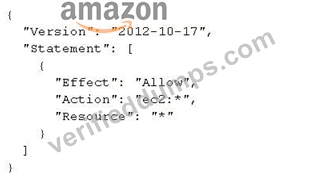
What changes should the Engineer make to achieve a policy of least permission? (Select THREE.) A)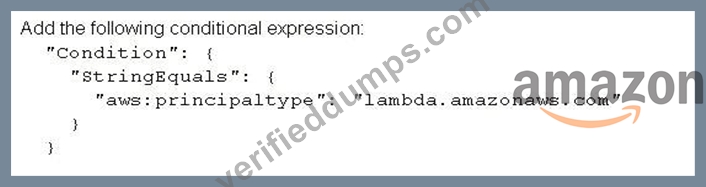
B)
C)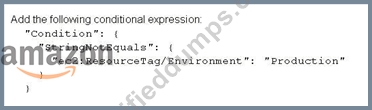
D)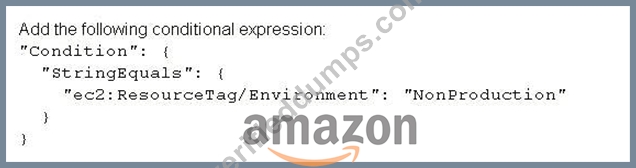
E)
F)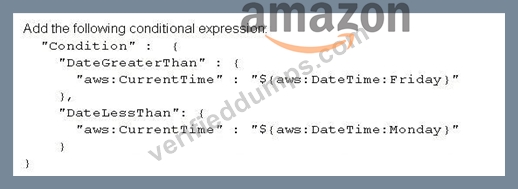
- A. Option E
- B. Option D
- C. Option A
- D. Option F
- E. Option C
- F. Option B
Answer: A,B,F
Explanation:
Explanation
https://docs.aws.amazon.com/ja_jp/IAM/latest/UserGuide/reference_policies_variables.html
https://aws.amazon.com/jp/premiumsupport/knowledge-center/restrict-ec2-iam/
NEW QUESTION 40
The operations team and the development team want a single place to view both operating system and application logs.
How should you implement this using AWS services? Choose 2 answers
- A. Using configuration management, set up remote logging to send events to Amazon Kinesis and insert these into Amazon CloudSearch or Amazon Redshift, depending on available analytic tools.
- B. Using AWS CloudFormation, create a CloudWatch Logs LogGroup.
Because the Cloudwatch Log agent automatically sends all operating system logs, you only have to configure the application logs for sending off-machine. - C. Using AWS CloudFormation, merge the application logs with the operating system logs, and use IAM Roles to allow both teams to have access to view console output from Amazon EC2.
- D. Using AWS CloudFormation and configuration management, set up remote logging to send events via UDP packets to CloudTrail.
- E. Using AWS CloudFormation, create a CloudWatch Logs LogGroup and send the operating system and application logs of interest using the CloudWatch Logs Agent.
Answer: A,E
NEW QUESTION 41
A DevOps Engineer must track the health of a stateless RESTful service sitting behind a Classic Load Balancer. The deployment of new application revisions is through a Cl/CD pipeline. If the service's latency increases beyond a defined threshold, deployment should be stopped until the service has recovered. Which of the following methods allow for the QUICKEST detection time?
- A. Use Amazon CloudWatch metrics provided by Elastic Load Balancing to calculate average latency.
Alarm and stop deployment when latency increases beyond the defined threshold. - B. Use AWS CodeDeploy's MinimumHealthyHosts setting to define thresholds for rolling back deployments. If these thresholds are breached, roll back the deployment.
- C. Use AWS Lambda and Elastic Load Balancing access logs to detect average latency. Alarm and stop deployment when latency increases beyond the defined threshold.
- D. Use Metric Filters to parse application logs in Amazon CloudWatch Logs. Create a filter for latency.
Alarm and stop deployment when latency increases beyond the defined threshold.
Answer: A
Explanation:
https://docs.amazonaws.cn/en_us/elasticloadbalancing/latest/application/load-balancer- cloudwatch-metrics.html
NEW QUESTION 42
You need your CI to build AM Is with code pre-installed on the images on every new code push. You need to do this as cheaply as possible. How do you do this?
- A. Have the CI launch a new on-demand EC2 instance when new commits come in, perform all instance configuration and setup, then create an AMI based on the on-demand instance.
- B. When the CI instance receives commits, attach a new EBS volume to the CI machine. Perform all setup on this EBS volume so you don't need
- C. Bid on spot instances just above the asking price as soon as new commits come in, perform all instance configuration and setup, then create an AM I based on the spot instance.
- D. Purchase a Light Utilization Reserved Instance to save money on the continuous integration machine.
Use these credits whenever your create AMIs on instances.
Answer: C
Explanation:
Explanation
Amazon CC2 Spot instances allow you to bid on spare Amazon CC2 computing capacity. Since Spot instances are often available at a discount compared to On- Demand pricing, you can significantly reduce the cost of running your applications, grow your application's compute capacity and throughput for the same budget, and enable new types of cloud computing applications.
For more information on Spot Instances, please visit the below URL:
* https://aws.amazon.com/ec2/spot/
NEW QUESTION 43
A web application with multiple services runs on Amazon EC2 instances behind an Application Load Balancer.
The application stores data in an Amazon RDS Multi-AZ DB instance. The instance health check used by the load balancer returns PASS if at least one service is running on the instance.
The company uses AWS CodePipeline with AWS CodeBuild and AWS CodeDeploy steps to deploy code to test and production environments. Recently, a new version was unable to connect to the database server in the test environment. One process was running, so the health checks reported healthy and the application was promoted to production, causing a production outage. The company wants to ensure that test builds are fully functional before a promotion to production.
Which changes should a DevOps Engineer make to the test and deployment process? (Choose two.)
- A. Refactor the health check endpoint the Elastic Load Balancer is checking to return a text-based status result and configure the load balancer to check for a valid response.
- B. Refactor the health check endpoint the Elastic Load Balancer is checking to better validate actual application functionality.
- C. Add an automated functional test to the pipeline that ensures solid test cases are performed.
- D. Add a manual approval action to the CodeDeploy deployment pipeline that requires a Testing Engineer to validate the testing environment.
- E. Add a dependency checking step to the existing testing framework to ensure compatibility.
Answer: A,E
NEW QUESTION 44
A company is using an AWS CodeBuild project to build and package an application. The packages are copied to a shared Amazon S3 bucket before being deployed across multiple AWS accounts. The buildspec.yml file contains the following: The DevOps Engineer has noticed that anybody with an AWS account is able to download the artifacts. What steps should the DevOps Engineer take to stop this?
- A. Modify the post_build to command to use ""-acl public-read and configure a bucket policy that grants read access to the relevant AWS accounts only.
- B. Configure a default ACL for the S3 bucket that defines the set of authenticated users as the relevant AWS accounts only and grants read-only access.
- C. Modify the post_build command to remove ""-acl authenticated-read and configure a bucket policy that allows read access to the relevant AWS accounts only.
- D. Create an S3 bucket policy that grants read access to the relevant AWS accounts and denies read access to the principal "*"
Answer: D
NEW QUESTION 45
You have a large number of web servers in an Auto Scalinggroup behind a load balancer. On an hourly basis, you want to filter and process the logs to collect data on unique visitors, and then put that data in a durable data store in order to run reports. Web servers in the Auto Scalinggroup are constantly launching and terminating based on your scaling policies, but you do not want to lose any of the log data from these servers during a stop/termination initiated by a user or by Auto Scaling. What two approaches will meet these requirements? Choose two answers from the optionsgiven below.
- A. Install an Amazon Cloudwatch Logs Agent on every web server during the bootstrap process. Create a CloudWatch log group and define Metric Filters to create custom metrics that track unique visitors from the streaming web server logs.
Create a scheduled task on an Amazon EC2 instance that runs every hour to generate a new report based on the Cloudwatch custom metrics. ^/ - B. Install an AWS Data Pipeline Logs Agent on every web server during the bootstrap process. Create a log group object in AWS Data Pipeline, and define Metric Filters to move processed log data directly from the web servers to Amazon Redshift and run reports every hour.
- C. On the web servers, create a scheduled task that executes a script to rotate and transmit the logs to Amazon Glacier. Ensure that the operating system shutdown procedure triggers a logs transmission when the Amazon EC2 instance is stopped/terminated. Use Amazon Data Pipeline to process the data in Amazon Glacier and run reports every hour.
- D. On the web servers, create a scheduled task that executes a script to rotate and transmit the logs to an Amazon S3 bucket. Ensure that the operating system shutdown procedure triggers a logs transmission when the Amazon EC2 instance is stopped/terminated. Use AWS Data Pipeline to move log data from the Amazon S3 bucket to Amazon Redshift In order to process and run reports every hour.
Answer: A,D
Explanation:
Explanation
You can use the Cloud Watch Logs agent installer on an existing CC2 instance to install and configure the Cloud Watch Logs agent.
For more information, please visit the below link:
* http://docs.aws.amazon.com/AmazonCloudWatch/latest/logs/QuickStartCC2lnstance.html
You can publish your own metrics to Cloud Watch using the AWS CLI or an API. For more information, please visit the below link:
* http://docs.aws.amazon.com/AmazonCloudWatch/latest/monitoring/publishingMetrics.htmI
Amazon Redshift is a fast, fully managed data warehouse that makes it simple and cost-effective to analyze all your data using standard SQL and your existing Business Intelligence (Bl) tools. It allows you to run complex analytic queries against petabytes of structured data, using sophisticated query optimization, columnar storage on high-performance local disks, and massively parallel query execution. Most results come back in seconds.
For more information on copying data from S3 to redshift, please refer to the below link:
* http://docs.aws.amazon.com/datapipeline/latest/DeveloperGuide/dp-copydata-redshifthtml
NEW QUESTION 46
You have a multi-docker environment that you want to deploy to AWS. Which of the following configuration
files can be used to deploy a set of Docker containers as an Elastic Beanstalk application?
- A. Dockerrun.awsjson
- B. Dockerfile
- C. Dockerrunjson
- D. .ebextensions
Answer: A
Explanation:
Explanation
A Dockerrun.aws.json file is an Clastic Beanstalk-specific JSON file that describes how to deploy a set of
Docker containers as an Clastic Beanstalk application. You
can use aDockerrun.aws.json file for a multicontainer Docker environment.
Dockerrun.aws.json describes the containers to deploy to each container instance in the environment as well as
the data volumes to create on the host instance for
the containers to mount.
* http://docs.aws.amazon.com/elasticbeanstalk/latest/dg/create_deploy_docker_v2config.
html
NEW QUESTION 47
You have deployed an Elastic Beanstalk application in a new environment and want to save the current state of
your environment in a document. You want to be able to restore your environment to the current state later or
possibly create a new environment. You also want to make sure you have a restore point. How can you
achieve this?
- A. Saved Configurations
- B. Configuration Management Templates
- C. Saved Templates
- D. Use CloudFormation templates
Answer: A
Explanation:
Explanation
You can save your environment's configuration as an object in Amazon S3 that can be applied to other
environments during environment creation, or applied to a
running environment. Saved configurations are YAML formatted templates that define an environment's
platform configuration, tier, configuration option settings,
and tags.
For more information on Saved Configurations please refer to the below link:
* http://docs.aws.a
mazon.com/elasticbeanstalk/latest/dg/envi ronment-configuration-savedconfig.html
NEW QUESTION 48
You have an application consisting of a stateless web server tier running on Amazon EC2 instances behind load balancer, and are using Amazon RDS with read replicas. Which of the following methods should you use to implement a self-healing and cost-effective architecture? Choose 2 answers from the optionsgiven below
- A. Set up an Auto Scalinggroup for the web server tier along with an Auto Scaling policy that uses the Amazon RDS DB CPU utilization Cloud Watch metric to scale the instances.
- B. Set up scripts on each Amazon EC2 instance to frequently send ICMP pings to the load balancer in order to determine which instance is unhealthy and replace it.
- C. Use an Amazon RDS Multi-AZ deployment.
- D. Set up an Auto Scalinggroup for the database tier along with an Auto Scaling policy that uses the Amazon RDS read replica lag CloudWatch metric to scale out the Amazon RDS read replicas.
- E. Set up a third-party monitoring solution on a cluster of Amazon EC2 instances in order to emit custom Cloud Watch metrics to trigger the termination of unhealthy Amazon EC2 instances.
- F. Set up an Auto Scalinggroup for the web server tier along with an Auto Scaling policy that uses the Amazon EC2 CPU utilization CloudWatch metric to scale the instances.
- G. Use a larger Amazon EC2 instance type for the web server tier and a larger DB instance type for the data storage layer to ensure that they don't become unhealthy.
Answer: C,F
Explanation:
Explanation
The scaling of CC2 Instances in the Autoscaling group is normally done with the metric of the CPU utilization of the current instances in the Autoscaling group For more information on scaling in your Autoscaling Group, please refer to the below link:
* http://docs.aws.a
mazon.com/autoscaling/latest/userguide/as-scaling-si mple-step.html
Amazon RDS Multi-AZ deployments provide enhanced availability and durability for Database (DB) Instances, making them a natural fit for production database workloads. When you provision a Multi-AZ DB Instance, Amazon RDS automatically creates a primary DB Instance and synchronously replicates the data to a standby instance in a different Availability Zone (AZ). Cach AZ runs on its own physically distinct, independent infrastructure, and is engineered to be highly reliable. In case of an infrastructure failure, Amazon RDS performs an automatic failover to the standby (or to a read replica in the case of Amazon Aurora), so that you can resume database operations as soon as the failover is complete. For more information on RDS Multi-AZ please refer to the below link:
* https://aws.amazon.com/rds/details/multi-az/
Option A is invalid because if you already have in-built metrics from Cloudwatch, why would you want to spend more in using a a third-party monitoring solution.
Option B is invalid because health checks are already a feature of AWS CLB Option C is invalid because the database CPU usage should not be used to scale the web tier.
Option C is invalid because increasing the instance size does not always guarantee that the solution will not become unhealthy.
Option F is invalid because increasing Read-Replica's will not suffice for write operations if the primary DB fails.
NEW QUESTION 49
A mobile application running on eight Amazon EC2 instances is relying on a third-party API endpoint. The third-party service has a high failure rate because of limited capacity which is expected to be resolved in a few weeks.
In the meantime the mobile application developers have added a retry mechanism and are logging failed API requests. A DevOps Engineer must automate the monitoring of application togs and count the specific error messages if there are more than 10 errors within a 1-minute window the system must issue an alert How can the requirements be met with MINIMAL management overhead?
- A. Install the Amazon CloudWatch Logs agent on all instances to push the application logs to CloudWatch Logs Use a metric filter to generate a custom CloudWatch metric that records the number of failures and triggers a CloudWatch alarm if the custom metric reaches 10 errors in a 1- mmute period
- B. Install AfterAllowTraffic hook to the AppSpec file that forces traffic not having fully propagated before the push the application logs to CloudWatch Logs Use metric fitters to count the error messages every minute and trigger a CloudWatch alarm if the count exceeds errors.
- C. Deploy a custom script on all instances to check application logs regularly in a job Count the number of error messages every minute and push a data point to a custom CloudWatch metric Trigger a CloudWatch alarm if the custom metric reaches 10 errors in a 1-minute period
- D. Install the Amazon CloudWatch Logs agent on all instances to push the access logs to CloudWatch Logs Create a CloudWatch Events rule to count the error messages every minute and trigger a CloudWatch alarm if the count exceeds 10 errors
Answer: A
NEW QUESTION 50
Which deployment method, when using AWS Auto Scaling Groups and Auto Scaling Launch Configurations, enables the shortest time to live for individual servers?
- A. Using UserData bootstrapping scripts.
- B. Using a Dockerfile bootstrap on instance launch.
- C. Pre-baking AMIs with all code and configuration on deploys.
- D. Using AWS EC2 Run Commands to dynamically SSH into fleets.
Answer: C
Explanation:
Note that the bootstrapping process can be slower if you have a complex application or multiple applications to install. Managing a fleet of applications with several build tools and dependencies can be a challenging task during rollouts. Furthermore, your deployment service should be designed to do faster rollouts to take advantage of Auto Scaling. Prebaking is a process of embedding a significant portion of your application artifacts within your base AMI. During the deployment process you can customize application installations by using EC2 instance artifacts such as instance tags, instance metadata, and Auto Scaling groups.
https://d0.awsstatic.com/whitepapers/overview-of-deployment-options-on-aws.pdf
NEW QUESTION 51
You have a large number of web servers in an Auto Scaling group behind a load balancer. On an hourly basis, you want to filter and process the logs to collect data on unique visitors, and then put that data in a durable data store in order to run reports. Web servers in the Auto Scaling group are constantly launching and terminating based on your scaling policies, but you do not want to lose any of the log data from these servers during a stop/termination initiated by a user or by Auto Scaling.
What two approaches will meet these requirements?
Choose 2 answers
- A. Install an Amazon Cloudwatch Logs Agent on every web server during the bootstrap process.
Create a CloudWatch log group and define Metric Filters to create custom metrics that track unique visitors from the streaming web server logs.
Create a scheduled task on an Amazon EC2 instance that runs every hour to generate a new report based on the Cloudwatch custom metrics. - B. On the web servers, create a scheduled task that executes a script to rotate and transmit the logs to Amazon Glacier.
Ensure that the operating system shutdown procedure triggers a logs transmission when the Amazon EC2 instance is stopped/terminated.
Use Amazon Data Pipeline to process the data in Amazon Glacier and run reports every hour. - C. On the web servers, create a scheduled task that executes a script to rotate and transmit the logs to an Amazon S3 bucket.
Ensure that the operating system shutdown procedure triggers a logs transmission when the Amazon EC2 instance is stopped/terminated.
Use AWS Data Pipeline to move log data from the Amazon S3 bucket to Amazon Redshift In order to process and run reports every hour. - D. Install an AWS Data Pipeline Logs Agent on every web server during the bootstrap process.
Create a log group object in AWS Data Pipeline, and define Metric Filters to move processed log data directly from the web servers to Amazon Redshift and run reports every hour.
Answer: A,C
NEW QUESTION 52
You are responsible for a large-scale video transcoding system that operates with an Auto Scaling group of video transcoding workers.
The Auto Scaling group is configured with a minimum of 750 Amazon EC2 instances and a maximum of 1000 Amazon EC2 instances.
You are using Amazon SQS to pass a message containing the URI for a video stored in Amazon S3 to the transcoding workers.
An Amazon CloudWatch alarm has notified you that the queue depth is becoming very large.
How can you resolve the alarm without the risk of increasing the time to transcode videos?
Choose 2 answers.
- A. Create a second queue in Amazon SQS.
- B. Adjust the Auto Scaling group configuration to increase the maximum number of Amazon EC2 instances.
- C. Change the Amazon CloudWatch alarm so that it monitors the CPU utilization of the Amazon EC2 instances rather than the Amazon SQS queue depth.
- D. Add an additional Availability Zone to the Auto Scaling group configuration.
- E. Create a new Auto Scaling group with a launch configuration that has a larger Amazon EC2 instance type
- F. Adjust the Amazon CloudWatch alarms for a higher queue depth.
Answer: B,E
NEW QUESTION 53
......
AWS DevOps Engineer Professional Exam advantages below
Amazon AWS DevOps Engineer Professional is distinguished among competitors. Amazon AWS DevOps Engineer Professional certification can give them an edge at that time easily when candidates appear for a job interview employers seek to notify something which differentiates the individual to another.
Amazon AWS DevOps Engineer Professional Certification provides practical experience to candidates from all the aspects to be a proficient worker in the organization.
Amazon AWS DevOps Engineer Professional has more useful and relevant networks that help them in setting career goals for themselves. Amazon AWS DevOps Engineer Professional networks provide them with the right career direction than non certified usually are unable to get.
Amazon AWS DevOps Engineer Professional Certifications provide opportunities to get a job easily in which they are interested in instead of wasting years and ending without getting any experience.
Amazon AWS DevOps Engineer Professional will be confident and stand different from others as their skills are more trained than non-certified professionals.
Amazon AWS DevOps Engineer Professional has the knowledge to use the tools to complete the task efficiently and cost effectively than the other non-certified professionals lack in doing so.
Step by Step Guide to Prepare for AWS-DevOps Exam: https://www.verifieddumps.com/AWS-DevOps-valid-exam-braindumps.html
AWS Certified DevOps Engineer AWS-DevOps Real Exam Questions and Answers FREE Updated: https://drive.google.com/open?id=19EczD5vXwH0a2rn67WKozNPw8bfvZGQU
