

New 2023 Realistic Free Oracle 1z0-1115-23 Exam Dump Questions and Answer
1z0-1115-23 Practice Test Engine: Try These 43 Exam Questions
Oracle 1z0-1115-23 Exam Syllabus Topics:
| Topic | Details |
|---|---|
| Topic 1 |
|
| Topic 2 |
|
| Topic 3 |
|
| Topic 4 |
|
NEW QUESTION # 19
What is the purpose of identity federation in the context of OracleDB for Azure?
- A. To provide a way for customers to manage database resources in OracleDB for Azure without using the OCI Console
- B. To allow users to log in to the OCI Console using the same Azure credentials
- C. To enable bidirectional communication between applications in the Azure tenancy and the database resources in OracleDB for Azure
- D. To link Azure subscriptions to your OCI tenancy
Answer: B
Explanation:
Azure users log into OracleDB for Azure using their Azure credentials, and OracleDB for Azure streams much of the day-to-day operational data from the OracleDB for Azure managed OCI data-bases to Azure Application Insights and Azure Log Analytics. Because of this, Azure developers spend most of their time in Azure.
In some instances, an OracleDB for Azure user must log into the OCI Console to perform specific tasks that aren't enabled or available in OracleDB for Azure today. To make this process easier, Az-ure customers setup identity federation between the Azure and OCI tenancies. With this in place, authorized users use a single set of credentials, their Azure credentials, to log into Azure and OCI
NEW QUESTION # 20
What is the purpose of using Oracle Cloud Infrastructure (OCI) Identity and Access Management (IAM) policies in a cross-cloud connection between Microsoft Azure and OCI?
- A. To control the type of traffic allowed between the Azure VNet and the OCI VCN
- B. To control the bandwidth of the connection between the Azure VNet and the OCI VCN
- C. To control who can manage OCI route tables, network security groups, and security lists
- D. To control the location of the cross-cloud connection
Answer: C
Explanation:
Controlling the Establishment of a Connection
With Oracle Cloud Infrastructure IAM policies, you can control:
Who in your organization has the authority to create a FastConnect virtual circuit.
Who can manage route tables, network security groups, and security lists.
Oracle and Microsoft have created a cross-cloud connection between Oracle Cloud Infrastructure and Microsoft Azure in certain regions. So, the option "To control the location of the cross-cloud connection" has nothing to do with IAM policies and hence is INCORRECT.
The option "To control the type of traffic allowed between the Azure VNet and the OCI VCN" is also INCORRECT as you use Security Lists/Network Security Group to filter traffic and not IAM policies.
IAM policies also have no role to play in determining the bandwidth of the connection.
NEW QUESTION # 21
What is the primary difference between using Oracle FastConnect with an Oracle partner and using FastConnect with colocation with Oracle?
- A. The number of available redundancy models
- B. The method of establishing the physical connection to Oracle Cloud Infrastructure
- C. The type of virtual circuits supported
- D. The geographical locations available for connections
Answer: B
Explanation:
FastConnect: With an Oracle Partner:
You can establish a FastConnect connection from your on-premise or remote data center to the data center where your Oracle Cloud resources are provisioned by requesting cloud connectivity services from any of Oracle's FastConnect partners. Oracle has integrated the FastConnect service with a geographically diverse set of IP, VPN, and Ethernet network providers and cloud exchanges to make it easy for you to establish a connection to Oracle Cloud services.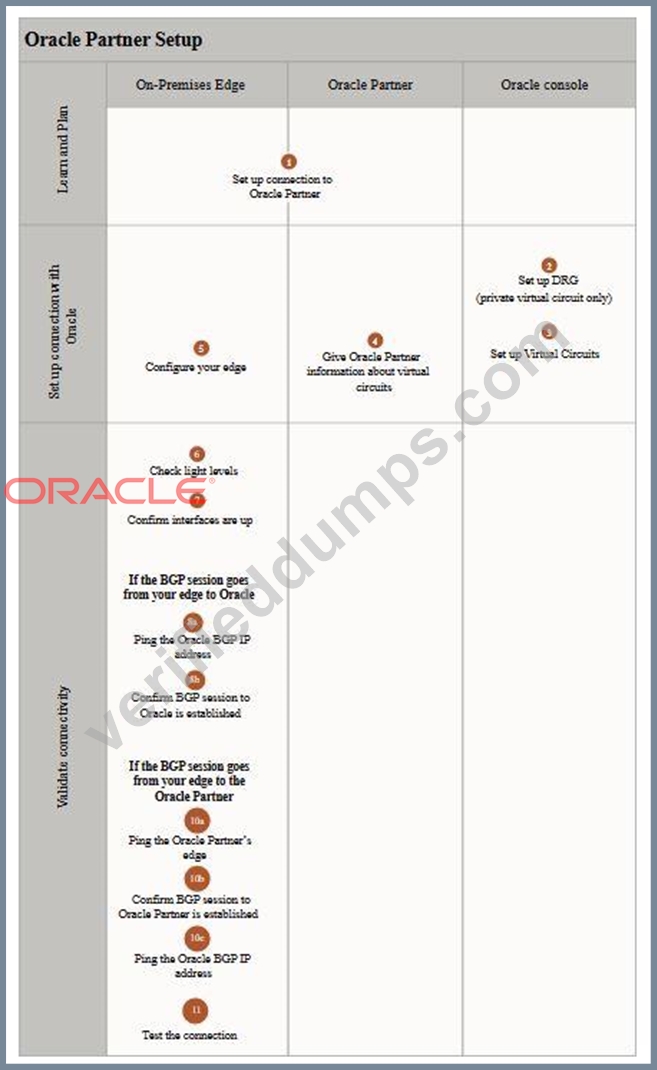
FastConnect: Colocation with Oracle:
If you have purchased colocation space from a data center provider, you can use Oracle FastCon-nect to establish connectivity from your network equipment in that colocation facility to your Oracle Cloud services provisioned at this location. Oracle will provide you a letter of authorization (LOA) that the data center provider will need in order to establish a direct cross-connect into Oracle's FastConnect edge devices provider will need in order to establish a direct cross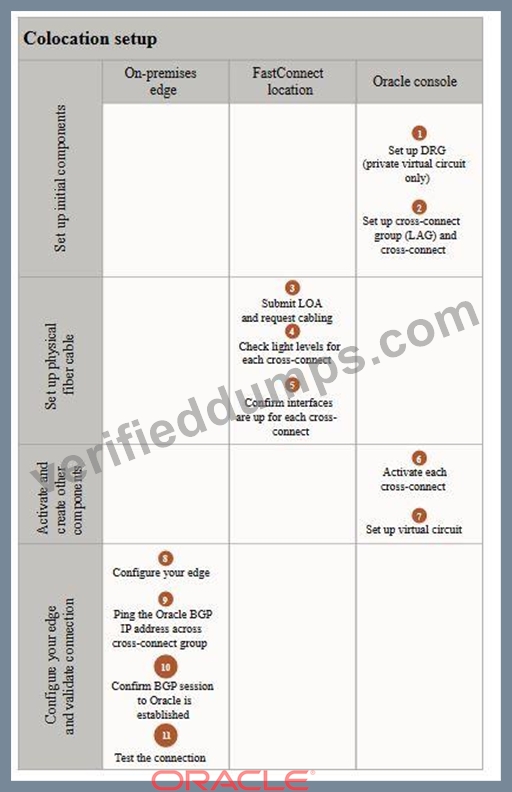
NEW QUESTION # 22
A company wants to seamlessly build a private interconnection between their OCI and Microsoft Azure environments with consistent performance and low latency. They want to enable their cloud engineers to set up Single Sign-On (SSO) between Microsoft Azure and OCI for their Oracle appli-cations, such as PeopleSoft, JD Edwards EnterpriseOne, and E-Business Suite.
Which technology integration can the company use to achieve this goal?
- A. Direct Connect and Azure VPN Gateway
- B. OCI Site-to-Site VPN and Azure Site-to-Site VPN
- C. Oracle FastConnect and Azure ExpressRoute
- D. Cloud Interconnect and Virtual WAN
Answer: C
Explanation:
By using Oracle FastConnect and Azure ExpressRoute, customers can seamlessly build a private interconnection between their OCI and Microsoft Azure environments. The Interconnect also ena-bles joint customers to take advantage of a unified identity and access management platform that leads to cost savings. Cloud engineers can set up SSO between Microsoft Azure and OCI for their Oracle applications, such as PeopleSoft, JD Edwards EnterpriseOne, and E-Business Suite. Having a federated SSO makes the integration seamless and allows users to authenticate only once to access multiple applications, without signing in separately to access each application.
NEW QUESTION # 23
Which step is NOT valid while implementing an OCI-Azure Interconnect?
- A. Set up an Azure ExpressRoute circuit.
- B. Create a Dynamic Routing Gateway and attach it to the OCI VCN.
- C. Select FastConnect Direct as the connection type.
- D. Set up an Oracle FastConnect virtual circuit.
Answer: C
Explanation:
As you can see in the below screenshot (from the OCI Console), while implementing OCI-Azure Interconnect you need to select Connection type: FastConnect partner and select Microsoft Azure ExpressRoute as the Partner.
Hence, "Select FastConnect Direct as the connection type" is NOT VALID and hence the correct answer.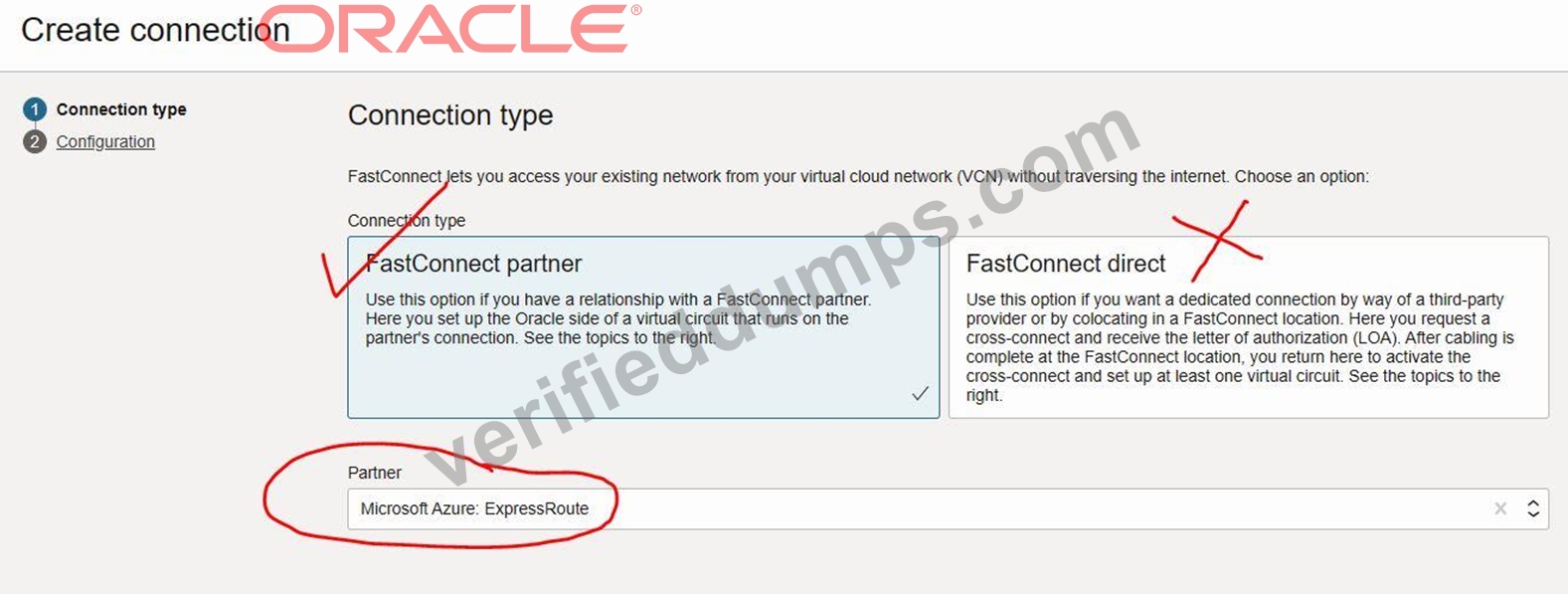
NEW QUESTION # 24
What should you do to prepare your Oracle Cloud Infrastructure (OCI) Virtual Cloud Network (VCN) for potential security risks when connected to a Microsoft Azure VNet?
- A. Allow all traffic from the Azure VNet without restrictions.
- B. Limit all inbound and outbound traffic from the Azure VNet to expected and well-defined traffic.
- C. Remove all OCI security rules.
- D. Disable the connection between Azure VNet and OCI VCN.
Answer: B
Explanation:
Controlling Traffic Flow Over the Connection
Even if a connection has been established between your VCN and VNet, you can control the packet flow over the connection with route tables in your VCN. For example, you can restrict traf-fic to only specific subnets in the VNet.
Controlling the Specific Types of Traffic Allowed
It's important that you ensure that all outbound and inbound traffic with the VNet is intended or expected and well defined. Implement Azure network security group and Oracle security rules that explicitly state the types of traffic one cloud can send to the other and accept from the other.
NEW QUESTION # 25
What components are required for setting up an Azure VNet to Oracle Cloud Infrastructure VCN connection as part of the OCI-Azure Interconnect?
- A. An Azure VNet with subnets and a virtual network gateway, and an OCI VCN with subnets and an attached internet gateway
- B. An Azure VNet with subnets and a virtual network gateway, and an OCI VCN with subnets and an attached dynamic routing gateway
- C. An Azure VNet with subnets and a virtual network gateway, and an OCI VCN with subnets and an attached service gateway
- D. An Azure VNet with subnets and a virtual network gateway, and an OCI VCN with subnets and an attached NAT gateway
Answer: B
Explanation:
If you closely look at the options, you can start eliminating some of them.
We can easily eliminate "An Azure VNet with subnets and a virtual network gateway, and an OCI VCN with subnets and an attached service gateway" as we don't require service gateway to setup OCI-Azure Interconnect.
On similar lines, we can also eliminate the options where internet gateway and NAT gateway is pre-sent.
Hence "An Azure VNet with subnets and a virtual network gateway, and an OCI VCN with sub-nets and an attached internet gateway" and "An Azure VNet with subnets and a virtual network gateway, and an OCI VCN with subnets and an attached NAT gateway".
As you can see in the architecture below, on the OCI side you require a Dynamic Routing Gate-way and on the Azure side you need a Virtual Network Gateway.
Hence the option "An Azure VNet with subnets and a virtual network gateway, and an OCI VCN with subnets and an attached dynamic routing gateway" is CORRECT.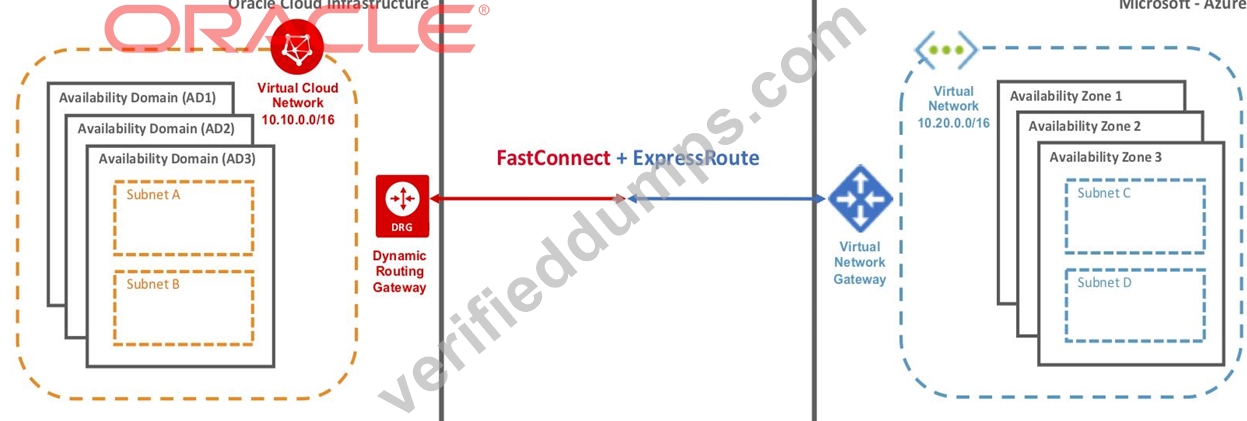
NEW QUESTION # 26
You plan to use OracleDB Service for Azure to easily provision, access, and operate enterprise-grade Oracle Database services in Oracle Cloud Infrastructure (OCI) with a familiar Azure-like ex-perience. What should you do to sign up for the OracleDB for Azure service?
- A. Visit the Azure portal and navigate to the Oracle Database Service page.
- B. Visit the sign up website at https://signup.multicloud.oracle.com/azure
- C. Contact Oracle support to request access to the service.
- D. Visit the sign up website at https://signup.multicloud.azure.com/oracle
Answer: B
Explanation:
To start OracleDB for Azure onboarding, go to https://signup.multicloud.oracle.com/azure
NEW QUESTION # 27
A company has deployed an application in Oracle Cloud Infrastructure consisting of multiple web servers, database servers, and application servers. The company wants to restrict communication be-tween these components, allowing only the necessary traffic between them. Which OCI feature would be most suitable to achieve this objective?
- A. Use Route Tables to define custom routing policies between each component.
- B. Use Network Security Groups to apply specific firewall rules for each component.
- C. Use Virtual Cloud Networks to create isolated networks for each component.
- D. Use Security Lists to configure network access rules for the entire Virtual Cloud Net-work.
Answer: B
Explanation:
Network security groups (NSGs) act as a virtual firewall for your compute instances .
An NSG consists of a set of ingress and egress security rules that apply only to a set of VNICs of your choice in a single VCN (for example: all the compute instances that act as web servers in the web tier of a multi-tier application in your VCN).
Hence, "Use Network Security Groups to apply specific firewall rules for each component." is the CORRECT answer.
In this question , you can straightaway reject "Use Virtual Cloud Networks to create isolated net-works for each component." and "Use Route Tables to define custom routing policies between each component." options.
NSG wins here due to the keywords "restrict communication between these components" in the question. A network security group (NSG) provides a virtual firewall for a set of cloud re-sources that all have the same security posture.
NEW QUESTION # 28
Which database system is NOT available in Oracle Database Service for Azure?
- A. Autonomous Database on dedicated Exadata infrastructure
- B. Base Database using Oracle Enterprise Edition or Oracle Standard Edition 2 databases
- C. Oracle Exadata Database
- D. Autonomous Database on shared Exadata infrastructure
Answer: A
Explanation:
Oracle Database Service for Azure offers the following products:
Oracle Exadata Database: You can provision flexible Exadata systems that allow you to add database compute servers and storage servers to your system at any time after provision-ing.
Autonomous Database on shared Exadata infrastructure: Autonomous Database pro-vides an easy-to-use, fully autonomous database that scales elastically, delivers fast query performance, and requires no database administration.
Base Database: Using OracleDB for Azure, you can deploy Oracle Enterprise Edition or Oracle Standard Edition 2 databases on virtual machine DB systems. You can deploy single-node systems or 2-node RAC systems.
MySQL Database with HeatWave: MySQL Database Service is a fully managed Oracle Cloud native service available through OracleDB for Azure. It is developed, managed, and supported by the MySQL team in Oracle. Optionally, you can add a HeatWave cluster to a MySQL DB system. HeatWave is a distributed, scalable, shared-nothing, in-memory, hybrid columnar, query processing engine designed for extreme performance.
Hence, "Autonomous Database on dedicated Exadata infrastructure" is NOT available and hence the CORRECT ANSWER.
NEW QUESTION # 29
Which is NOT an Azure resource that is created when you provision a database using Oracle Data-base Service for Azure?
- A. Oracle Database Service
- B. Custom Dashboard workspace
- C. Log Analytics workspace
- D. Application Insights workspace
Answer: A
Explanation:
Log Analytics Workspace, Application Insights and Custom Dashboard are Azure resources and hence we can eliminate these options.
We are left with Oracle Database Service which is the CORRECT answer.
NEW QUESTION # 30
Which database system does NOT require an Azure Virtual Network during provisioning?
- A. Autonomous Database on shared Exadata infrastructure
- B. Base Database with Oracle Enterprise Edition or Oracle Standard Edition 2
- C. Oracle Exadata Database
- D. MySQL Database with HeatWave
Answer: A
Explanation:
See the screenshots below for the databases mentioned in the question:
You can
see the Azure Virtual Network option for Base Database, MySQL Database with Heat-Wave and Oracle Exadata Database.
Base Database: Requires Azure Virtual Network
MySQL Database with HeatWave: Requires Azure Virtual Network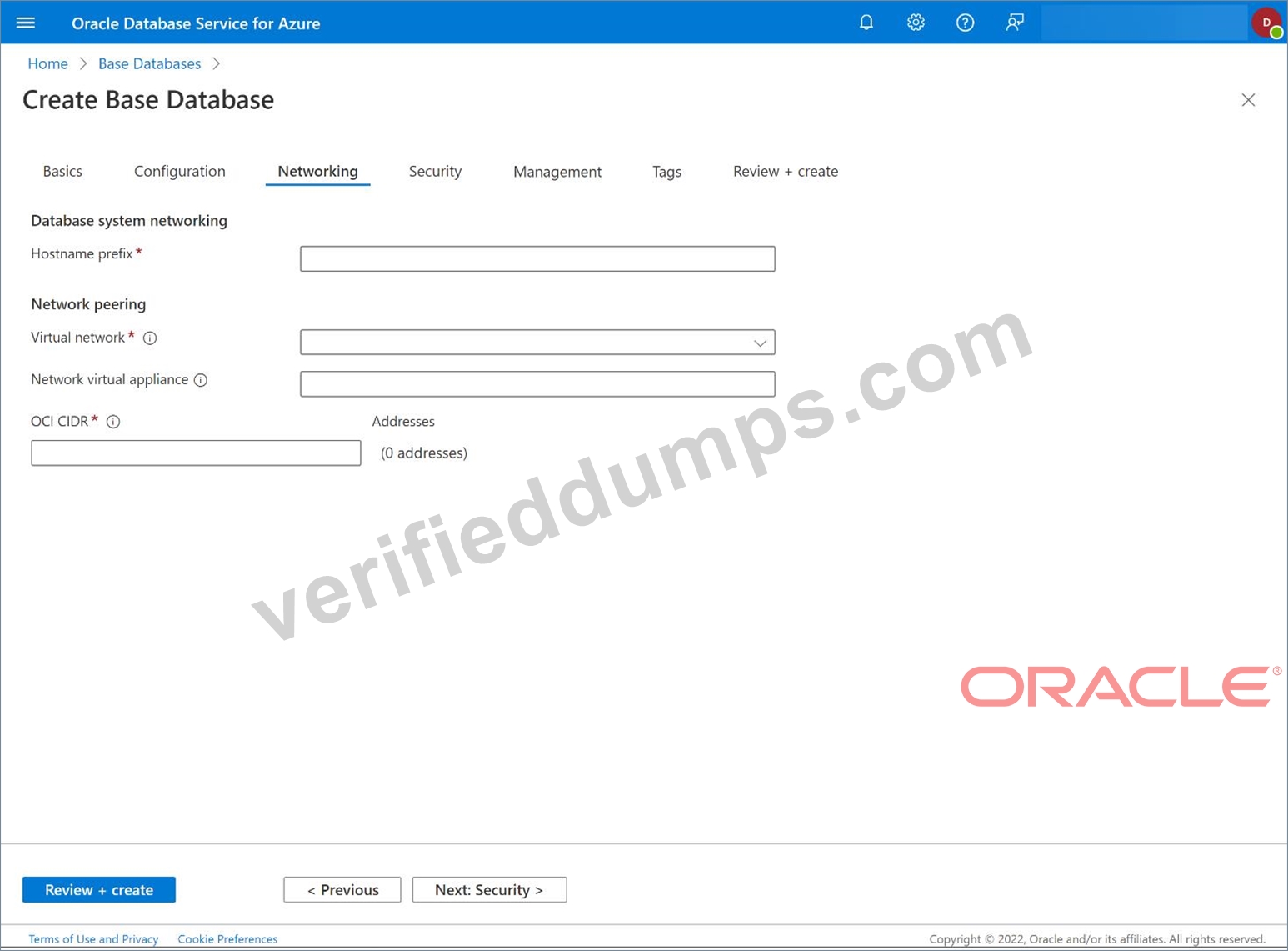
Oracle Exadata Database : Requires Azure Virtual Network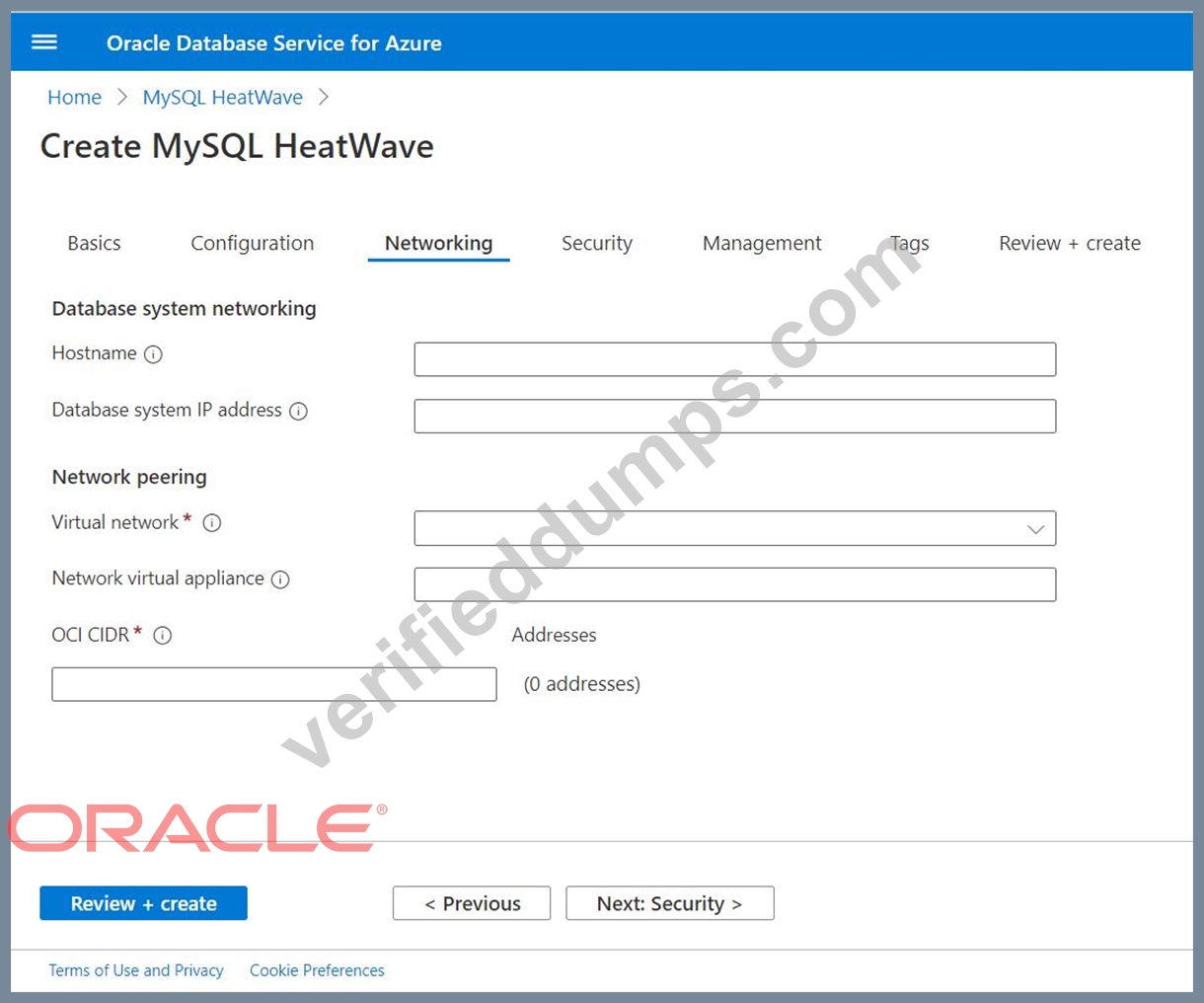
Autonomous Database on shared Exadata infrastructure: DOES NOT require an Azure VNeT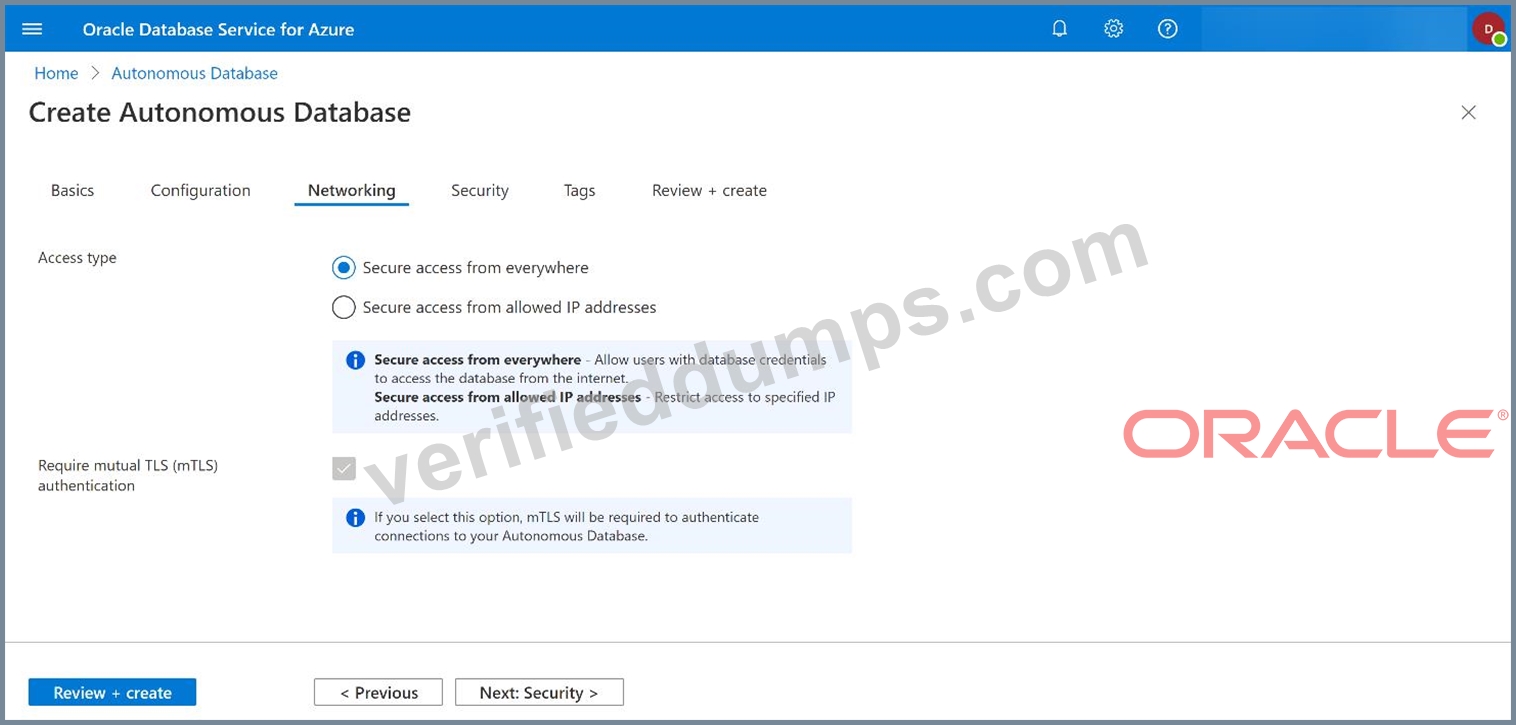
NEW QUESTION # 31
What is the purpose of the SAML metadata file in the OCI Federation setup with Azure Active Di-rectory (AD)?
- A. It is used to exchange metadata information between Azure AD and OCI.
- B. It is used to store user credentials for authentication.
- C. It is used to configure attribute mapping between Azure AD and OCI.
- D. It is used to establish trust between Azure AD and OCI.
Answer: A
Explanation:
In general, SAML metadata is used to share configuration information between the Identity Pro-vider (IdP) and the Service Provider (SP).
NEW QUESTION # 32
An organization has decided to implement a multicloud solution by using Microsoft Azure for their frontend data analytics applications and Oracle Cloud Infrastructure (OCI) for their backend Oracle Autonomous Data Warehouse. In this scenario, how can the organization ensure secure and low la-tency data transfer between the frontend applications and the backend data warehouse?
- A. Leverage a VPN Gateway to create an encrypted tunnel between Azure and OCI for secure data transfer.
- B. Use public internet connections to transfer data between Azure and OCI, encrypting the data in transit.
- C. Implement a hybrid cloud approach by integrating on-premises infrastructure with both Azure and OCI.
- D. Establish a dedicated, private connection between Azure and OCI using Azure Ex-pressRoute and Oracle FastConnect.
Answer: D
Explanation:
In the question, frontend is in Azure and backend is in OCI. And the keywords are SECURE and LOW LATENCY data transfer.
Use public internet connections to transfer data between Azure and OCI, encrypting the data in transit - INCORRECT as this option won't provide LOW LATENCY data transfer (as it is us-ing public internet).
Leverage a VPN Gateway to create an encrypted tunnel between Azure and OCI for secure data transfer - INCORRECT as Site-to-Site VPN Connection won't provide LOW LATENCY data transfer as the connection traverses through public internet.
Implement a hybrid cloud approach by integrating on-premises infrastructure with both Azure and OCI - INCORRECT as there is no mention of on-premises environment in the question. This option is irrelevant here.
Establish a dedicated, private connection between Azure and OCI using Azure ExpressRoute and Oracle FastConnect - CORRECT as it provides a direct Interconnect between OCI and Microsoft Azure which in turn provides <2ms latency for superior multicloud network performance.
NEW QUESTION # 33
What is the primary purpose of the MySQL Database Service HeatWave option in Oracle Cloud Infrastructure (OCI)?
- A. To offer a serverless MySQL deployment
- B. To ensure high availability and fault tolerance
- C. To enable seamless database migration from on-premises to OCI
- D. To provide a distributed in-memory query accelerator
Answer: D
Explanation:
HeatWave is an in-memory query accelerator developed for Oracle MySQL Database Service. It's a massively parallel, hybrid, columnar, query-processing engine with state-of-art algorithms for distributed query processing which provide very high performance for queries.
NEW QUESTION # 34
Which is NOT a security capability available with OracleDB for Azure?
- A. Security features such as network isolation and access controls
- B. Automatic security updates for the database
- C. Encryption of data at rest and in transit
- D. IPsec tunnel
Answer: D
NEW QUESTION # 35
......
Guaranteed Success in Oracle Cloud 1z0-1115-23 Exam Dumps: https://www.verifieddumps.com/1z0-1115-23-valid-exam-braindumps.html
Oracle 1z0-1115-23 Daily Practice Exam New 2023 Updated 43 Questions: https://drive.google.com/open?id=1qYdNtyA868UXUQC2oA_Er_2m9JziYslT
