

[Nov-2021] 156-915.80 Dumps are Available for Instant Access using VerifiedDumps
156-915.80 Dumps 2021 - New CheckPoint 156-915.80 Exam Questions
NEW QUESTION 213
CORRECT TEXT
Fill in the blanks. To view the number of concurrent connections going through your firewall, you would use the command and syntax __ ___ __ __________ __ .
Answer:
Explanation:
fw tab -t connections -s
NEW QUESTION 214
What are the available options for downloading Check Point hotfixes in Gaia WebUI (CPUSE)?
- A. Update Automatically, Update Now, Disable Update
- B. Manually, Scheduled, Automatic
- C. Update Now, Scheduled Update, Offline Update
- D. Manual Update, Disable Update, Automatic Update
Answer: B
Explanation:
Explanation/Reference:
Reference: https://sc1.checkpoint.com/documents/R80.10/WebAdminGuides/EN/ CP_R80.10_Gaia_AdminGuide/html_frameset.htm?topic=documents/R80.10/WebAdminGuides/EN/ CP_R80.10_Gaia_AdminGuide/84387
NEW QUESTION 215
You have created a Rule Base for firewall, websydney. Now you are going to create a new policy package with security and address translation rules for a second Gateway.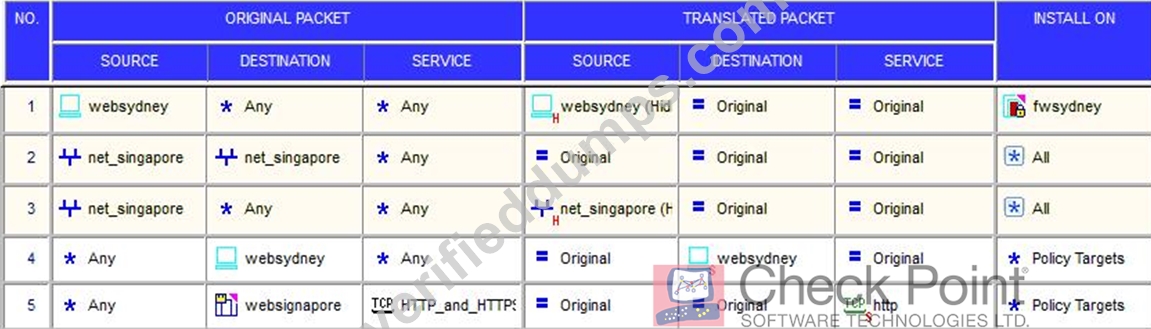
What is TRUE about the new package's NAT rules?
- A. NAT rules will be empty in the new package.
- B. Rules 1, 2, 3 will appear in the new package.
- C. Only rule 1 will appear in the new package.
- D. Rules 4 and 5 will appear in the new package.
Answer: B
NEW QUESTION 216
For interfaces can you configure to use the Multi-Queue
a valid synchronization status?
- A. Lagging
- B. Never been synchronized
- C. Collision
- D. Down
Answer: D
NEW QUESTION 217
The SmartEvent R80 Web application for real-time event monitoring is called:
- A. SmartView Monitor
- B. There is no Web application for SmartEvent
- C. SmartView
- D. SmartEventWeb
Answer: A
NEW QUESTION 218
Which of these options is an implicit MEP option?
- A. Primary-backup
- B. Load Sharing
- C. Source address based
- D. Round robin
Answer: A
Explanation:
There are three methods to implement implicit MEP:
* First to Respond, in which the first Security Gateway to reply to the peer Security Gateway is chosen. An organization would choose this option if, for example, the organization has two Security Gateways in a MEP configuration - one in London, the other in New York. It makes sense for VPN-1 peers located in England to try the London Security Gateway first and the NY Security Gateway second. Being geographically closer to VPN peers in England, the London Security Gateway is the first to respond, and becomes the entry point to the internal network. See: First to Respond.
* Primary-Backup, in which one or multiple backup Security Gateways provide "high availability" for a primary Security Gateway. The remote peer is configured to work with the primary Security Gateway, but switches to the backup Security Gateway if the primary goes down. An organization might decide to use this configuration if it has two machines in a MEP environment, one of which is stronger than the other. It makes sense to configure the stronger machine as the primary. Or perhaps both machines are the same in terms of strength of performance, but one has a cheaper or faster connection to the Internet. In this case, the machine with the better Internet connection should be configured as the primary. See: Primary-Backup Security Gateways.
* Load Distribution, in which the remote VPN peer randomly selects a Security Gateway with which to open a connection. For each IP source/destination address pair, a new Security Gateway is randomly selected. An organization might have a number of machines with equal performance abilities. In this case, it makes sense to enable load distribution. The machines are used in a random and equal way. See: Random Selection.
Reference: https://sc1.checkpoint.com/documents/R77/CP_R77_VPN_AdminGuide/13812.htm
NEW QUESTION 219
Check Point APIs allow system engineers and developers to make changes to their organization's security policy with CLI tools and Web Services for all of the following except?
- A. Create products that use and enhance the Check Point Solution.
- B. Create new dashboards to manage 3rd party task
- C. Create products that use and enhance 3rd party solutions.
- D. Execute automated scripts to perform common tasks.
Answer: B
Explanation:
Check Point APIs let system administrators and developers make changes to the security policy with CLI tools and web-services. You can use an API to:
*Use an automated script to perform common tasks
*Integrate Check Point products with 3rd party solutions
*Create products that use and enhance the Check Point solution
NEW QUESTION 220
Your customer, Mr. Smith needs access to other networks and should be able to use all services. Session authentication is not suitable. You select Client Authentication with HTTP. The standard authentication port for client HTTP authentication (Port 900) is already in use. You want to use Port 9001 but are having connectivity problems. Why are you having problems?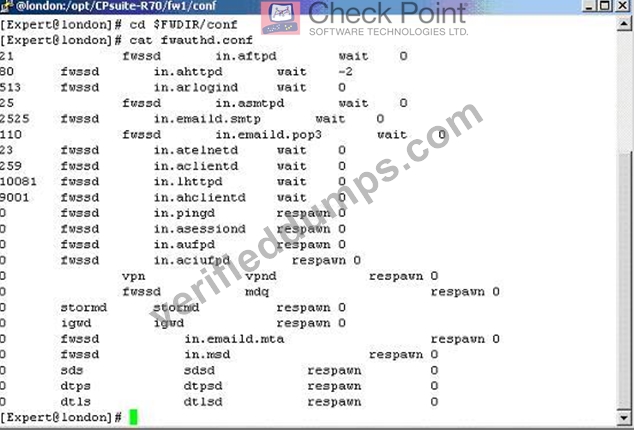

- A. You can't use any port other than the standard port 900 for Client Authentication via HTTP.
- B. The configuration file $FWDIR/conf/fwauthd.conf is incorrect.
- C. The Security Policy is not correct.
- D. The service FW_clntauth_http configuration is incorrect.
Answer: B
NEW QUESTION 221
The Regulatory Compliance pane shows compliance statistics for selected regulatory standards, based on the Security Best Practice scan. Which of the following does NOT show in this pane?
- A. The total number of Regulatory Requirements that are monitored
- B. The average number of Regulatory Requirements that are monitored
- C. The Average compliance score for each regulation shown
- D. The Number of Regulatory Requirements for each Regulation
Answer: B
Explanation:
Reference: https://sc1.checkpoint.com/documents/R77/CP_R77_Compliance_WebAdminGuide/96026.htm
NEW QUESTION 222
The CDT utility supports which of the following?
- A. Only major version upgrades to R80.10
- B. Only Jumbo HFA's and hotfixes
- C. Major version upgrades to R77.30
- D. All upgrades
Answer: D
Explanation:
Section: (none)
Explanation/Reference:
Explanation:
The Central Deployment Tool (CDT) is a utility that runs on an R77 / R77.X / R80 / R80.10 Security Management Server / Multi-Domain Security Management Server (running Gaia OS).
It allows the administrator to automatically install CPUSE Offline packages (Hotfixes, Jumbo Hotfix Accumulators (Bundles), Upgrade to a Minor Version, Upgrade to a Major Version) on multiple managed Security Gateways and Cluster Members at the same time.
Reference: https://community.checkpoint.com/thread/5319-my-top-3-check-point-cli-commands
NEW QUESTION 223
You are trying to configure Directional VPN Rule Match in the Rule Base. But the Match column does not have the option to see the Directional Match. You see the following window.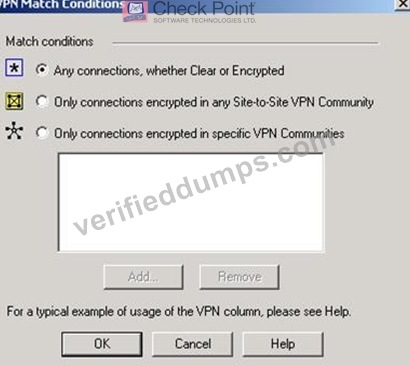
What must you enable to see the Directional Match?
- A. VPN Directional Match on the Gateway object's VPN tab
- B. directional_match(true) in the objects_5_0.C file on Security Management Server
- C. VPN Directional Match on the VPN advanced window, in Global Properties
- D. Advanced Routing on each Security Gateway
Answer: C
NEW QUESTION 224
Check Point APIs allow system engineers and developers to make changes to their organization's security policy with CLI tools and Web Services for all of the following except?
- A. Create new dashboards to manage 3rd party task
- B. Create products that use and enhance 3rd party solutions.
- C. Execute automated scripts to perform common tasks.
- D. Create products that use and enhance the Check Point Solution.
Check Point APIs let system administrators and developers make changes to the security policy with CLI tools and web-services. You can use an API to:
* Use an automated script to perform common tasks
* Integrate Check Point products with 3rd party solutions
* Create products that use and enhance the Check Point solution
Answer: A
NEW QUESTION 225
Which of the following commands shows the status of processes?
- A. cpwd -l
- B. cpwd_admin -l
- C. cpwd admin_list
- D. cpwd_admin list
Answer: D
Explanation:
Reference: https://community.checkpoint.com/thread/8054-cpwdadmin-list-overview-sms
NEW QUESTION 226
CORRECT TEXT
In a zero downtime scenario, which command do you run manually after all cluster members are upgraded?
Answer:
Explanation:
cphaconf set_ccp multicast
NEW QUESTION 227
The command that typically generates the firewall application, operating system, and hardware specific drivers is _________ .
Answer:
Explanation:
snapshot
NEW QUESTION 228
Which command collects diagnostic data for analyzing customer setup remotely?
- A. cpinfo
- B. cpview
- C. sysinfo
- D. migrate export
Answer: A
Explanation:
CPInfo is an auto-updatable utility that collects diagnostics data on a customer's machine at the time of execution and uploads it to Check Point servers (it replaces the standalone cp_uploader utility for uploading files to Check Point servers).
The CPInfo output file allows analyzing customer setups from a remote location. Check Point support engineers can open the CPInfo file in a demo mode, while viewing actual customer Security Policies and Objects. This allows the in-depth analysis of customer's configuration and environment settings.
NEW QUESTION 229
Fill in the blank.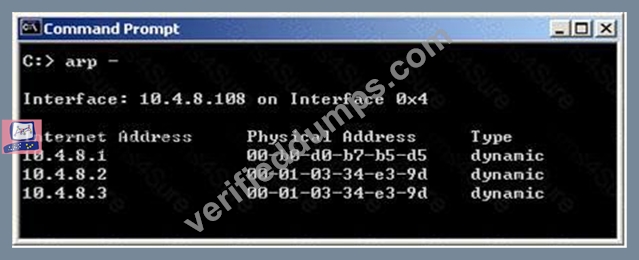
In New Mode HA, the internal cluster IP VIP address is 10.4.8.3.
The internal interfaces on two members are 10.4.8.1 and 10.4.8.2 Internal host 10.4.8.108 pings 10.4.8.3, and receives replies.
Review the ARP table from the internal Windows host 10.4.8.108.
According to the output, which member is the standby machine?
Answer:
Explanation:
10.4.8.1
NEW QUESTION 230
Which one of these is NOT a firewall chain?
- A. RTM packet in (rtm)
- B. IP Options restore (in) (ipopt_res)
- C. VPN node add (vpnad)
- D. Fw SCV inbound (scv)
Answer: C
Explanation:
Explanation/Reference:
Reference: http://dkcheckpoint.blogspot.com/2016/07/chapter-2-chain-module.html
NEW QUESTION 231
To accelerate the rate of connection establishment, SecureXL groups all connection that match a particular service and whose sole differentiating element is the source port. The type of grouping enables even the very first packets of a TCP handshake to be accelerated. The first packets of the first connection on the same service will be forwarded to the Firewall kernel which will then create a template of the connection. Which of these IS NOT a SecureXL template?
- A. Deny template
- B. Accept Template
- C. NAT Template
[Expert@GW:0]# fwaccel statAccelerator Status : onAccept Templates : enabledDrop Templates : disabledNAT Templates : enabledNMR Templates : enabledNMT Templates : enabled - D. Drop Template
Answer: A
NEW QUESTION 232
What is the proper CLISH syntax to configure a default route via 192.168.255.1 in Gaia?
- A. set static-route 192.168.255.0/24 nexthop gateway logical eth1 on
- B. set static-route nexthop default gateway logical 192.168.255.1 priority 1 on
- C. set static-route default nexthop gateway address 192.168.255.1 priority 1 on
- D. set static-route 192.168.255.0/24 nexthop gateway address 192.168.255.1 priority 1 on
Answer: C
NEW QUESTION 233
Which one of these features is NOT associated with the Check Point URL Filtering and Application Control Blade?
- A. Use UserCheck to help users understand that certain websites are against the company's security policy.
- B. Make rules to allow or block applications and Internet sites for individual applications, categories, and risk levels.
- C. Configure rules to limit the available network bandwidth for specified users or groups.
- D. Detects and blocks malware by correlating multiple detection engines before users are affected.
Answer: D
Explanation:
Explanation/Reference:
Explanation:
Use the URL Filtering and Application Control Software Blades to:
Create a Granular Policy - Make rules to allow or block applications and Internet sites for individual
applications, categories, and risk levels. You can also create an HTTPS policy that enables Security Gateways to inspect HTTPS traffic and prevent security risks related to the SSL protocol.
Manage Bandwidth Consumption - Configure rules to limit the available network bandwidth for
specified users or groups. You can define separate limits for uploading and downloading.
Keep Your Policies Updated - The Application Database is updated regularly, which helps you makes
sure that your Internet security policy has the newest applications and website categories. Security Gateways connect to the Check Point Online Web Service to identify new social networking widgets and website categories.
Communicate with Users - UserCheck objects add flexibility to URL Filtering and Application Control
and let the Security Gateways communicate with users. UserCheck helps users understand that certain websites are against the company's security policy. It also tells users about the changes in Internet policy related to websites and applications.
Reference: https://sc1.checkpoint.com/documents/R80/CP_R80_SecMGMT/html_frameset.htm?
topic=documents/R80/CP_R80_SecMGMT/126197
NEW QUESTION 234
......
Check Point Certified Security Expert Update - R80 (CCSE) 156-915.80 Exam
Check Point Certified Security Expert Update - R80 (CCSE) 156-915.80 Exam is related to Check Point Certified Security Expert Certification.156-915.80 Exam Validate candidates understanding and skills necessary to configure and optimally manage Check Point Next-Generation Firewalls. System Security Consultant and Server Managers usually hold or pursue this certification and candidate can expect the same job roles after completion of this Check Point Certified Security Expert Update - R80 (CCSE) 156-915.80 certification.
CheckPoint 156-915.80 Exam Practice Test Questions: https://www.verifieddumps.com/156-915.80-valid-exam-braindumps.html
