

Download the Latest Associate-Cloud-Engineer Dumps - 2023 Associate-Cloud-Engineer Exam Questions
Latest Google Associate-Cloud-Engineer Certification Practice Test Questions
Below are the Problems in taking the Associate Cloud Engineer Exam
Google Certified Specialist is the most powerful certification that candidates can have on their resume. But for this, they will have to pass Associate Cloud Engineer questions. Associate Cloud Engineer is a challenging exam to pass this exam Candidates will have to work hard with the help of the right focus and preparation material passing this exam is an achievable goal. VerifiedDumps help candidates by providing the most relevant and updated Associate Cloud Engineer exam dumps. Furthermore, We also provide the Associate Cloud Engineer practice test that will be much beneficial in the preparation. VerifiedDumps aims to provide the best Associate Cloud Engineer exam dumps that are verified by the Google experts. If Candidates feel any doubt in the Associate Cloud Engineer practice test then our team is always there to help them. Associate Cloud Engineer exam dumps are the perfect way to prepare the Associate Cloud Engineer exam with good grades in the just first attempt. So, Candidates want instant success in the Associate Cloud Engineer exam with quality Associate Cloud Engineer training material then VerifiedDumps is the best option for them because our management is well trained in it and we update each question of all exams on regular basis after consulting recent updates with our Google certified professionals.
NEW QUESTION # 95
You are building a pipeline to process time-series data. Which Google Cloud Platform services should you put in boxes 1,2,3, and 4?
- A. Cloud Pub/Sub, Cloud Dataflow, Cloud Bigtable, BigQuery
- B. Cloud Pub/Sub, Cloud Dataflow, Cloud Datastore, BigQuery
- C. Firebase Messages, Cloud Pub/Sub, Cloud Spanner, BigQuery
- D. Cloud Pub/Sub, Cloud Storage, BigQuery, Cloud Bigtable
Answer: A
Explanation:
Explanation/Reference: https://cloud.google.com/solutions/correlating-time-series-dataflow
NEW QUESTION # 96
You are working for a hospital that stores its medical images in an on-premises data room. The hospital wants to use Cloud Storage for archival storage of these images. The hospital wants an automated process to upload any new medical images to Cloud Storage. You need to design and implement a solution. What should you do?
- A. Create a script that uses the gsutilcommand line interface to synchronize the on-premises storage with Cloud Storage. Schedule the script as a cron job.
- B. In the Cloud Console, go to Cloud Storage. Upload the relevant images to the appropriate bucket.
- C. Create a Pub/Sub topic, and enable a Cloud Storage trigger for the Pub/Sub topic. Create an application that sends all medical images to the Pub/Sub topic.
- D. Deploy a Dataflow job from the batch template, "Datastore to Cloud Storage." Schedule the batch job on the desired interval.
Answer: A
NEW QUESTION # 97
You recently deployed a new version of an application to App Engine and then discovered a bug in the release. You need to immediately revert to the prior version of the application. What should you do?
- A. On the App Engine Versions page of the GCP Console, route 100% of the traffic to the previous version.
- B. On the App Engine page of the GCP Console, select the application that needs to be reverted and click Revert.
- C. Deploy the original version as a separate application. Then go to App Engine settings and split traffic between applications so that the original version serves 100% of the requests.
- D. Run gcloud app restore.
Answer: C
Explanation:
Reference:
https://medium.com/google-cloud/app-engine-project-cleanup-9647296e796a
NEW QUESTION # 98
Every employee of your company has a Google account. Your operational team needs to manage a large number of instances on Compute Engine. Each member of this team needs only administrative access to the servers. Your security team wants to ensure that the deployment of credentials is operationally efficient and must be able to determine who accessed a given instance. What should you do?
- A. Generate a new SSH key pair. Give the private key to each member of your team. Configure the public key in the metadata of each instance.
- B. Ask each member of the team to generate a new SSH key pair and to add the public key to their Google account. Grant the "compute.osAdminLogin" role to the Google group corresponding to this team.
- C. Generate a new SSH key pair. Give the private key to each member of your team. Configure the public key as a project-wide public SSH key in your Cloud Platform project and allow project-wide public SSH keys on each instance.
- D. Ask each member of the team to generate a new SSH key pair and to send you their public key. Use a configuration management tool to deploy those keys on each instance.
Answer: B
Explanation:
Explanation
https://cloud.google.com/compute/docs/instances/managing-instance-access
NEW QUESTION # 99
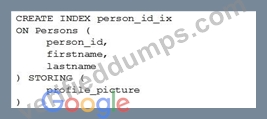
Your customer has implemented a solution that uses Cloud Spanner and notices some read latency-related performance issues on one table. This table is accessed only by their users using a primary key. The table schema is shown below.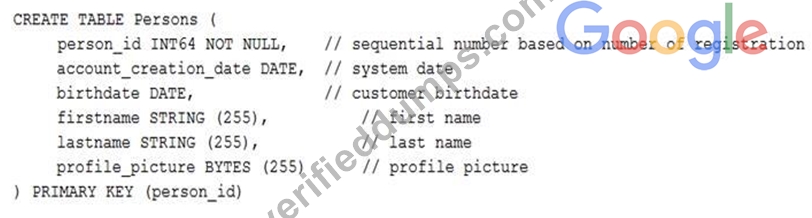
You want to resolve the issue. What should you do?
- A. Create a secondary index using the following Data Definition Language (DDL):
- B. Remove the profile_picture field from the table.
- C. Change the primary key to not have monotonically increasing values.
- D. Add a secondary index on the person_id column.
Answer: C
Explanation:
Schema design best practice #1: Do not choose a column whose value monotonically increases or decreases as the first key part for a high write rate table.
https://cloud.google.com/spanner/docs/schema-design#postgresql
NEW QUESTION # 100
You want to configure 10 Compute Engine instances for availability when maintenance occurs. Your requirements state that these instances should attempt to automatically restart if they crash. Also, the instances should be highly available including during system maintenance. What should you do?
- A. Create an instance group for the instances. Set the 'Autohealing' health check to healthy (HTTP).
- B. Create an instance templated for the instances. Set 'Automatic Restart' to off. Set 'On-host maintenance' to Terminate VM instances. Add the instance template to an instance group.
- C. Create an instance template for the instances. Set the 'Automatic Restart' to on. Set the 'On-host maintenance' to Migrate VM instance. Add the instance template to an intsance group.
- D. Create an instance group for the instance. Verify that the 'Advanced creation options' setting for 'do not retry machine creation' is set to off.
Answer: B
NEW QUESTION # 101
You're trying to provide temporary access to some files in a Cloud Storage bucket. You want to limit the time that the files are available to 10 minutes. With the fewest steps possible, what is the best way to generate a signed URL?
- A. Create a service account and JSON key. Use the gsutil signurl -t 10m command and pass in the JSON key and bucket.
- B. Create a service account and JSON key. Use the gsutil signurl -d 10m command and pass in the JSON key and bucket.
- C. In the UI select the objects and click the "Sign With Key" button.
- D. In the UI select the objects and click the Generate Signed URL button.
Answer: B
NEW QUESTION # 102
A VM instance is trying to read from a Cloud Storage bucket. IAM roles assigned to the VM service account allows the VM instance to read from the bucket. But the scopes assigned to the VM deny the reading bucket. What will happen when VM tries to read from the bucket?
- A. The read will not execute as IAM roles and scopes both determine what operations will be performed
- B. The application performing the read will drop the read operation
- C. The read will succeed because the most permissive permission is allowed
- D. The read operation will execute, but a message will be sent to the Stackdriver Logging
Answer: A
NEW QUESTION # 103
Your company runs one batch process in an on-premises server that takes around 30 hours to complete. The task runs monthly, can be performed offline, and must be restarted if interrupted.
You want to migrate this workload to the cloud while minimizing cost. What should you do?
- A. Migrate the workload to a Compute Engine Preemptible VM.
- B. Create an Instance Template with Preemptible VMs On.
Create a Managed Instance Group from the template and adjust Target CPU Utilization.
Migrate the workload. - C. Migrate the workload to a Google Kubernetes Engine cluster with Preemptible nodes.
- D. Migrate the workload to a Compute Engine VM.
Start and stop the instance as needed.
Answer: D
Explanation:
Install the workload in a compute engine VM, start and stop the instance as needed, because as per the question the VM runs for 30 hours, process can be performed offline and should not be interrupted, if interrupted we need to restart the batch process again. Preemptible VMs are cheaper, but they will not be available beyond 24hrs, and if the process gets interrupted the preemptible VM will restart.
NEW QUESTION # 104
You want to run a single caching HTTP reverse proxy on GCP for a latency-sensitive website. This specific reverse proxy consumes almost no CPU. You want to have a 30-GB in-memory cache, and need an additional
2 GB of memory for the rest of the processes. You want to minimize cost. How should you run this reverse proxy?
- A. Run it on Compute Engine, choose the instance type n1-standard-1, and add an SSD persistent disk of
32 GB. - B. Create a Cloud Memorystore for Redis instance with 32-GB capacity.
- C. Run it on Compute Engine, and choose a custom instance type with 6 vCPUs and 32 GB of memory.
- D. Package it in a container image, and run it on Kubernetes Engine, using n1-standard-32 instances as nodes.
Answer: C
NEW QUESTION # 105
You are monitoring an application and receive user feedback that a specific error is spiking. You notice that the error is caused by a Service Account having insufficient permissions. You are able to solve the problem but want to be notified if the problem recurs. What should you do?
- A. In the Log Viewer, filter the logs on severity 'Error' and the name of the Service Account.
- B. Grant Project Owner access to the Service Account.
- C. Create a sink to BigQuery to export all the logs. Create a Data Studio dashboard on the exported logs.
- D. Create a custom log-based metric for the specific error to be used in an Alerting Policy.
Answer: D
NEW QUESTION # 106
You are running multiple VPC-native Google Kubernetes Engine clusters in the same subnet. The IPs available for the nodes are exhausted, and you want to ensure that the clusters can grow in nodes when needed.
What should you do?
- A. Create a new subnet in the same region as the subnet being used.
- B. Add an alias IP range to the subnet used by the GKE clusters.
- C. Create a new VPC, and set up VPC peering with the existing VPC.
- D. Expand the CIDR range of the relevant subnet for the cluster.
Answer: C
Explanation:
Explanation
To create a VPC peering connection, first create a request to peer with another VPC.
NEW QUESTION # 107
You received a JSON file that contained a private key of a Service Account in order to get access to several resources in a Google Cloud project. You downloaded and installed the Cloud SDK and want to use this private key for authentication and authorization when performing gcloud commands. What should you do?
- A. Place the private key file in the installation directory of the Cloud SDK and rename it to "credentials ison"
- B. Use the command gcloud auth activate-service-account and point it to the private key
- C. Use the command gcloud auth login and point it to the private key
- D. Place the private key file in your home directory and rename it to
`'GOOGLE_APPUCATION_CREDENTiALS".
Answer: B
Explanation:
https://cloud.google.com/sdk/docs/authorizing
NEW QUESTION # 108
Every employee of your company has a Google account. Your operational team needs to manage a large number of instances on Compute Engine. Each member of this team needs only administrative access to the servers. Your security team wants to ensure that the deployment of credentials is operationally efficient and must be able to determine who accessed a given instance. What should you do?
- A. Ask each member of the team to generate a new SSH key pair and to send you their public key.
Use a configuration management tool to deploy those keys on each instance. - B. Generate a new SSH key pair. Give the private key to each member of your team.
Configure the public key in the metadata of each instance. - C. Generate a new SSH key pair. Give the private key to each member of your team.
Configure the public key as a project-wide public SSH key in your Cloud Platform project and allow project-wide public SSH keys on each instance. - D. Ask each member of the team to generate a new SSH key pair and to add the public key to their Google account.
Grant the "compute.osAdminLogin" role to the Google group corresponding to this team.
Answer: C
NEW QUESTION # 109
You and your team have been working on a new application over the past couple weeks. While it's still in development, it's becoming a bit costly for your limited budget. The entire team had a meeting on Friday to talk about how to save money until you're able to launch. One of your team members suggested shutting down some services overnight and during the weekend. Though no official decision was made before leaving for the weekend, a junior team member sent out an email saying he found a solution to the problem.
When arriving at the office on Monday, you find that your project is no longer in the drop-down inside the Console. What's the most likely reason for the missing project?
- A. Your trial credits expired, and the project was removed.
- B. The engineer clicked the "shut down" link thinking it was like a light switch that he could toggle on and off.
- C. The engineer removed the project and attached all of the resources directly to the Organization.
- D. The project was moved to another account.
Answer: B
NEW QUESTION # 110
You need to update a deployment in Deployment Manager without any resource downtime in the deployment. Which command should you use?
- A. gcloud deployment-manager resources update --config <deployment-config-path>
- B. gcloud deployment-manager deployments create --config <deployment-config-path>
- C. gcloud deployment-manager resources create --config <deployment-config-path>
- D. gcloud deployment-manager deployments update --config <deployment-config-path>
Answer: D
Explanation:
Reference:
https://cloud.google.com/sdk/gcloud/reference/deployment-manager/deployments/update
NEW QUESTION # 111
You are building a pipeline to process time-series data. Which Google Cloud Platform services should you put in boxes 1,2,3, and 4?
- A. Cloud Pub/Sub, Cloud Dataflow, Cloud Bigtable, BigQuery
- B. Cloud Pub/Sub, Cloud Dataflow, Cloud Datastore, BigQuery
- C. Firebase Messages, Cloud Pub/Sub, Cloud Spanner, BigQuery
- D. Cloud Pub/Sub, Cloud Storage, BigQuery, Cloud Bigtable
Answer: A
Explanation:
Explanation
Explanation/Reference: https://cloud.google.com/solutions/correlating-time-series-dataflow
NEW QUESTION # 112
Your Dataproc cluster runs in a single Virtual Private Cloud (VPC) network in a single subnet with range 172.16.20.128/25. There are no private IP addresses available in the VPC network. You want to add new VMs to communicate with your cluster using the minimum number of steps.
What should you do?
- A. Create a new VPC network for the VMs with a subnet of 172.32.0.0/16.
Enable VPC network Peering between the Dataproc VPC network and the VMs VPC network.
Configure a custom Route exchange. - B. Create a new VPC network for the VMs.
Enable VPC Peering between the VMs' VPC network and the Dataproc cluster VPC network. - C. Modify the existing subnet range to 172.16.20.0/24.
- D. Create a new Secondary IP Range in the VPC and configure the VMs to use that range.
Answer: B
Explanation:
A subnet has a single primary IP address range and, optionally, one or more secondary IP address ranges. For each subnet IP address range, Google Cloud creates a subnet route. When you use VPC Network Peering, Google Cloud always exchanges the subnet routes that don't use privately reused public IP addresses between the two peered networks. If firewall rules in each network permit communication, VM instances in one network can communicate with instances in the peered network.
Reference: https://cloud.google.com/vpc/docs/vpc-peering
NEW QUESTION # 113
......
Verified Associate-Cloud-Engineer Dumps Q&As - 1 Year Free & Quickly Updates: https://www.verifieddumps.com/Associate-Cloud-Engineer-valid-exam-braindumps.html
Get 2023 Updated Free Google Associate-Cloud-Engineer Exam Questions and Answer: https://drive.google.com/open?id=12BWoIE8NpCTTHHiS2OyVjceHWS7xuqv5
