

Updated Jul-2022 Exam Engine for DP-100 Exam Free Demo & 365 Day Updates
Exam Passing Guarantee DP-100 Exam with Accurate Quastions!
The dream of becoming a highly skilled data scientist can turn into a reality with the help of the Microsoft DP-100 exam. This exam tries to impart an associate-level understanding of data science and machine learning with an aim to generate a skilled workforce of data scientists.
Target Audience & Requirements
The candidates for this Microsoft exam are Azure Data Scientists. These professionals have expertise in applying their knowledge of machine learning and data science to run and implement ML workloads on Azure. This is particularly in the usage of Azure ML Service. These applicants are the experts in planning and creating the appropriate working environments for data science workloads within Azure. They also train predictive models and run data experiments. The individuals who want to earn ACE college credit can also take this certification test.
The Microsoft DP-100: Designing & Implementing a Data Science Solution on Azure test has no official requirement. However, the candidates must develop an in-depth understanding of the exam topics. They should also have expertise in model optimization and management and ML models deployment within the production.
NEW QUESTION 145
You need to set up the Permutation Feature Importance module according to the model training requirements.
Which properties should you select? To answer, select the appropriate options in the answer area.
NOTE: Each correct selection is worth one point.
Answer:
Explanation:
Explanation
Box 1: Accuracy
Scenario: You want to configure hyperparameters in the model learning process to speed the learning phase by using hyperparameters. In addition, this configuration should cancel the lowest performing runs at each evaluation interval, thereby directing effort and resources towards models that are more likely to be successful.
Box 2: R-Squared
NEW QUESTION 146
A coworker registers a datastore in a Machine Learning services workspace by using the following code:
You need to write code to access the datastore from a notebook.
Answer:
Explanation:
Reference:
https://docs.microsoft.com/en-us/azure/machine-learning/how-to-access-data
NEW QUESTION 147
You use the Azure Machine Learning service to create a tabular dataset named training.data. You plan to use this dataset in a training script.
You create a variable that references the dataset using the following code:
training_ds = workspace.datasets.get("training_data")
You define an estimator to run the script.
You need to set the correct property of the estimator to ensure that your script can access the training.data dataset Which property should you set?
A)
B)
C)
D)
- A. Option A
- B. Option B
- C. Option C
- D. Option D
Answer: A
Explanation:
Example:
# Get the training dataset
diabetes_ds = ws.datasets.get("Diabetes Dataset")
# Create an estimator that uses the remote compute
hyper_estimator = SKLearn(source_directory=experiment_folder,
inputs=[diabetes_ds.as_named_input('diabetes')], # Pass the dataset as an input compute_target = cpu_cluster, conda_packages=['pandas','ipykernel','matplotlib'], pip_packages=['azureml-sdk','argparse','pyarrow'], entry_script='diabetes_training.py') Reference:
https://notebooks.azure.com/GraemeMalcolm/projects/azureml-primers/html/04%20-%20Optimizing%20Model%20Training.ipynb
NEW QUESTION 148
You need to define a modeling strategy for ad response.
Which three actions should you perform in sequence? To answer, move the appropriate actions from the list of actions to the answer area and arrange them in the correct order.
Answer:
Explanation:
Explanation:
Step 1: Implement a K-Means Clustering model
Step 2: Use the cluster as a feature in a Decision jungle model.
Decision jungles are non-parametric models, which can represent non-linear decision boundaries.
Step 3: Use the raw score as a feature in a Score Matchbox Recommender model The goal of creating a recommendation system is to recommend one or more "items" to "users" of the system. Examples of an item could be a movie, restaurant, book, or song. A user could be a person, group of persons, or other entity with item preferences.
Scenario:
Ad response rated declined.
Ad response models must be trained at the beginning of each event and applied during the sporting event.
Market segmentation models must optimize for similar ad response history.
Ad response models must support non-linear boundaries of features.
References:
https://docs.microsoft.com/en-us/azure/machine-learning/studio-module-reference/multiclass-decision-jungle
https://docs.microsoft.com/en-us/azure/machine-learning/studio-module-reference/score-matchbox-recommender
NEW QUESTION 149
You create machine learning models by using Azure Machine Learning.
You plan to train and score models by using a variety of compute contexts. You also plan to create a new compute resource in Azure Machine Learning studio.
You need to select the appropriate compute types.
Which compute types should you select? To answer, drag the appropriate compute types to the correct requirements. Each compute type may be used once, more than once, or not at all. You may need to drag the split bar between panes or scroll to view content.
NOTE: Each correct selection is worth one point.
Answer:
Explanation:
NEW QUESTION 150
You plan to build a team data science environment. Data for training models in machine learning pipelines will be over 20 GB in size.
You have the following requirements:
* Models must be built using Caffe2 or Chainer frameworks.
* Data scientists must be able to use a data science environment to build the machine learning pipelines and train models on their personal devices in both connected and disconnected network environments.
* Personal devices must support updating machine learning pipelines when connected to a network.
You need to select a data science environment.
Which environment should you use?
- A. Azure Databricks
- B. Azure Machine Learning Studio
- C. Azure Kubernetes Service (AKS)
- D. Azure Machine Learning Service
Answer: D
Explanation:
The Data Science Virtual Machine (DSVM) is a customized VM image on Microsoft's Azure cloud built specifically for doing data science. Caffe2 and Chainer are supported by DSVM.
DSVM integrates with Azure Machine Learning.
Incorrect Answers:
B: Use Machine Learning Studio when you want to experiment with machine learning models quickly and easily, and the built-in machine learning algorithms are sufficient for your solutions.
References:
https://docs.microsoft.com/en-us/azure/machine-learning/data-science-virtual-machine/overview
NEW QUESTION 151
An organization creates and deploys a multi-class image classification deep learning model that uses a set of labeled photographs.
The software engineering team reports there is a heavy inferencing load for the prediction web services during the summer. The production web service for the model fails to meet demand despite having a fully-utilized compute cluster where the web service is deployed.
You need to improve performance of the image classification web service with minimal downtime and minimal administrative effort.
What should you advise the IT Operations team to do?
- A. Increase the VM size of nodes in the compute cluster where the web service is deployed.
- B. Increase the node count of the compute cluster where the web service is deployed.
- C. Create a new compute cluster by using larger VM sizes for the nodes, redeploy the web service to that cluster, and update the DNS registration for the service endpoint to point to the new cluster.
- D. Increase the minimum node count of the compute cluster where the web service is deployed.
Answer: B
Explanation:
Explanation
The Azure Machine Learning SDK does not provide support scaling an AKS cluster. To scale the nodes in the cluster, use the UI for your AKS cluster in the Azure Machine Learning studio. You can only change the node count, not the VM size of the cluster.
Reference:
https://docs.microsoft.com/en-us/azure/machine-learning/how-to-create-attach-kubernetes
NEW QUESTION 152
You need to select a feature extraction method.
Which method should you use?
- A. Mutual information
- B. Pearson's correlation
- C. Fisher Linear Discriminant Analysis
- D. Spearman correlation
Answer: D
Explanation:
Spearman's rank correlation coefficient assesses how well the relationship between two variables can be described using a monotonic function.
Note: Both Spearman's and Kendall's can be formulated as special cases of a more general correlation coefficient, and they are both appropriate in this scenario.
Scenario: The MedianValue and AvgRoomsInHouse columns both hold data in numeric format. You need to select a feature selection algorithm to analyze the relationship between the two columns in more detail.
Incorrect Answers:
B: The Spearman correlation between two variables is equal to the Pearson correlation between the rank values of those two variables; while Pearson's correlation assesses linear relationships, Spearman's correlation assesses monotonic relationships (whether linear or not).
Reference:
https://docs.microsoft.com/en-us/azure/machine-learning/studio-module-reference/feature-selection-modules Perform Feature Engineering Question Set 3
NEW QUESTION 153
You need to define a process for penalty event detection.
Which three actions should you perform in sequence? To answer, move the appropriate actions from the list of actions to the answer area and arrange them in the correct order.
Answer:
Explanation:
1 - Vary the length of frequency bands between modeling epochs.
2 - Standardize to stereo audio clips.
3 - Use an Inverse Fourier transform on frequency changes over time.
NEW QUESTION 154
An organization uses Azure Machine Learning service and wants to expand their use of machine learning.
You have the following compute environments. The organization does not want to create another compute environment.
You need to determine which compute environment to use for the following scenarios.
Which compute types should you use? To answer, drag the appropriate compute environments to the correct scenarios. Each compute environment may be used once, more than once, or not at all. You may need to drag the split bar between panes or scroll to view content.
NOTE: Each correct selection is worth one point.
Answer:
Explanation:
Explanation:
Box 1: nb_server
Box 2: mlc_cluster
With Azure Machine Learning, you can train your model on a variety of resources or environments, collectively referred to as compute targets. A compute target can be a local machine or a cloud resource, such as an Azure Machine Learning Compute, Azure HDInsight or a remote virtual machine.
Reference:
https://docs.microsoft.com/en-us/azure/machine-learning/concept-compute-target
https://docs.microsoft.com/en-us/azure/machine-learning/how-to-set-up-training-targets
NEW QUESTION 155
You register a model that you plan to use in a batch inference pipeline.
The batch inference pipeline must use a ParallelRunStep step to process files in a file dataset. The script has the ParallelRunStep step runs must process six input files each time the inferencing function is called.
You need to configure the pipeline.
Which configuration setting should you specify in the ParallelRunConfig object for the PrallelRunStep step?
- A. mini_batch_size= "6"
- B. error_threshold= "6"
- C. node_count= "6"
- D. process_count_per_node= "6"
Answer: C
Explanation:
node_count is the number of nodes in the compute target used for running the ParallelRunStep.
Incorrect Answers:
A: process_count_per_node
Number of processes executed on each node. (optional, default value is number of cores on node.) C: mini_batch_size For FileDataset input, this field is the number of files user script can process in one run() call. For TabularDataset input, this field is the approximate size of data the user script can process in one run() call.
Example values are 1024, 1024KB, 10MB, and 1GB.
D: error_threshold
The number of record failures for TabularDataset and file failures for FileDataset that should be ignored during processing. If the error count goes above this value, then the job will be aborted.
Reference:
https://docs.microsoft.com/en-us/python/api/azureml-contrib-pipeline-steps/ azureml.contrib.pipeline.steps.parallelrunconfig?view=azure-ml-py
NEW QUESTION 156
You are a data scientist building a deep convolutional neural network (CNN) for image classification.
The CNN model you built shows signs of overfitting.
You need to reduce overfitting and converge the model to an optimal fit.
Which two actions should you perform? Each correct answer presents a complete solution.
NOTE: Each correct selection is worth one point.
- A. Add L1/L2 regularization.
- B. Reduce the amount of training data.
- C. Add an additional dense layer with 512 input units.
- D. Add an additional dense layer with 64 input units
- E. Use training data augmentation
Answer: A,B
Explanation:
References:
https://machinelearningmastery.com/how-to-reduce-overfitting-in-deep-learning-with-weight-regularization/
https://en.wikipedia.org/wiki/Convolutional_neural_network
NEW QUESTION 157
You need to implement a new cost factor scenario for the ad response models as illustrated in the performance curve exhibit.
Which technique should you use?
- A. Set the threshold to 0.05 and retrain if weighted Kappa deviates +/- 5% from 0.5.
- B. Set the threshold to 0.5 and retrain if weighted Kappa deviates +/- 5% from 0.45.
- C. Set the threshold to 0.75 and retrain if weighted Kappa deviates +/- 5% from 0.15.
- D. Set the threshold to 0.2 and retrain if weighted Kappa deviates +/- 5% from 0.6.
Answer: B
Explanation:
Explanation
Scenario:
Performance curves of current and proposed cost factor scenarios are shown in the following diagram:
The ad propensity model uses a cut threshold is 0.45 and retrains occur if weighted Kappa deviated from 0.1
+/- 5%.
NEW QUESTION 158
You are a data scientist creating a linear regression model.
You need to determine how closely the data fits the regression line.
Which metric should you review?
- A. Precision
- B. Root Mean Square Error
- C. Coefficient of determination
- D. Mean absolute error
- E. Recall
Answer: C
Explanation:
Coefficient of determination, often referred to as R2, represents the predictive power of the model as a value between 0 and 1. Zero means the model is random (explains nothing); 1 means there is a perfect fit. However, caution should be used in interpreting R2 values, as low values can be entirely normal and high values can be suspect.
Incorrect Answers:
A: Root mean squared error (RMSE) creates a single value that summarizes the error in the model. By squaring the difference, the metric disregards the difference between over-prediction and under-prediction.
C: Recall is the fraction of all correct results returned by the model.
D: Precision is the proportion of true results over all positive results.
E: Mean absolute error (MAE) measures how close the predictions are to the actual outcomes; thus, a lower score is better.
Reference:
https://docs.microsoft.com/en-us/azure/machine-learning/studio-module-reference/evaluate-model
NEW QUESTION 159
You create a binary classification model using Azure Machine Learning Studio.
You must use a Receiver Operating Characteristic (RO C) curve and an F1 score to evaluate the model.
You need to create the required business metrics.
How should you complete the experiment? To answer, select the appropriate options in the dialog box in the answer area.
NOTE: Each correct selection is worth one point.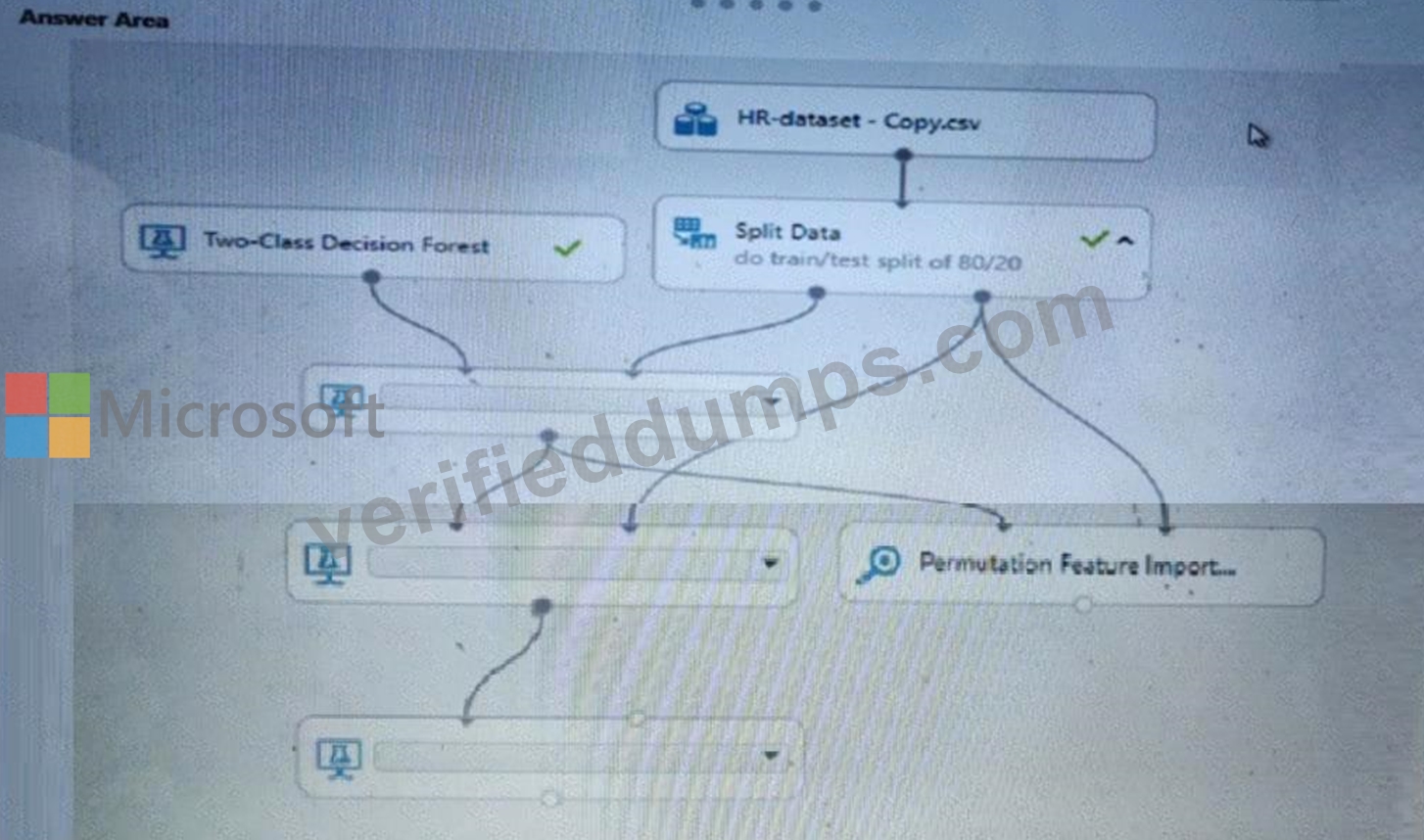

Answer:
Explanation:
NEW QUESTION 160
Note: This question is part of a series of questions that present the same scenario. Each question in the series contains a unique solution that might meet the stated goals. Some question sets might have more than one correct solution, while others might not have a correct solution.
After you answer a question in this section, you will NOT be able to return to it. As a result, these questions will not appear in the review screen.
You are using Azure Machine Learning to run an experiment that trains a classification model.
You want to use Hyperdrive to find parameters that optimize the AUC metric for the model. You configure a HyperDriveConfig for the experiment by running the following code:
You plan to use this configuration to run a script that trains a random forest model and then tests it with validation data. The label values for the validation data are stored in a variable named y_test variable, and the predicted probabilities from the model are stored in a variable named y_predicted.
You need to add logging to the script to allow Hyperdrive to optimize hyperparameters for the AUC metric. Solution: Run the following code:
Does the solution meet the goal?
- A. Yes
- B. No
Explanation
Use a solution with logging.info(message) instead.
Note: Python printing/logging example:
logging.info(message)
Destination: Driver logs, Azure Machine Learning designer
Answer: B
Explanation:
Reference:
https://docs.microsoft.com/en-us/azure/machine-learning/how-to-debug-pipelines
NEW QUESTION 161
You plan to preprocess text from CSV files. You load the Azure Machine Learning Studio default stop words list.
You need to configure the Preprocess Text module to meet the following requirements:
* Ensure that multiple related words from a single canonical form.
* Remove pipe characters from text.
* Remove words to optimize information retrieval.
Which three options should you select? To answer, select the appropriate options in the answer area.
NOTE: Each correct selection is worth one point.
Answer:
Explanation: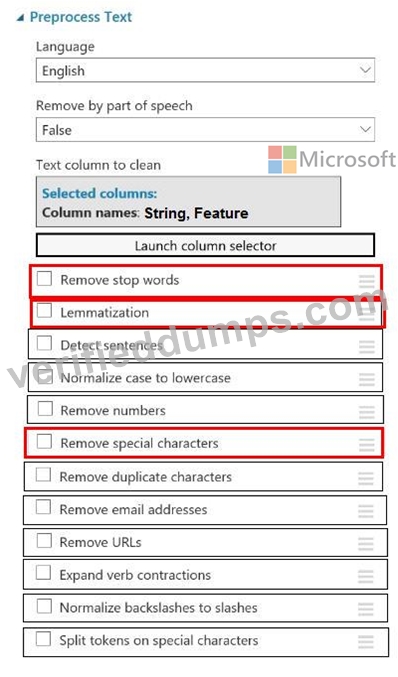
Explanation:
Box 1: Remove stop words
Remove words to optimize information retrieval.
Remove stop words: Select this option if you want to apply a predefined stopword list to the text column. Stop word removal is performed before any other processes.
Box 2: Lemmatization
Ensure that multiple related words from a single canonical form.
Lemmatization converts multiple related words to a single canonical form Box 3: Remove special characters Remove special characters: Use this option to replace any non-alphanumeric special characters with the pipe | character.
References:
https://docs.microsoft.com/en-us/azure/machine-learning/studio-module-reference/preprocess-text
NEW QUESTION 162
......
Exam Questions for DP-100 Updated Versions With Test Engine: https://www.verifieddumps.com/DP-100-valid-exam-braindumps.html
Test Engine to Practice Test for DP-100 Valid and Updated Dumps: https://drive.google.com/open?id=1jdcCvKnkSx1eAuyB-lWfwsVbzIuEetUx
